What do we have here?

I was reading about how to build a capacitor checker from the December 1959 issue of Popular Electronics and stumbled across something that looked very familiar.

Dec-1959-Popular-Electronics

I know that shape.

Bose-901s

Nearly identical to a Bose® 901 Series I/II cabinet, and even specifically references expanding the sound field with a reflected wave. The 901 series uses what Bose calls “Direct/Reflecting” technology.

Anyone know about these “Cosmos Industries” speakers? Does anyone know any of their names, who might have gone on to work for the early Bose® corporation?

Posted in Audio, Bose, Collections, Commentary, DIY, Electronics, Vintage | Tagged , , , , , , , , , , , , , | 2 Comments

Bose® 402E Active Equalizer #102853 Repaired

The first Bose® 402E Active Equalizer, for the Panaray speaker system, just came through the shop. It’s a small speaker array system, designed around similar drivers in the 901, and uses an Active Equalizer for the same effect. They’re designed for a limited frequency response, 90 Hz – 16 kHz, up to 120W at 8 Ohms.

It’s a small box with two channels of 1/4″ TRS. There are no adjustments. Inside, there’s a power supply similar to that found on a Series III or IV, three op-amp chips, and a handful of electrolytic capacitors. This unit was noisy and had uneven volume when it came to the bench, and those should components should have it good as new again.

The board was produced in early 1985 in Atlanta, apparently.

It was time for some tests. It sounded pretty good, but how was it performing? I ran a frequency response sweep on the Audio Precision System One:

Both channels perfectly matched, in an interesting saddle curve rolling off sharply at 100 Hz down past -30 dB at 20 Hz, and a healthy boost to the high end. Comparing with the service manual,

Identical. This 402E Active Equalizer is performing perfectly and should work great for years to come.


Posted in Audio, Bose, Electronics, Projects | Tagged , , , , , , , , | 7 Comments

Retrofitting Light Fixtures with New, High Efficiency LED Bulbs

I posted a while back about LED filament bulbs that use the new silicon-on-glass manufacturing process to produce Edison bulbs with thin strips of LEDs. Perfect for where you want that vintage styling of an incandescent bulb without all the wasted energy and extra heat. Since then, I’ve moved to replace nearly every one of my home’s light bulbs with various types of LEDs.

The results? Brighter, whiter, cleaner light that makes my living space look larger and neater – all while removing almost 100W of electricity which was going to generate nothing but extra heat.

I started exploring after one of my CFL bulbs came apart in its socket, leaving the mess dangling against the side of the light fixture.

My place is ridiculously well insulated, and the efficiency improvements for me are less about my energy bill and more about removing waste heat. Every watt of electricity that isn’t producing light turns into heat instead. A classic 60W incandescent bulb produces about 600 lumens of light output. The same light output in a compact fluorescent bulb consumes around 18W (with 42W per bulb of heat removed from the environment), and an LED or LED Filament bulb puts out the same amount of light for around 10W.

There were three main places I replaced CFLs with LEDs: in the bathroom vanity and fan fixture, in recessed lighting in the bedrooms and hallway, and in a number of desk and floor lamps. LED light bulbs come in several styles which are appropriate for different installations.

For the visible bathroom fixture lighting, I went with the new LED filament bulbs. These are available in quite a few places these days, even turning up in my local Home Depot. Japan and Taiwan, led by their research into semiconductor manufacturing techniques, were the first to develop these bulbs but manufacturing of less-expensive variants quickly moved to China.

Reportedly, the Chinese bulbs use a cheaper resin over the LED strips which becomes brittle after a few hundred hours of operation (of an expected lifetime of around 20,000 hours) and can fracture when removed and re-installed or if they’re bumped in their fixtures. Not a problem for my application, but it is one thing to keep in mind if you’re thinking of installing these somewhere they might get roughly handled.

ledfilament-8

These seem to be the simplest designs – just a number of series combinations of printed LEDs forming a filament, 1W per filament, connected in parallel to achieve the desired light output. I picked up 8W bulbs, producing about 900 lumens at 6000K, or about as much as a 75W incandescent each. I’m a big fan so far, although these do strobe most noticeably; it’s visible in the steams of water coming from the sink and shower taps. The rolling shutter on my camera really picks it up too, but they look fine with human eyes. They’re warm to the touch but cool enough to handle even after running for a while, due to their low power consumption, and they’re filled with an inert gas to help with heat transfer.

There’s a pretty cool “how they’re made” video on YouTube, too, that’s worth the couple of minutes it takes to watch.

These go for about $7 per bulb on eBay.

For the recessed lighting fixtures, I selected some LED flood light bulbs. These come in a ton of different sizes, styles, and color combinations and while I ended up with a physically smaller size than I expected, they put out plenty of light. These also came from eBay but many, many vendors offer bulbs in this style and they’re available at big-box home improvement stores, and even my local neighborhood hardware store if you want a name-brand like CREE or similar.

These bulbs are an interesting construction. There’s a pretty simple two-transistor power supply and a set of series-parallel surface mounted LED chips bonded to a substrate and covered with the diffuser

ledflood-powersupply

ledflood-stockphoto

This gives them less flicker than the LED filament “Edison” bulbs, although the camera’s shutter can still slightly pick it up.

There’s a good teardown video on YouTube, too:

These consume 15W each and put out around 1300 lumens per bulb, for a cost of around $10 each.

Finally, for my lamps, I selected another style of bulb. Most of my lamps seem to take E12 “candelabra” style bulbs, for some reason. Incandescent and florescent E12 bulbs are limited in their power output, mostly due to their heat dissipation, but since LEDs are so much more efficient there are many more options available. Moving to LEDs allows me to use bedside lights with brighter bulbs than they could otherwise take, and have a more aesthetic result.

Since these lamps all have lamp shades, I opted for some LED “corn bulbs“.

These are a simple arrangement of chip LEDs mounted in a circular stack and covered with a plastic housing. Light output varies widely – from these 7W models putting out about 600 lumens up through huge models putting out 6500+ lumens. These look very interesting, for sure, but kind of weird when exposed so I only used them inside of lamps with shades. They seem to have a simpler power supply, too, with the large amount of flicker.

Shown here, I used an E12-to-E27 adapter, an E27 splitter, and a pair of E27-to-E12 adapters to fit two of these bulbs into a single socket for double the light output. I wasn’t able to find any E12 splitters, which was a bit weird. They look great in the lamps, though.

These were only about $2.50 each, too.

All in all, this has been a good upgrade. I’m satisfied with the light they produce, and in one of my most frequently used (and lit) rooms, the extra heat removal has translated to about a 2 degree decrease in the temperature so it’s more comfortable overall. Based on the energy consumption, it’s about $0.15 saved per hour that every single one of these bulbs is active simultaneously, or more realistically probably about $0.07 per hour. So, the payback in power bills will take a long time, but in addition to being cooler these won’t need to be replaced for about a decade barring an unexpected failure.

You might be eligible for incentives provided by your local electric utility for upgrading, too.

If you’ve been on the fence about LED lighting, don’t be. The technology seems to be in a pretty mature place. Give it a try!

Posted in Commentary, Gadgets | Tagged , , , , , , , , , | 3 Comments

Service Shortcuts – November 1932

Radio Retailing brings you some helpful service shortcuts:

Tube Numbering That Means Something

The RMA is seriously considering a new three-character system of marking radio receiving tubes which may shortly come into general use in place of the present meaningless type numbers. Easily grasped, the system makes it possible to roughly identify all tube types by their designations without resorting to complicated charts. A detailed description of the plan follows.

The first numeral is to be definitely related to filament, or heater, voltage.

0 to 2 volts: 1
2.1 to 2.9: 2
3.0 to 3.9: 3
4.0 to 4.9: 4
5.0 to 5.9: 5
6.0 to 6.9: 6
etc.

The second character is to be a letter, arbitrarily assigned to distinguish tubes having the same filament voltage and same number of elements from each other. The first tube of a given type to be marketed will be classified “A”, the second “B” and so on. Thus a 24 would be a 2A5 while the later 35 would be a 2B5.

The third character is to correspond with the number of usable elements having external connections.

Following is a table which shows old and new designating numbers of standard receiving tubes.

Do not use this chart as a tube substitution reference.

(It wasn’t adopted quite as described, though. For instance, a “6E5” tube – understood in the above chart to be a #42 power pentode, is actually an eye tube. Do not use the above chart as a tube substitution reference.)

Practical 175 Kc. Oscillator

Here is a circuit diagram of a 175 kc. oscillator used in my shop. It employs a type 30 tube and is completely encased in an old brass shield taken from a battery radio. Batteries could have been external, with the leads to the oscillator shielded. 22 1/2 volts is sufficient plate potential for a strong signal.

Practical 175 Kc. Oscillator Fig. 1

The main oscillator coil, L2, is wound in the slot of a wooden form having the dimensions shown in the attached drawing. It should consist of exactly 196 turns of No. 21 s.c.e. wire wound 14 turns to the layer, tapped at the 98th turn. The pickup coil, L1, is 14 turns of No. 21 s.c.e. wire basket-weave wound to 4 1/2 inches in diameter, squared off and fitted around the main coil. A coil wound haphazard fashion in the hand, securely tied with string, will do if basket-weaving forms are not available.

Practical 175 Kc. Oscillator Fig 2

To calibrate the device I selected a superheterodyne known to have accurate dial calibration. The oscillator was connected to the input circuit of this set and the receiver tuned to exactly 875 kc. Then the oscillator dial was rotated until it produced the loudest possible signal.

The device may of course be used to generate signals within the broadcast band of frequencies by selecting the proper harmonics.

A Replacement Mercury Switch

Several makes of automatic record-changing phonographs employ a liquid mercury switch of the tilting variety as part of the changing mechanism. These frequently become cracked, allowing air to seep through the glass and foul the mercury.

To replace these switches where the time required to secure delivery from the factory cannot be spared secure a small pillbottle having the same dimensions as the original switch tube, a rubber stopper and two ordinary sewing needles. Fill the bottle about 1/4 full of mercury, insert the stopper as tightly as possible and then push the needles through it as far apart as possible. Solder flexible leads to the protruding eyes of the needles and then coat bottle and needles with molten wax.

Fasten the completed unit to the switch tipping frame in the same manner as the original mercury unit.

Knob-Removing Cord

To remove contrary tuning and adjusting knobs of the slip-on type take a piece of heavy cord about 9 in. long and tie the ends together, forming a loop. Now tie a knot approximately in the center of the loop, thus forming the cord into two loops.

Slip one loop behind the knob and the other on your fingers and pull. The knob will come away without damage to either finger-nails or cabinet.

High D.C. Voltage from a 6-Volt Battery

An old B-eliminator may be quickly and cheaply converted into a device for obtaining high d.c. potentials from a 6-volt storage battery. The same device also provides high a.c. potentials which are useful in the shop.

Disconnect the 5-volt filament winding which normally heats the 280 rectifier and short the two socket filament terminals together as shown in the accompanying diagram. Leave the high positive lead to the filter circuit untouched. Plug a BR rectifier into this socket.

High D.C. Voltage from a 6-Volt Battery

Now, connect a high-frequency buzzer, the contacts of which are shunted by a 1. mfd. high-voltage condenser, in series with the 5-volt winding and a storage battery. Thus connected the 5-volt winding becomes the primary winding while the original primary is left open. High-voltage d.c. may not be obtained from the output circuit of the device while high-voltage a.c. is present across the original primary leads.

Using a Majestic eliminator and the primary of a Ford spark-coil for an interrupter the output will be approximately 190 volts d.c. Adjustment of the vibrator points is not unduly critical. Current output is largely determined by the character of the buzzer used.

3.8 Volt Pilots

Number 13 Mazda focussing 3.8-volt flashlight lamps work out fine where 2.5-volt pilot lights repeatedly burn out due to excess voltag.e They are also handy when 2.5-volt bulbs are not immediately available.

Try the number 13, too, in Sparton sets using 3-volt filament type 485 tubes.

Curing Cone Rattles

If shellacking a cone and centering its apex fails to remove objectionable rattle press the rubber of a lead-pencil firmly to the extreme edge of the cone where it is clamped or glued in place. Try the pencil pressure on top, bottom and sides, being careful not to press so hard that the cone is damaged, until a point is reached where the rattle ceases.

If the cone is glued, smear shellac heavily between frame and cone at this point and let it try. If it is clamped, loosen the clamp enough to permit the insertion of a small soft-wood shim.

Another Well-Equipped Test Bench

Bill Garlitzs of Coraopolis, Pa., sends us this photo of one of his two excellently equipped test benches. Note the set analyzer, tube checker, two oscillators, output meter, battery charger and complement of tools.

Another Well-Equipped Test Bench November 1932

Posted in Collections, Vintage | Tagged , , , | 1 Comment

Are Kids the Future of Ham Radio?

Bob K0NR has an alternate take on how to keep ham radio alive as many of its practitioners age up:

For whatever reason, it seems that most people find themselves in a situation as an adult that causes them to say “I want to get my ham radio license.” When asked why they want to get their ham license, the top response is always emergency/disaster communications, followed by backcountry communications, pursuing electronics as a hobby and learning about radio communications. I suspect that starting to be established in a community and having some disposable income also play a role.

My hypothesis is that the most effective way of growing a vibrant ham radio community is to target adults ages 25 to 40.

He’s got some data to back it up from the tech license classes he teaches:

chart1-1024x735

Hard to argue with those numbers. I passed my tech (and general) at about 25, but it was definitely for those reasons: emergency communications, backcountry communications (such as while skiing), and relating to my existing electronics hobby. In high school and college, I had way too much going on – not to mention not as developed of an interest in electronics in the first place – to pay any attention to ham radio.

Not that I’m doing much better now, my only operation so far has been a handful of sessions on 70cm Simplex with cheap HTs to communicate with another vehicle in something of a convoy situation.

Are you a ham radio operator? What do you think?

[The K0NR Radio Site]

Posted in Commentary, Ham Radio | Tagged , , , , , , | 1 Comment

Harman-Kardon Festival D-1000 Tube Receiver Repair

All vintage gear has a story to tell, but something really rare and interesting recently came across the bench: the Harman-Kardon Festival D-1000.

While it looks somewhat unassuming, a fairly straightforward 15-tube receiver with push-pull 6L6GC outputs and an AM and FM tuner, it’s definitely more than meets the eye: the Festival D-1000 was the very first commercially produced integrated stereo receiver!

Produced in 1954, the concept of combining a pre-amp, power amplifier, and tuner into one as our modern receivers due had been mulled about for a while but it proved a significant engineering challenge. Harman Kardon changed all that with their release of the Festival D-1000 receiver.

Harman-Kardon did have to make some design compromises to fit everything into this package, so while it’s a solid performer, if one were looking the absolute best sound at the time it would still be separates.

This one came from a storage unit, and it was due for an overhaul before being put into service. First up was testing all the tubes – and they all passed! The 5881 outputs were replaced the 6L6GCs, but they’re interchangeable.

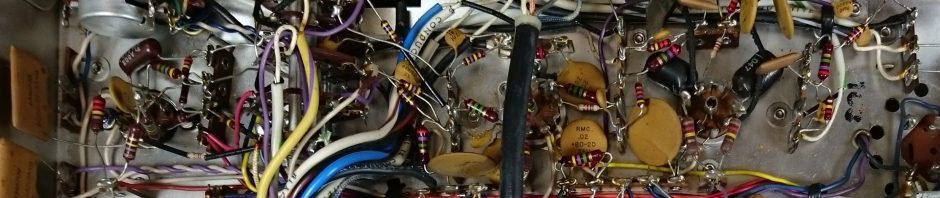
Underneath it looks like it had never been serviced before:

Spot-checking the resistors, the sample I selected were all within their tolerance. Harman-Kardon must have used a good quality resistor with a protective coating – it’s quite unusual to find a unit this old where the resistors check out. So it was on to capacitors:

Adding some terminal strips for the power supply capacitors:

Component replacement complete!

Next up was an alignment. The FM reception distortion started off a bit above 0.5%, which is definitely pretty far out of adjustment; it finished out around 0.05%. Much better!

After following the factory alignment instructions, FM cleaned up very nicely, and AM was much improved!

All fixed up, this receiver will be a fantastic addition to any hi-fi collection, and will be a great performer for years to come.

Posted in Audio, Electronics, Hi-Fi, Vintage | Tagged , , , | 4 Comments

Harman-Kardon Citation 11 Pre-Amp Overhaul

A neighbor brought me his brother’s Citation 11 for a full overhaul. After a few decades of faithful stereo reproduction, then a number of years in storage, it was time for an overhaul to get it working good as new again!

Of course, everyone knows Harman-Kardon’s quality, and this Citation 11 is no exception. It’s a beautifully constructed piece of stereo history, and unusually features a 5-band graphic equalizer on the front to help you fine-tune the output to your listening environment and personal taste.

These are also a real pleasure to work on – all of the circuitry is fitted on plug-in cards which makes it a breeze to pull and inspect the different components. And underneath, the wiring harnesses are labeled clearly and effectively:

As with most stereo pre-amps, there’s quite a few components to replace, but it was easy pulling out the cards.

There was some evidence of past repairs:

But overall it was in great shape.

One interesting thing is that, while the boards are very well marked with component values, the installed components didn’t necessarily line up. Shown here, the board is labeled for a 100 uF 50V part but a 16V part was installed. Those ended up being replaced with 63V capacitors.

Underneath there were a couple of capacitors to replace:

And the big can up top! This involved converting from the old terminals to screw terminals.

This particular pre-amp doesn’t have any adjustments to make, so that was that! A thorough control cleaning later to clean up the crackles and pops while making adjustments and it was good as new.

Looks as good as it sounds!

Posted in Audio, Electronics, Projects, Stereo, Vintage | Tagged , , , , | 15 Comments

The Speaker Spotter – November 6th, 2015

Today’s Speaker Spotter showing the most interesting speakers for sale on the local Craigslist has a number of rare, unusual, and high-end speakers you’re not likely to find anywhere else. As always, I’m not affiliated with any of these sellers, and if the ad is gone then it’s likely the speaker sold already.

Here’s what’s interesting this week!

Microtower MT1 Stereo Speakers
$60 in Lakewood, WA

Interesting looking, if somewhat questionable in performance, these speaker towers feature a crossover-less pair of 4.5″ drivers mounted on either side, and a large port on the bottom. Maybe an early example of a waveguide-type speaker enclosure to accentuate the bass response which would otherwise be limited by the driver size? Might be a worthwhile addition to a collection if you’re up for the risk.

1-1

Realistic Nova 10 Speakers
$100 in Kirkland, WA

Radio Shack’s Realistic brand equipment often gets knocked, but their vintage speaker offerings – especially the higher end ones like these Nova 10s – are quite good quality and are fairly collectible. These 50W 2-way speakers feature a tweeter, large woofer, and passive radiator and look to be in very good cosmetic condition.

2-1 2-2

KEF KM1 Active Studio Monitors
$6000 in Puyallup, WA

These very unusual active studio monitors from KEF are a fully integrated, active design, featuring 4x100W, 2x350W, and 1x400W amplifiers for the bass, midrage, and treble respectively which should provide plenty of headroom for even the most demanding source material, and frequency response from 38 Hz-23 kHz. A little disappointing that with such bass power, the frequency response doesn’t extend down to 20 Hz, but relatively little music actually happens that low anyway so it’s not a  huge loss.

3-1 3-2

Sansui SP-1500 3-Way Speakers
$140 in Olympia, WA

Swap out a couple of crossover capacitors and you’ll have a fantastic sounding, beautiful set of vintage Japanese lattice-grille speakers. I used to own a set of these myself, they’re great performers when paired with a suitable amplifier, and they really look fantastic in any room.

4-1

Sony APM-55 Speakers
$500 in the Renton Highlands

Sony doesn’t get a lot of love today (although their yellow Kevlar-coned speakers are actually quite good sounding and have very extended treble frequency response great for EDM, at the expense of being very inefficient) but their vintage offerings were quite well respected. These big, powerful 3-way speakers offer the very unusual set of square-framed woofers and midranges, too. Definitely something different!

5-1 5-2

Vintage Olson 12″ Triaxial Speakers in Barzilay Cabinets
$300 in Seattle, WA

From the late ’60s/early ’70s, these Olson triaxial speakers were a good attempt to reduce phase distortion and present as more of a point source. They’re very efficient, although don’t always have the flattest frequency response. With a 12″ woofer, midrange whizzer and horn tweeter stacked coaxially these should be a very interesting addition to any speaker collection.

6-1 6-2

Epicure M201 Speakers
$175 in Seattle, WA

Epicure speakers are known for their construction and sound quality, and these M201 speakers are no exception. The M201s feature a pair of woofers and a pair of tweeters on each cabinet, one mounted forward-firing and one at an angle, to provide a wider and more immersive sound field. Butyl rubber surrounds means there’s no need to re-foam them, either! This listing also comes with a single EPI 100 speaker, “half” of an M201. Maybe a good center-channel?

7-1 7-2

Empire Grenadier 800 Table Speakers
$250 in Olympia, WA

These interesting table-stand speakers feature a front-firing midrange and tweeter, a downward-firing 15″ woofer, and an interesting columnar design with marble tabletops on both. They look to be in great shape, and might be a good addition if you’re looking to add some sound to a room where more obvious speakers might not fit in. Reports on the Internet are that the woofer on these often comes out of alignment due to the effects of gravity on the woofer while being stored, but it can be re-seated easily enough by turning them upside down and playing a low bass note through them for 24-48 hours. Likely not an issue if they’ve been played recently, though!

8-1

STR Omega II Speakers
$239 in Snohomish, WA

A fairly rare speaker from the ’70s, these stretched the upper boundaries of a home speaker and were getting into the range of PA/commercial speaker territory. Featuring a pair of downward-firing 12″ woofers, a 6″ midrange and dome tweeter in front, and a horn tweeter firing to the rear these certainly will offer a lot of sound. On the back are provisions for bi- or tri-amping, depending on your setup, or you can use the common input and internal crossovers. Big and heavy, but very interesting!

9-1

Infinity Reference RS 2.5 Speakers
$1275 in Des Moines, WA

Infinity speakers, especially their older vintage models, are fantastic in quality and often feature electrostatic/ribbon midranges and tweeters, the RS 2.5s are no exception. These freshly-refrubished units feature a large 12″ woofer and electrostatic mid-ranges and tweeters in an array. These are one of the smaller Reference RS series, but certainly pack a punch. One benefit is the active equalizer required for correct operation is integrated directly into these speakers, unlike other bigger models where it’s a separate box that can get lost or damaged. I’d buy these if I had room for them in a heartbeat!

10-1

Like some of these speakers? Click through to the ad and contact the seller!

Posted in Audio, Collections, Commentary, Hi-Fi, Speakers | Tagged , , , , , , , , | 1 Comment

Mailbag: What’s the best multitester for vintage radios?

I recently got this question in the mailbag, and it seemed like a good one to answer:

What’s the best multitester for vintage radio repair?

That’s actually a tougher question than it seems. The short answer? Well…it depends a bit, but most multitesters (not to be confused with multimeters, which are very useful) aren’t that useful for vintage radio work. They’re not a bad thing to have, but most of their functionality is lost on a vintage radio.

To re-cap, a multitester is a neat little microcontroller instrument which can do quick analysis of 2- and 3-terminal devices. It’s useful for checking capacitor value and ESR, quickly checking transistors and FETs, checking diode voltage drop and capacitance, measuring DCR and inductance of coils, and low-ohms resistance measurements. Powered by a 9V battery and a microcontroller, these devices take a lot of the guesswork out of quick go/no-go checks for a variety of types of electrical components. The most common model is the MK-168, available from a ton of different vendors primarily on eBay for $20-50.

s-l500

The trouble with these devices for vintage radio repair is that you won’t end up using them all that often. Resistance measurements for vintage radio can easily be handled by most multimeters, like those in my Basic Tools round-up. Transistors started turning up at the very, very end of the tube radio era and you’re unlikely to encounter one of those hybrids and multi-testers can’t do anything for a tube beyond what a regular multimeter can. While DCR and inductance of coils is occasionally something to consider, more often than not you’ll have a good coil or an open coil and not a lot of in-between. And with vintage radios (and even most stereo gear through the ’80s) it’s just not worth it to test individual components before replacing; you’re better off just replacing all the parts subject to failure at once regardless of what they might measure. Not to mention, with a 9V battery supplying the power, you’re going to be far below the hundreds of volts found in most vintage devices.

That said, if you want the vintage equivalent of a multi-tester for a vintage radio, you do have a few options.

First would be a signal tracer. Signal tracers are fairly straightforward devices with a probe, detector, amplifier, and speaker. By injecting a tone at the antenna terminals of your radio under test and moving the probe through the signal path, you can find where it disappears. The probe can detect an AM RF or IF envelope and turn it into audio or amplify a small audio signal to find out which stage of the radio fails to pass a signal. These fell out of fashion after about the 1960s, but you can still find them on eBay. They were typically made by bench service companies like Conar, EICO, Heathkit, Knight, PACO, Superior Instruments, and others. They’re all pretty much the same – although being old gear, if you buy one you’ll want to make sure it’s in good working order (or you refurbish it) and the probes, if any, are provided. You should pay less than $100 for a fully working model. You’ll need a signal generator to go along with the tracer, of course.

s-l1600

Secondly, if you have a bit bigger of a budget or like rare test equipment, you might consider an RCA-Rider Chanalyst.

RCAChanalyst02

These are pretty rare and hard to find, but they’re unprecedented if you need a full functioned signal tracer and generator. These offer RF and IF generators, an oscillator injector, a power meter, and audio output (and you can even hook the various stages together and use one as it’s own radio if you wanted!) Sadly, though, these are rare and expensive and aren’t any better than a signal generator+signal tracer combo.

In general, though, I’m not sure I can really recommend a signal tracer if you’ll be doing more repair work than just vintage AM tube radios. They have little use in an FM radio, stereo receiver, or even most other electronics projects beyond a radio with the AM broadcast band and a 455-ish KHz IF. I used to have one, and used it once or twice very early on, but quickly moved up to other test gear and it sat taking up bench space until I finally got rid of it. About the only place they have any real use, in my opinion, would be tracking down issues with a radio’s front end – between, say, the antenna coil and a first RF amplifier ahead of the mixer – where signal levels might be too low for most oscilloscopes to display. Signal injection with a generator would likely be able to overcome this limitation, though.

So, in conclusion: in my opinion, a multi-tester isn’t a great tool if you’re just doing vintage radio repair. You’ll be better off with a plain old signal generator and tracer (along with your multimeter and standard bench tools) for your first set of vintage radio repair tools, if you’re not sure about taking the plunge for bigger and more expensive test equipment. Multitesters are fantastic little devices, but have limited applications in vintage radio repair, and so you’d be better off saving your money if that’s all you’re planning on working on. As far as signal tracers, while they are useful for vintage radio repair, they do have a limited usefulness beyond AM radios so keep that in mind when deciding if one is right for you or not.

Posted in Commentary, DIY, Electronics, Gadgets, Test Equipment | Tagged , , , , | 2 Comments

1937 Zenith 5-S-126 Tune-Up

This very nice Zenith 5-S-126 came through the shop a little while ago. It was originally purchased by a local collector from eBay already restored and playing, and served well for a couple of years, until it started having some trouble.

The 5-S-126 is a 1937 Zenith radio, with 5 tubes and a 6″ speaker firing up through the top of the cabinet. It receives the AM broadcast band and two shortwave bands. The owner reported that it used to have great reception, but it had slowly picked up a bit of hum, as the reception faded to nothing.

The previous technician did a workable, if not especially pretty, repair job. I cleaned up some of the wiring, moving the two filter capacitors to more secure tie points and replacing them with brand new units for long life and reliability; the installed ones were starting to wear out. The radio then received an IF alignment which was pretty significantly off, but there was still no over-the-air reception.

That would be why! The 6A8 converter tube was dead, showing no emissions at all. Replacing it with a new old stock 6A8G tube brought the radio to life right away with great sensitivity and tone. Then it was back in the case and back home!

Posted in Audio, Bose, Projects | Tagged , , , , , | 6 Comments