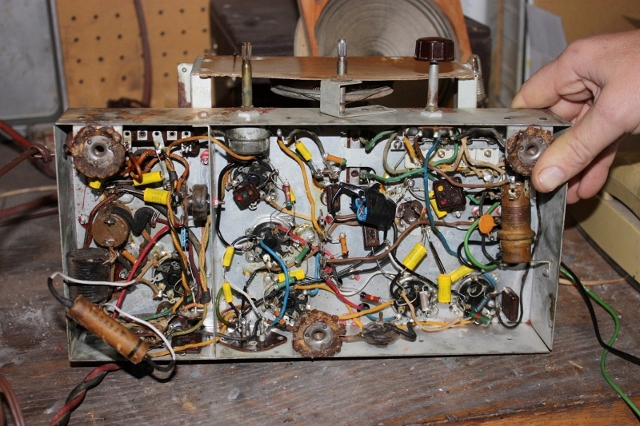
I was talking with a fellow antique radio hobbyist on the phone the other day about a repair he was working on. A TrueTone battery radio, he’d taken care of all the important steps – checking out the tubes, replacing capacitors, replacing the broken wires, that sort of thing. The radio worked before the service but wouldn’t play after and so we talked through the steps to see if there was anything he’d missed and get a second set of eyes on it.
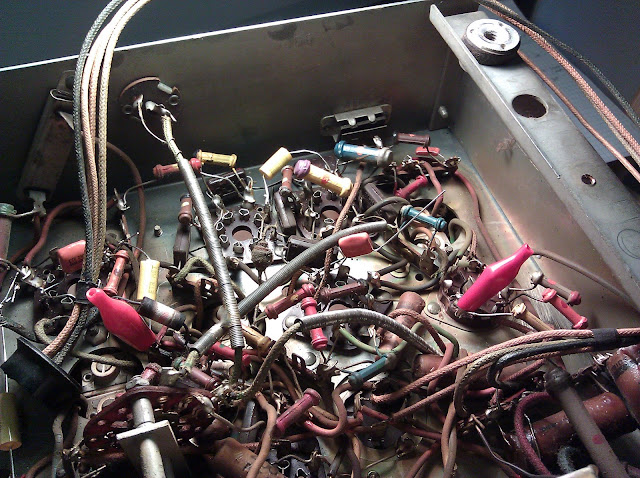
This set had a lot of rubber covered wire which has degraded over time and turned into bare wire, so some of that needed to be replaced. This started to become a problem around the second half of the 1930s up through WW2 and sometimes after…you can replace the wire or unhook one end and cover it with heat shrink tubing. Everything sounded good until I heard about replacing some wires “on top of the variable capacitor.”
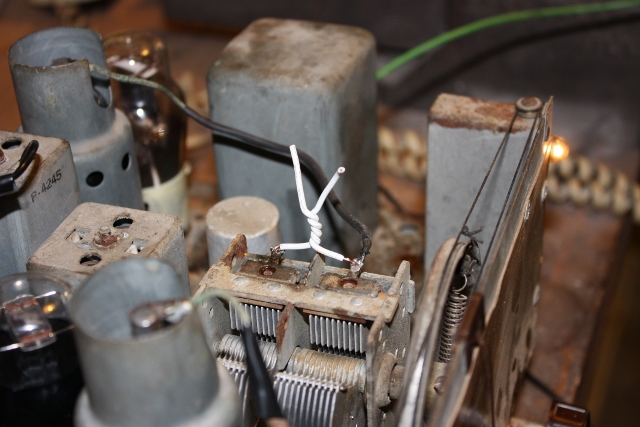
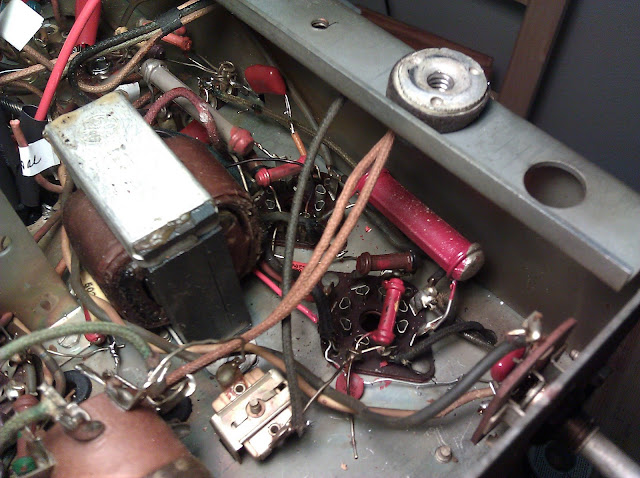
RF issues in these old things are insidious and tough to locate and it takes a lot less than you’d think to throw it off. Wire diameter, wire length, physical positioning and shielding are all involved to some degree. Wiring changes in the front end are the first thing to take a look at. He’d mentioned a broken wire on top that he’d replaced.
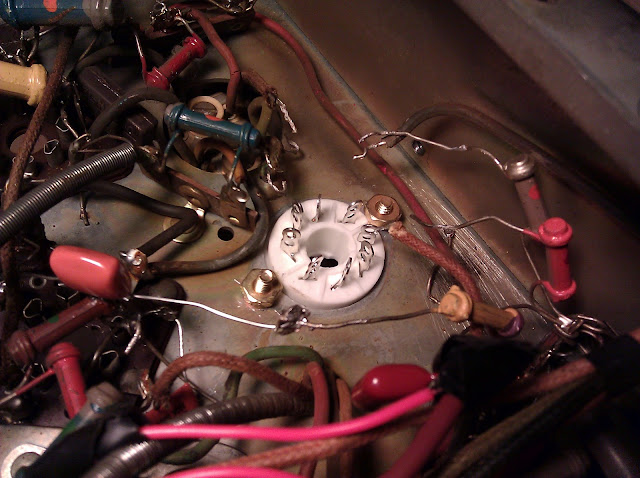
That rang a bell. My next question was, “Were they twisted around each other?” They had been. Problem identified.
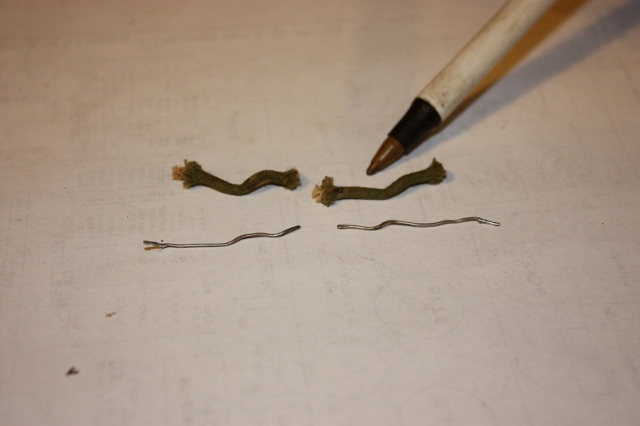
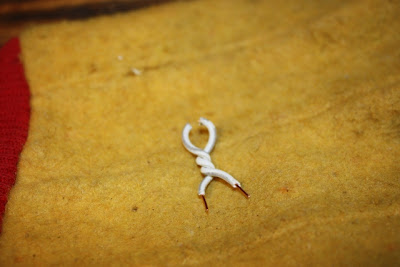
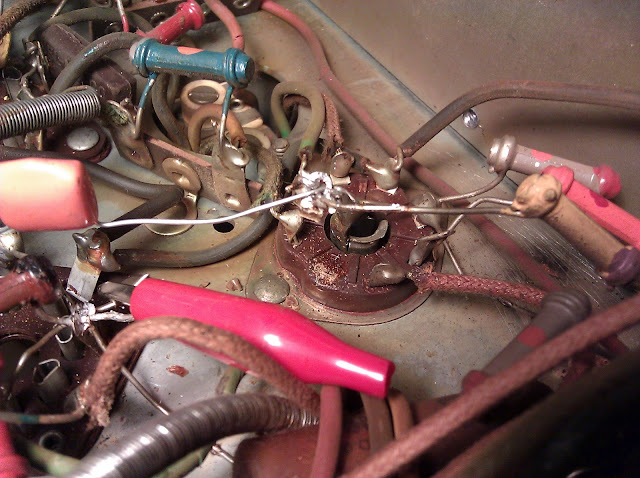
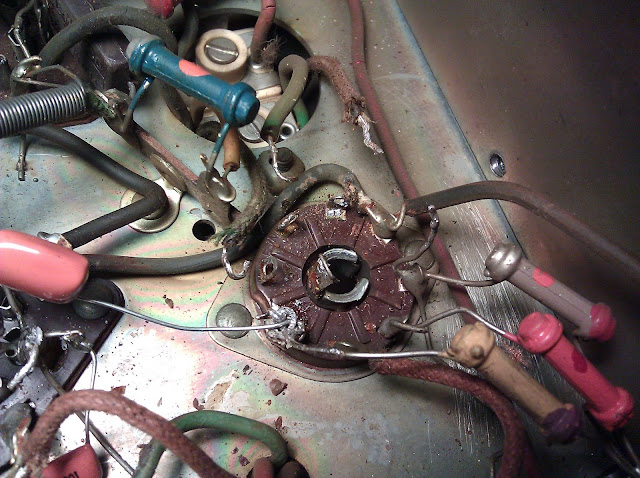
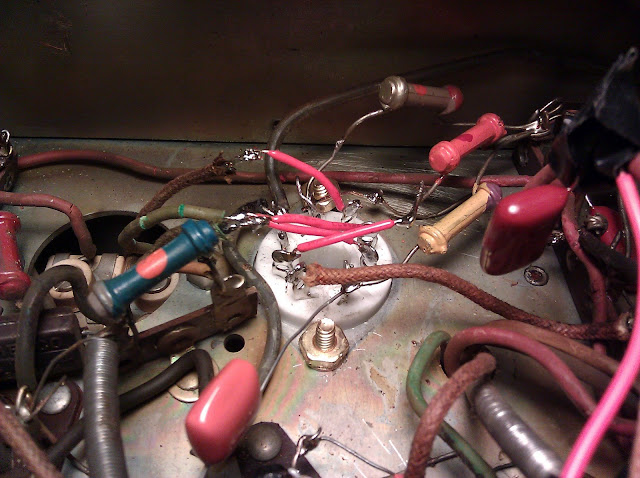
This twisted-wire “fake” capacitor is called a gimmick and was a way to save a few cents on the manufacturing cost. It doesn’t take much to make a capacitor. All you need is a two conductive charged plates separated by something non-conductive; two wires twisted around each other don’t provide much but but can make a few pF. Just enough to couple a small bit of a high-frequency signal like in the RF or IF frequencies. It’s not always obvious that a bit of twisted broken wire is actually a circuit feature, though – especially if it’s in bad shape from age, so replacing it with a new piece of wire is a pretty obvious thing to do.
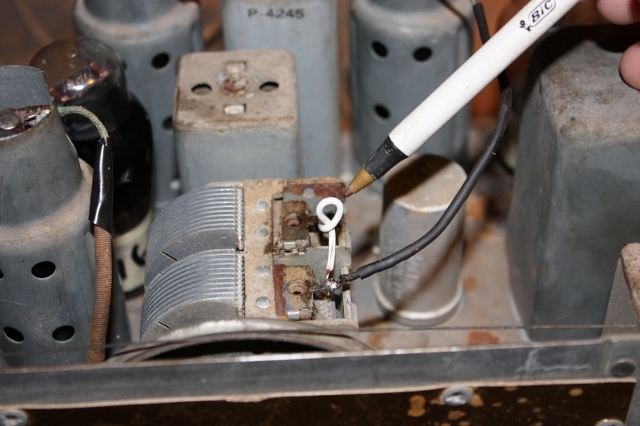
Unfortunately in this case, though, the circuit as connected is shorting the oscillator and antenna sections of the variable capacitor together and the radio won’t receive anything. It was a really quick fix, though. Just twist a little tighter and snip!
Doesn’t look like much but it gets the job done – the radio fired right up and received stations after the quick change.
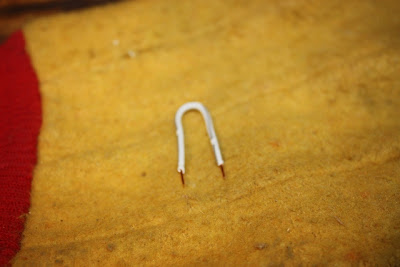
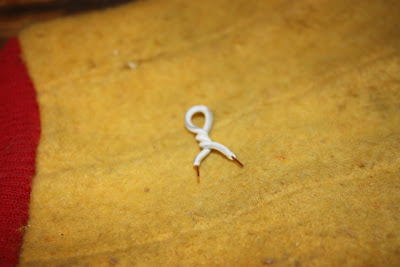
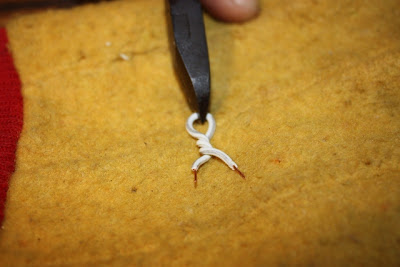
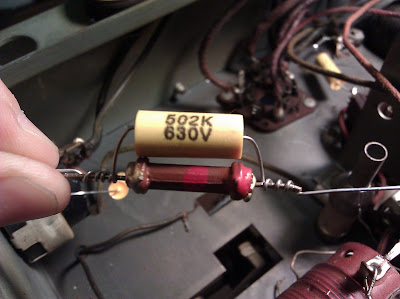
He sent over some construction photos to show how you can make your own gimmick replacement:
Thanks Steve for the photos! I’m glad the TrueTone is back in operation.
It’s 1987 and I’ve been needing a new laptop. After a careful process of comparison shopping I settled on my Sharp PC-4501 from Montgomery Ward. Let’s open it up and take a look!
For only $699.99, it’s a state of the art machine. A 7.16MHz processor, 640KB of RAM, and mine comes with an optional second 3.5″ floppy disk drive! Now I can work on a program and save its data at the same time. It was designed to be especially easy to use.
Good thing they provide unpacking instructions inside the box.
It comes with an instruction manual and the operating system disk.
I’ll make sure to return the warranty card.
Power up…time to go through the BIOS setup!
One thing I don’t like so much is the screen is front-lit with ambient lighting, and is glossy. Makes it a challenge to see what’s being displayed sometimes.
We’ll try out a productivity application.
Looks productive!
I can’t wait to begin editing documents and spreadsheets from my own home. It’ll be so much easier than my old typewriter!
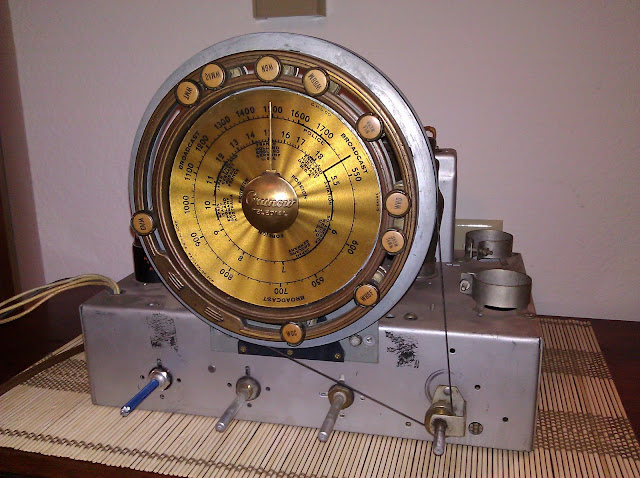
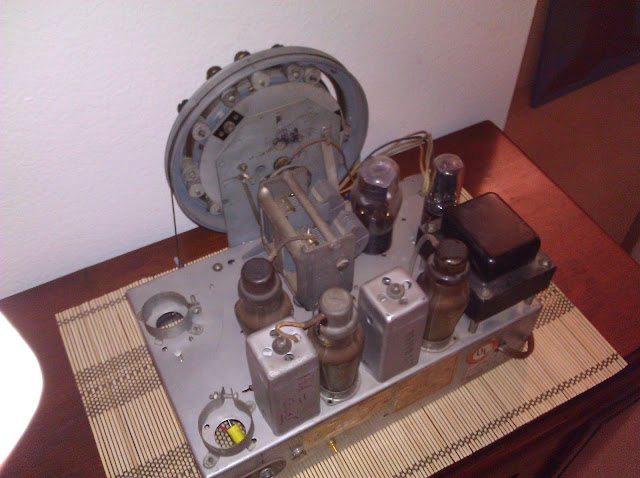
I’ve seen this model radio before in my shop and it was pretty exciting to work on another identical one. This particular one came in excellent shape – it looks like it was stored well for most of its life. The chassis arrived with no dust, no rust, a shiny coating, and not even any cadmium flaking off under the chassis.
The radio looks like it was well loved during its time. Built in 1937, it has evidence of being repaired several times all the way up through the 1950s. The UL Reexamination Service sticker is somewhat of a testament to this as well, and the fact that it’s in nearly perfect shape.
I performed the customary intake checks – all coils, transformers, tubes and controls. This one was in pretty good electrical shape. Only two of the tubes needed to be replaced after the years, testing very weak. The volume control was in bad shape, though – same as on the other 589. Unfortunately though for this particular radio, it couldn’t be saved and needed to be replaced. The output transformer connecting the radio to the speaker was also open and needed to be replaced before the radio would run again.
I sourced a volume control identical to the original (250K with a tap for tone compensation) and a functional replacement output transformer. With these parts on hand, it was a simple matter of performing the replacements. All capacitors were replaced with brand new models, and any resistors that had drifted in value by more than 10% were also replaced. On this radio, the first audio output tube (type 76) used a bias battery to establish a control voltage. As circuitry evolved, engineers discovered this was no longer necessary; I updated the circuit design to eliminate the battery by changing the 500K grid resistor to a 10 Meg grid resistor and jumping across the battery.
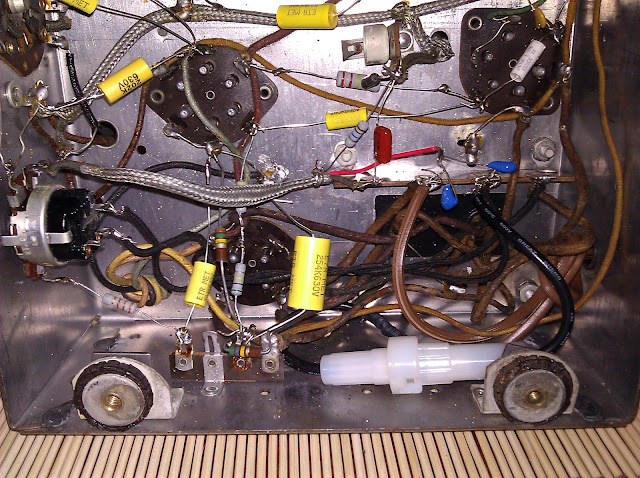
I also installed interference-suppression capacitors on the incoming power line, and a 0.75A inline fuse under the chassis to protect against a tube shorting and taking out the power transformer. With these modernizations, the radio will play beautiful and should perform without maintenance for many years.
A few parts were replaced during this operation:
The radio’s owner sent me a photo of it installed back in its cabinet after he received it from service. It looks – and sounds – great!
I picked up a very nice 1937/1938 General Electric model F-135 radio from Craigslist a few weeks ago, and have been starting to dig into it. It’s one of the highest end radios they produced that year for the 1937 holiday season and 1938 production year: with 13 tubes, automatic frequency control to eliminate station drift, experimental hi-fi reception in 4 bands from 550KHz (AM) up past 40MHz (VHF) continuously, it offers a motorized tuning with 13 station presets and push-pull 6L6 tubes pushing 20W into a huge speaker. It should sound incredible when it’s all fixed up, and it’s the most complex and highest-end radio in my collection.
I found an ad mentioning my F-135, and showing the next lower model the F-96, in the Dec 1937 issue of Radio Retailing:
I used to have an F-96, actually, but sold it unrestored for the same price I paid for it without touching to free up some storage space – a decision I still regret, but have rectified by getting a new F-135. It’s a beast of a radio, stored fairly well but with some rubs, scratches, water rings and a cigar burn on the top.
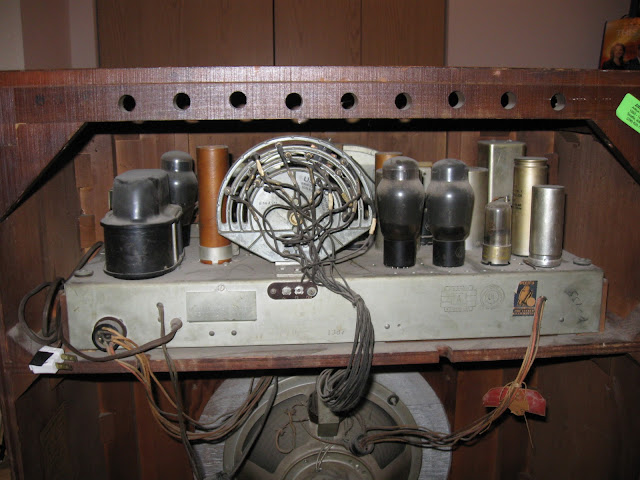
I vacuumed miles of cob-webs and a 1/4″ thick layer of dust before even attempting to remove it from the back. The radio has a unique power transformer style, only GE used “bathtub” power transformers like this. Most are normally square with square cores…this one’s an oval. You can see the motor preset assembly and the pair of output tubes as well.
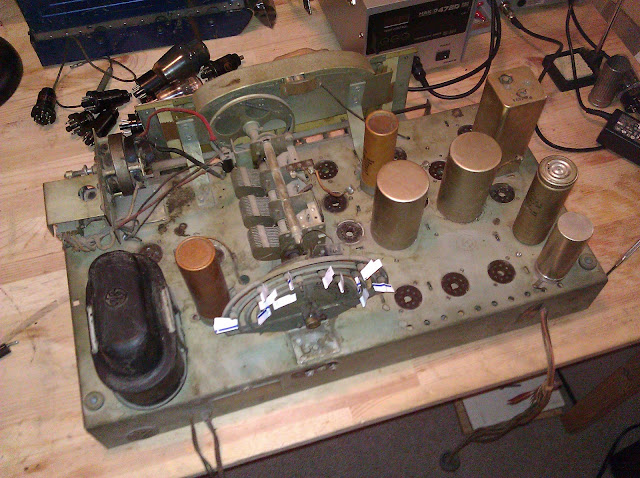
The chassis is enormous and has a lot going on.
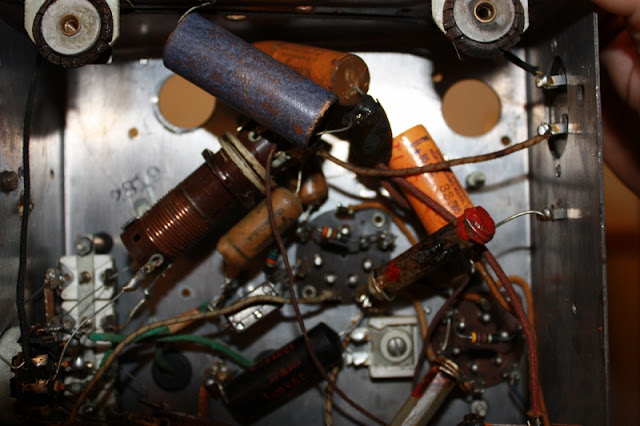
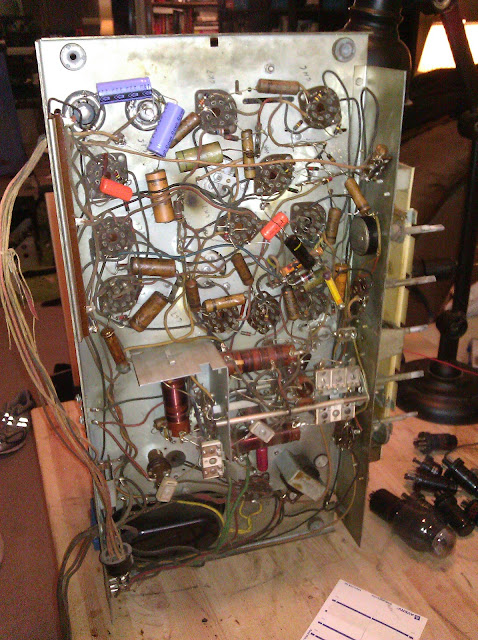
Underneath, it looks like someone’s taken a crack at it in the ’80s or ’90s. There are a pair of orange drops, and a pair of modern electrolytic capacitors – and a few 1940s/1950s era replacements – but other than that it’s all original. There’s a decent amount of crumbling rubber wire that will need to be replaced, and one of the coils has a broken solder lug that I’ll have to fix, but it’s in shockingly good shape otherwise and should be easy to service. Not many things are buried.
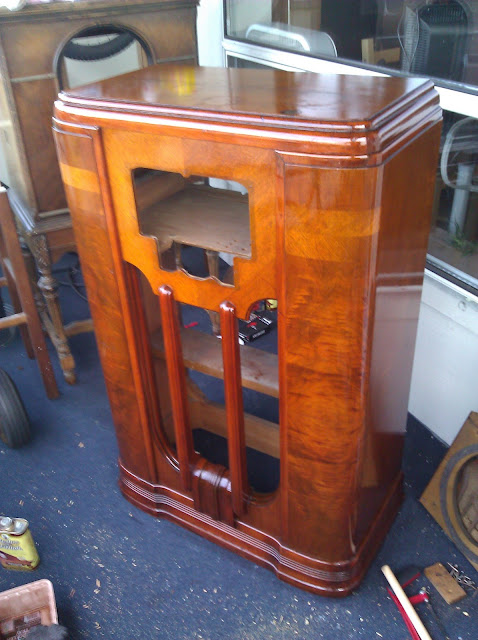
The cabinet cleaned up very nicely after intensive scrubbing with cleaning wipes, Goop, and plain water and rags alternately. Following that, two applications of Howard’s. It brought out the shine on the finish while still leaving the patina around the corners, and blending the scratches in the original finish. I lightly sanded the rings on the top, but not all the way, and left the cigar burn – I didn’t want to remove all of the “character” in the cabinet.
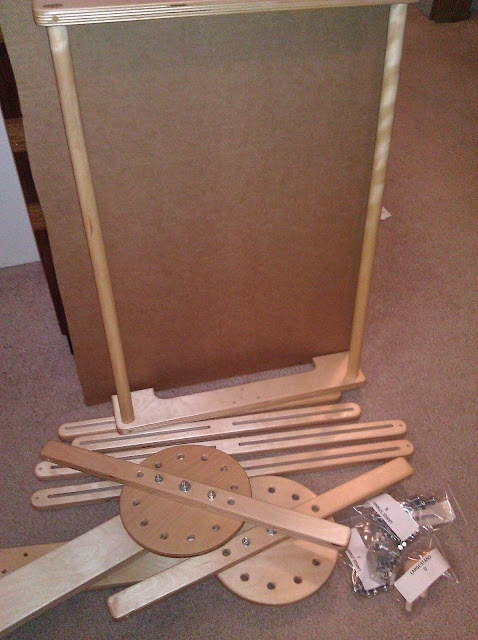
The chassis doesn’t have any good mounting points, so I bit the bullet and ordered one from Steve Strong who makes custom radio chassis stands. They’re huge, high-quality, fully articulated and can support a lot of weight. Arrived some assembly required:
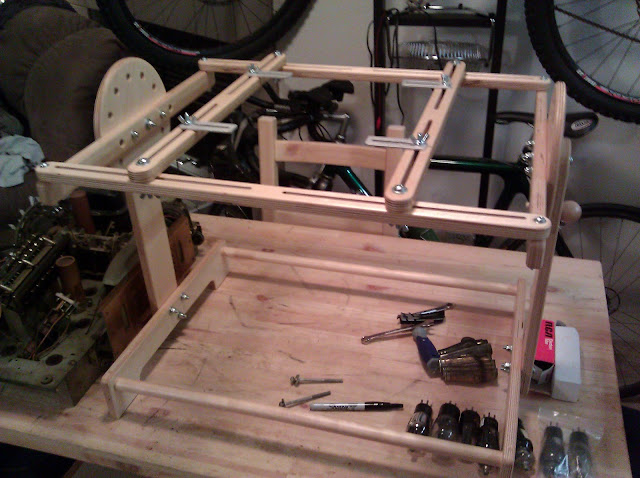
All assembled, it can rotate 360° including suspending the chassis upside down, locked in with the chassis retaining bolts that normally hold the radio into the cabinet.
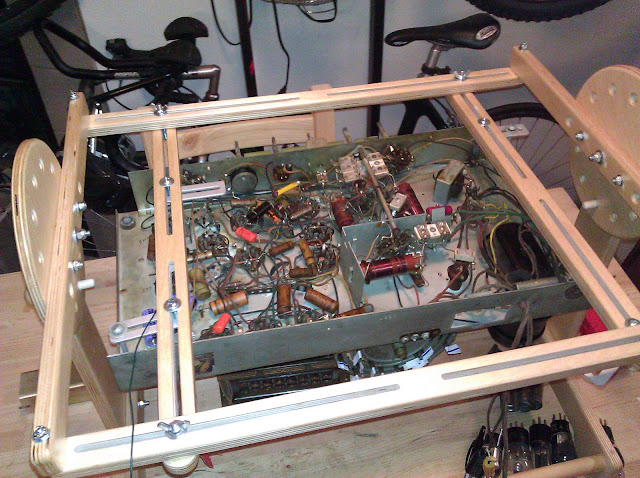
And locked in ready to go:
Most of the coils in the radio test fine, with the exception of the output transformer which has one half of the push-pull primary open. That’s bad news, but fortunately 6L6 tubes are pretty commonly used today in guitar and hi-fi gear, so new-stock output transformers are easy to come by. The original was rated for 20W; the closest size available for the replacement is an Edcor 30W transformer. The new transformer might even improve the sound quality a bit – losses in transformers were one of the sources of poor fidelity in older radios (and even in modern hi-fi gear); the new transformer is flat from 20Hz-20KHz.
Edcor builds the transformers to order, so it won’t be here for another month or so, but I’ll be starting on the rest of the repairs before then. Stay tuned!
In “House”, Season 8 Episode 5 (aired 11/7), we can see that the good Doctor has a 1937 Philco 37-620 Radiobar in his office. Unclear whether or not it has the original glassware. I’d love to have one of these in my collection, but they’re quite rare and expensive.
This Philco Radiobar sold for $252.50 in 1937 dollars, around $3800 in today’s money. This was a high end luxury for the wealthy to have in their homes, but out of reach of most consumers of the time.
Just a short update to show what I’m working on right now. Other priorities have gotten in the way of actually updating this site over the last week, but things are still going on in the background!
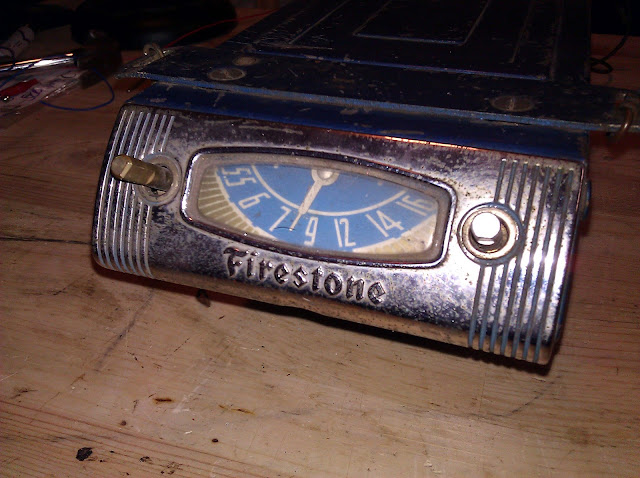
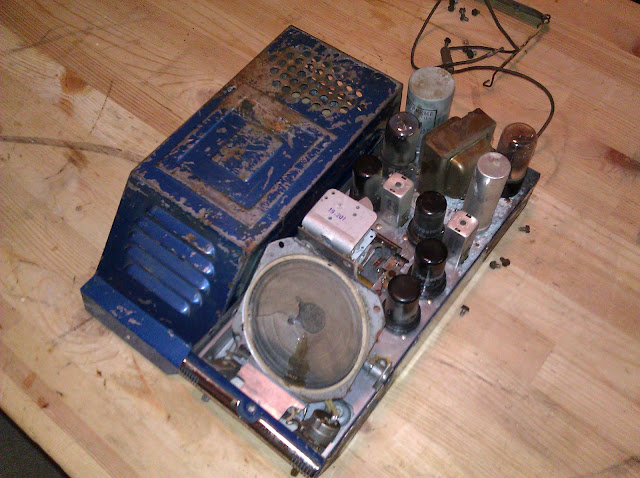
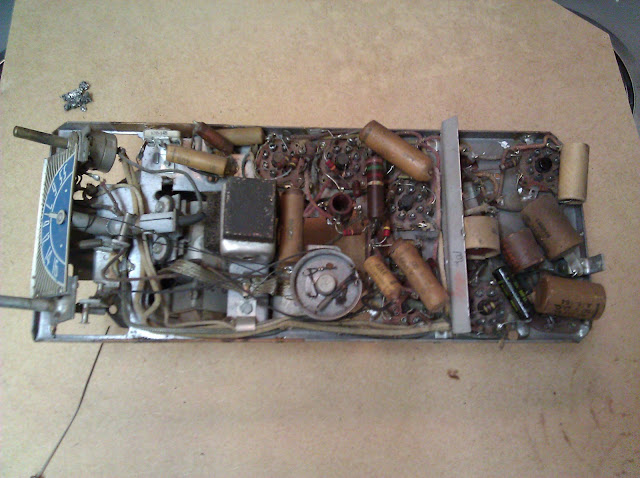
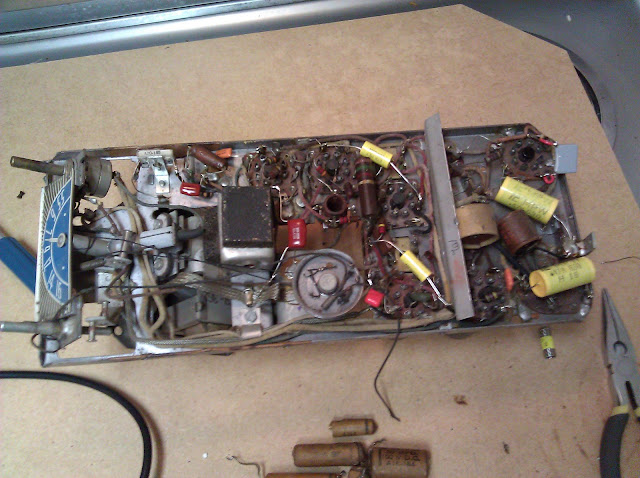
One project up on my bench is a 1951 car radio, a Firestone 4-B-31 “Roamer”. It’s a 6V radio that uses a vibrator power supply and 6 tubes to receive the AM band, and should clean up pretty nicely once it’s finished. I’m repairing this one for a client I met locally who is building a rat rod out of 1920s-1960s car parts.
(June 2026 – Noting that this was one of my early repairs, several years before I started taking commercial work and this was truly a hobby. A few things you’ll see here don’t reflect how I’d do that work today!)
After a brief delay while I waited on parts from my supplier, I’m finally set to finish up the GE LF-116 that I’ve been working on this month. It’s going to be returned to my office in playing shape very soon!
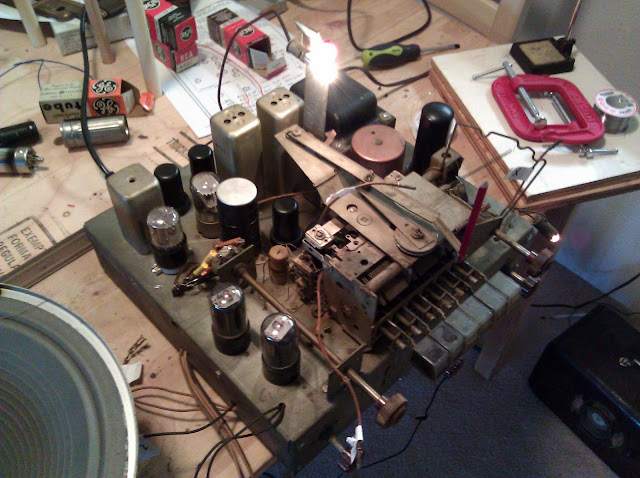
I powered up the radio for the first time with the power supply activated to get a feel for it, and played an MP3 through the line input. It played great – for about five minutes, until it heated up, then a nasty 60Hz hum took over. I’d let the set sit for a few minutes, then power it back on and it was fine for a minute or two before humming again. This was very clearly a thermal short, heater to a cathode. There are four tubes in the radio that are prone to H-K shorts: two 6SG7s and two 6SH7s. One of each tested totally dead, and the others were weak. So was the 7Q7 oscillator. I ended up ordering a new set of NOS tubes for the RF stages, and installed them; the radio played perfectly at this point although not very well aligned.
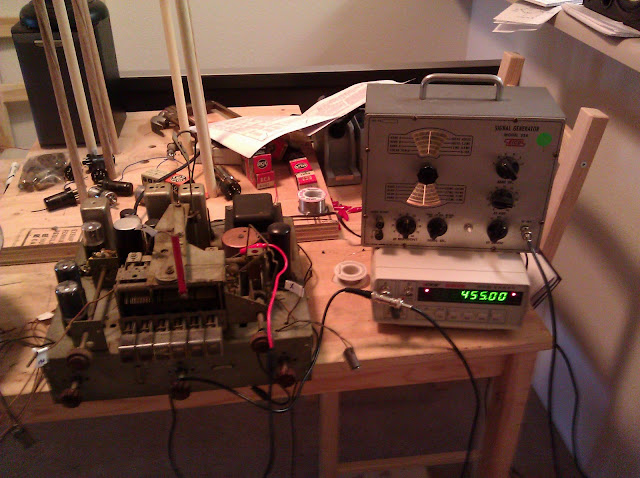
First, I peaked up the IF transformers with a 455KHz reference signal from my generator:
This step could be done outside of the cabinet, but the RF alignment required putting it back in and attaching the antennas.
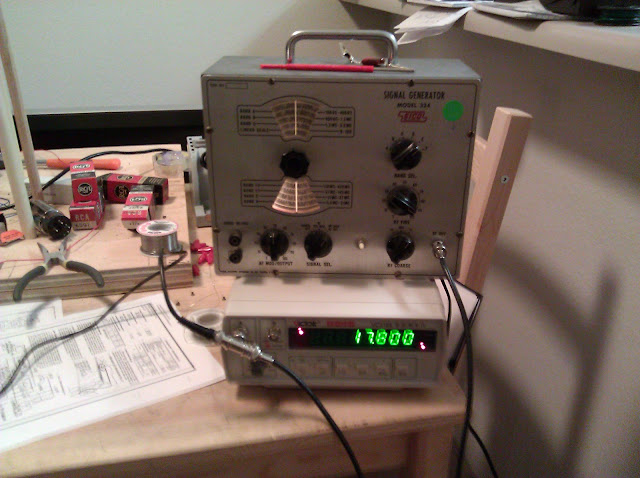
With the installation complete, I switch over to RF calibration, first with a 17.8MHz reference signal, then a 1500KHz, finally a 580KHz signal to align the Shortwave and AM bands.
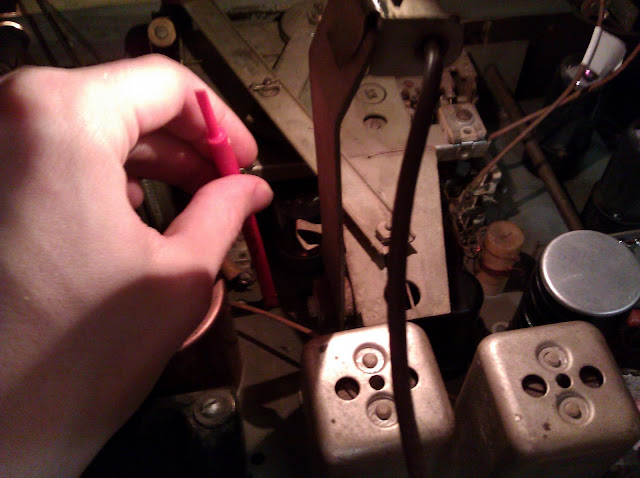
I peak the alignment trimmers with the radio installed in the cabinet using a non-inductive alignment tool:
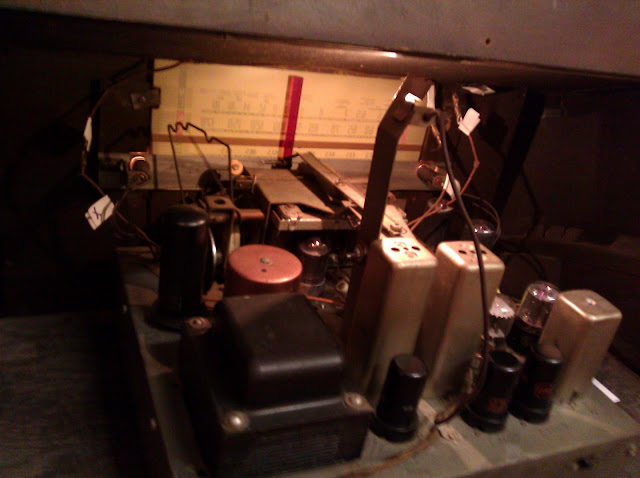
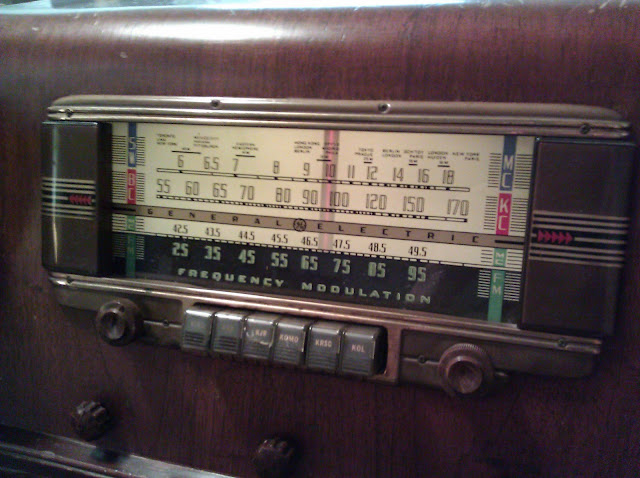
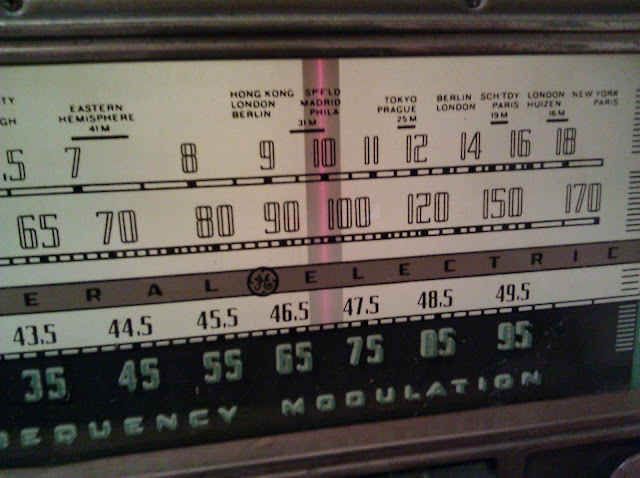
The trimmer locations were clearly called out on the service documents, so it was easy to find where to adjust even though it’s not the easiest to reach. It aligned up nicely! The dial tracks perfectly now. And speaking of the dial scale, it’s interesting – the tuned station is indicated by a thin line of red light surrounded by shadow.
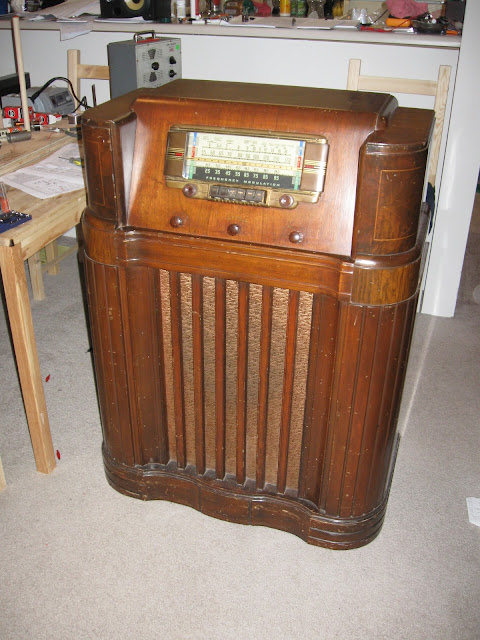
And that’s it! Back to the office it goes. I’m not planning to do much with the cabinet as it’s not that bad, and it’s going to be in a bit of a high-traffic location so if something happens to the finish I won’t have to worry about it.
The last of the three radios I picked up from an estate sale a few weeks ago, I spent about an hour this evening bringing it back to life. I’m still waiting on parts for my GE LF-116 – my supplier sent me the wrong tubes – so while that’s on hold I’m checking off more projects from my list. This was the most recent one:
The RCA Globetrotter A-20 radio is a Canadian design, not sold in the U.S. but quite a few have made it south of the border over the years. It was designed by famous industrial designer John Vassos for RCA which makes it a desirable and very attractive, if not terribly well-performing, radio.
It’s a simple five-tube transformer radio with a ready input for hooking up an MP3 player or other external audio device, controlled by a switch on the back. It has interesting shortwave bands – on U.S. radios, the wave bands are usually 1.8MHz-5.5MHz and 5.5MHz-18MHz; on this one it’s 2-6.7MHz and 7-22MHz to match what the Canadians were using at the time.
The previous owner had replaced about half of the capacitors with late ’80s or early ’90s Orange Drops; I replaced five more capacitors he’d left in place as well as the electrolytic filters. Then it was time to power on and see what happened:
Powered on nicely! A bit more hum than the other sets I have, but not enough that it’s malfunctioning – it’s just a radio with simple circuitry.
It was tricky getting the dial scale back in alignment with the pointer, as the dial stays in the cabinet and a slug fits in between two pins on the pointer to move it. It took a few tries to get it aligned right, then I tapped it into place with a long-handled screwdriver.
The alignment is spot on, receiving KIXI 880 AM exactly where it should be on the dial, no further repairs necessary. Including time spent removing material from the cabinet, this was about a two hour project. I skipped a lot of the initial checks and just started working on this one, since it’s for my own collection, which cut down on the time significantly.
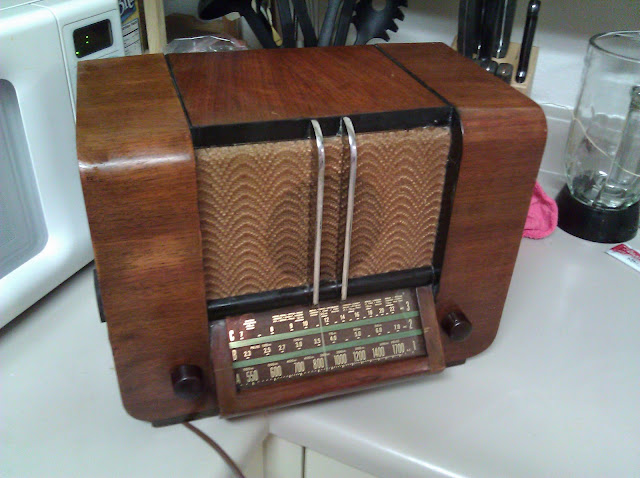
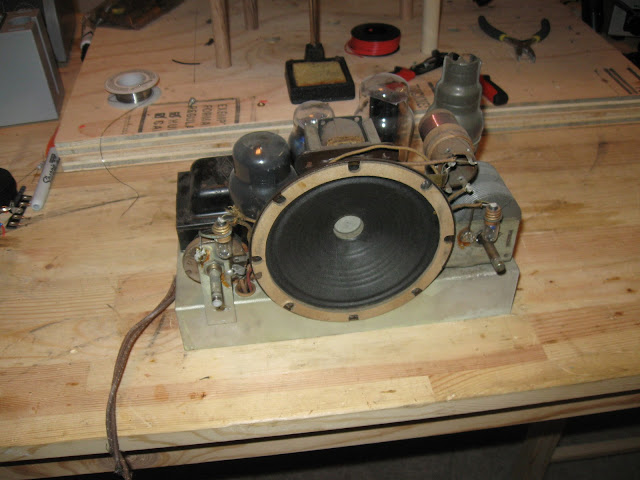
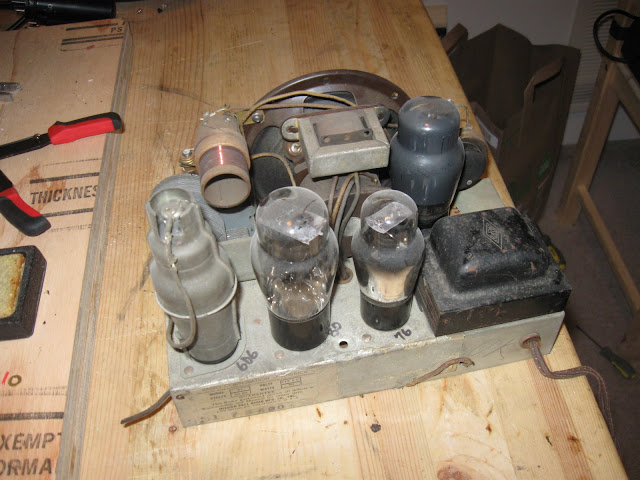
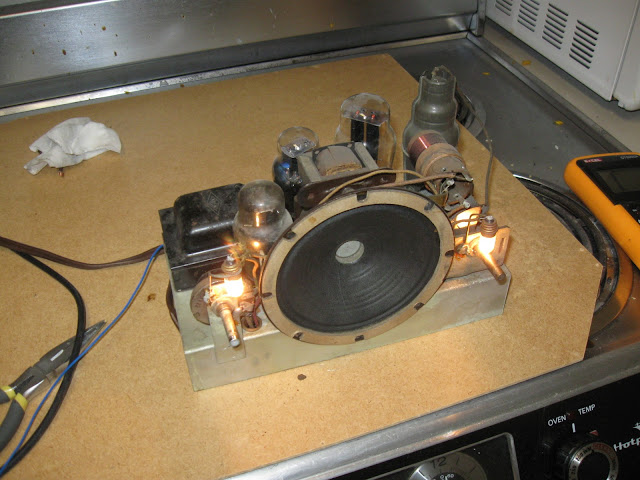
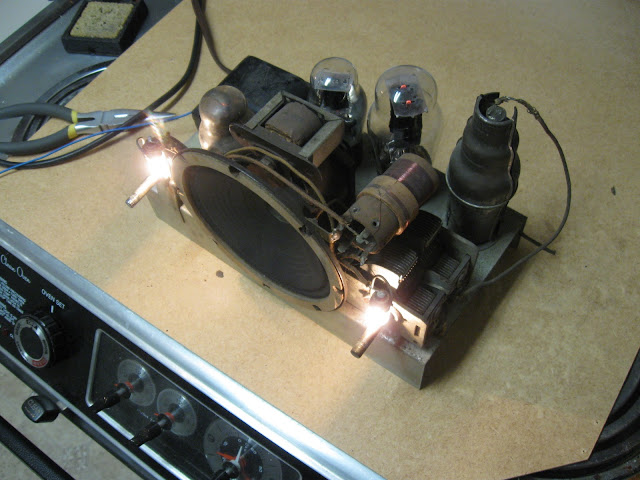
I visited a radio collector’s estate sale this morning and went home with a couple new projects. I started working on the first of them this afternoon, an incredibly simple small radio without any particular brand identification. I snapped these photos quickly while working, so they’re a little less pretty than I usually have. There’s a complete picture at the bottom!
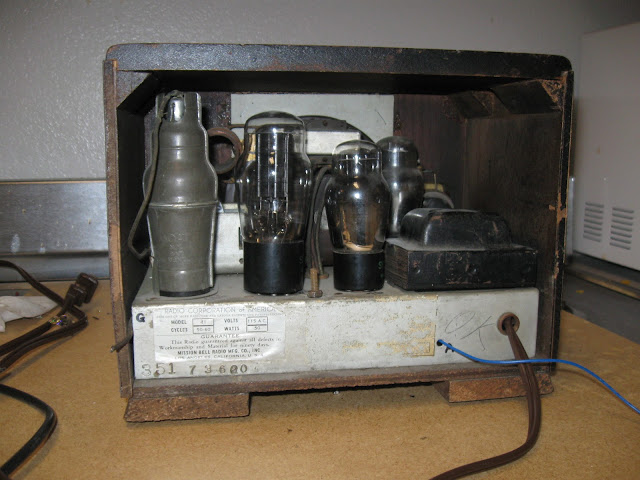
Edit: I’ve identified this as a private-label rebranding of a 1935 Mission Bell model 35 radio.
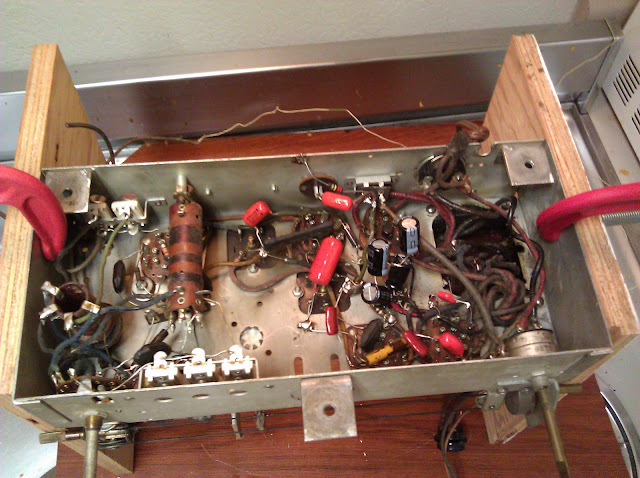
The radio is very simple. It’s a 4-tube tuned radio frequency (TRF) type receiver with line-up 6D6 76 42 80. This is about the simplest radio you could make during the mid 1930s, acceptable if you lived in an urban area close to the radio station but not sensitive enough to pick up anything further away.
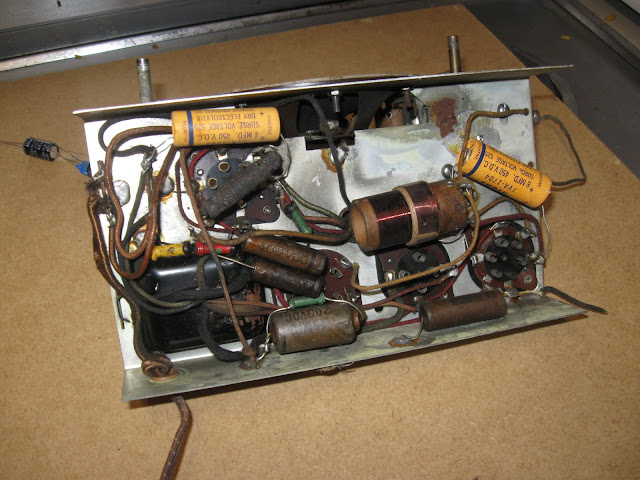
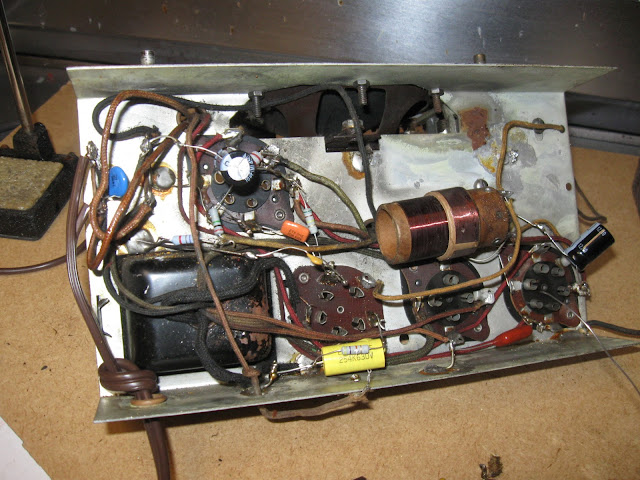
Like I said, there’s not really much going on down there. It has a total of six capacitors, five resistors, and an interstage coil. I replaced everything that could possibly be replaced, including the fraying power cord, and added an interference suppression capacitor across the line. I changed the 4uF and 8uF filters to both 10uF, which is within the tolerance for the 80 rectifier and will eliminate a little more hum.
Powering on for the first time…a whole lot of nothing.
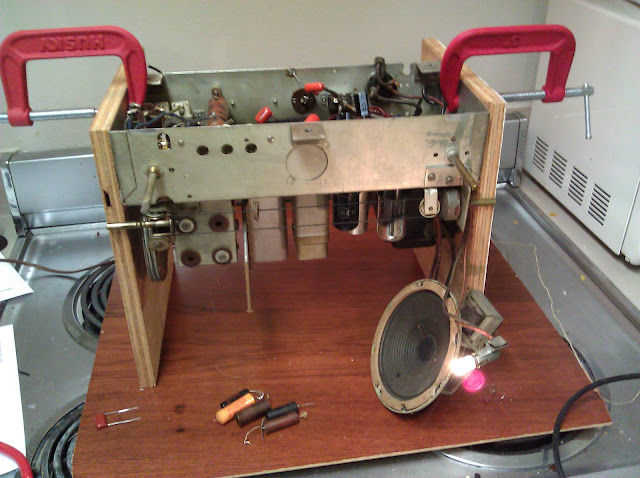
Turns out the output tube, the 42, was bad. I don’t have any spare 42s, but it’s basically identical to the 41 tube and I have a few of those lying around. With that substitution made, it makes sound! As you can see, I worked on this one in my kitchen with the vent hood going – the main work bench is taken up by the GE that is currently on hold pending a tube to arrive in the mail.
Back into the case. The radio itself bears a tag indicating it was built by Mission Bell in Los Angeles but the provided model, 41, does not match the Mission Bell model 41. It’s most likely a no-name contract radio sold in a neighborhood drugstore or similar.
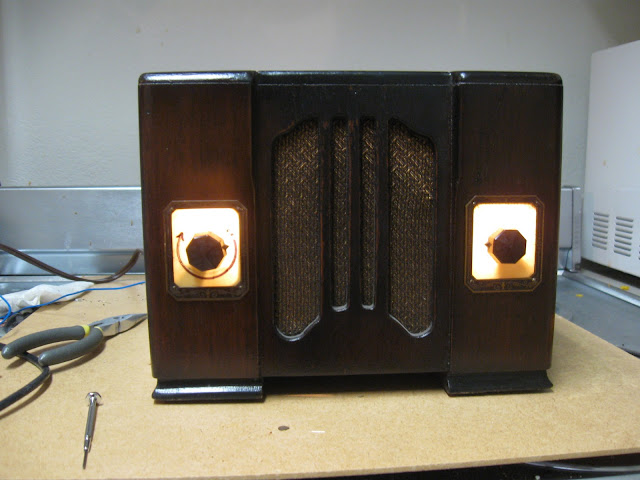
And lit up!
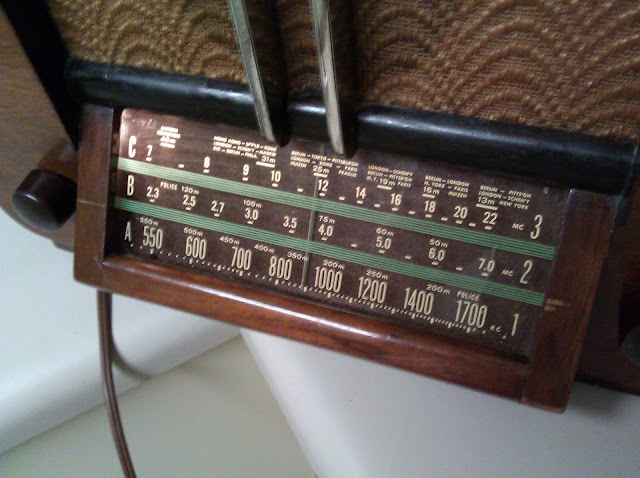
Power-Volume on the left, Tuning on the right. It’s not the most exciting thing in the world, but it was a fun short project that took about 2 hours total – some of that time spent figuring out what a totally obliterated resistor was supposed to be, and finding where I’d put my stash of #41 tubes.
(June 2026 – Noting that this was one of my early repairs, several years before I started taking commercial work and this was truly a hobby. A few things you’ll see here don’t reflect how I’d do that work today!)
I’m continuing to work on this 1942 GE radio which I’ve been enjoying in my office for a year, and now it’s time to make it play again. I’ve pulled the chassis out of its cabinet for inspection, made a test jig, and rebuilt the multi-section can capacitor above the chassis due to lack of room underneath for mounting replacements. In this issue, I’m going through the capacitors and cleaning up a few other issues that cropped up along the way.
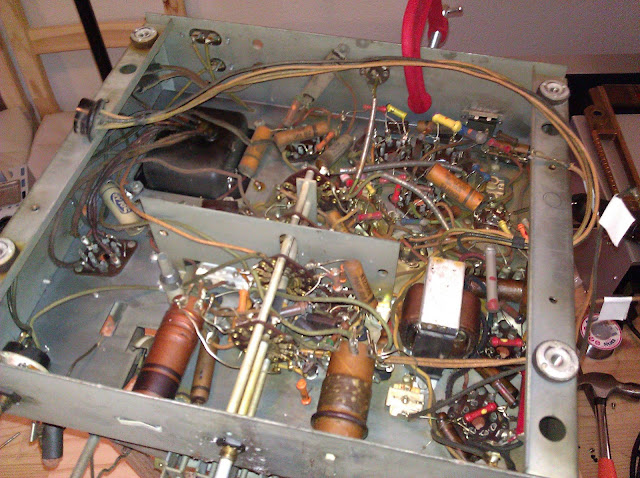
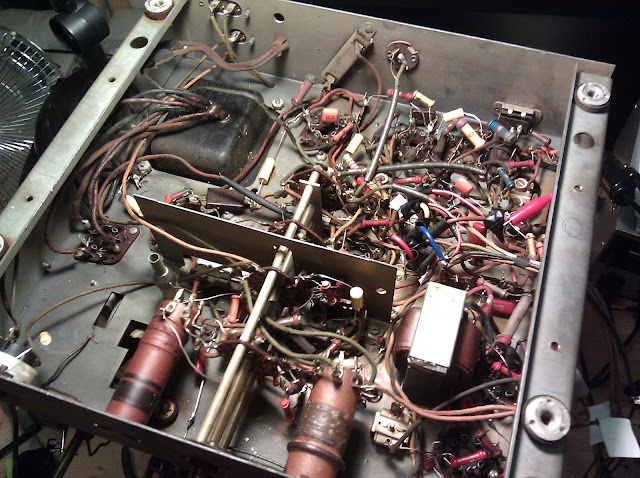
As we’ve already seen, there’s a fair amount going on down here. For all the empty space under this large chassis, General Electric’s engineers decided for one reason or another to use only about 1/3 of the available space and pack everything into that area as tightly as possible. There may have been some interference concerns, but I suspect a cost-saving measure for one reason or another that’s long lost to history. It does make it a lot of fun to work on, as capacitors are tucked in between the band switch, three layers deep under wiring and resistors, or otherwise made as annoying as possible to access. I’ve been spending a good bit of time with a needle-nose in each hand and that requires a special amount of coordination that makes for slow going.
This radio uses an interesting arrangement. On shortwave or AM bands, the first tube is a tuned RF amplifier helping with distant reception. On the FM band, the first tube is switched into the first stage of a cascade converter system where there’s a two-stage stepdown to the 4.3MHz intermediate frequency – this was done because at the time, tubes didn’t have the bandwidth to perform the conversion in one step without losing quality. It makes for a crowded and more complicated circuit, though, as quite a few coils are switched in and out depending on what’s being requested at the time.
The radio bears evidence of having been serviced many times throughout its life with several different brands of capacitors from varying ages, date codes ranging from 1940 up into the ’60s. There’s the usual poor soldering in a few spots, clipped component leads left on terminals, and general quick re-work but by and large it’s in decent shape and doesn’t appear to have been “hacked on” very much.
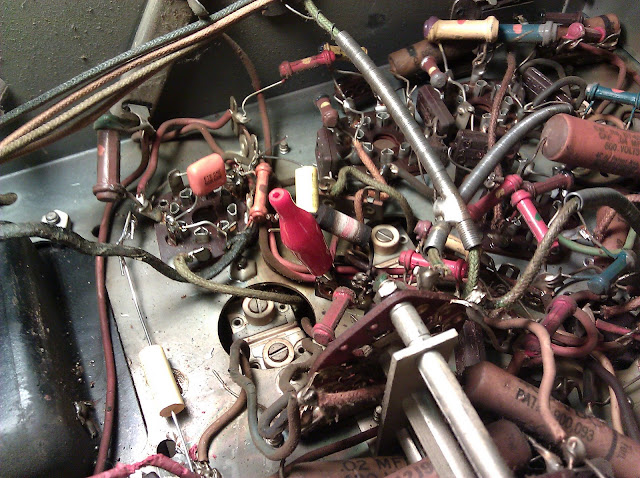
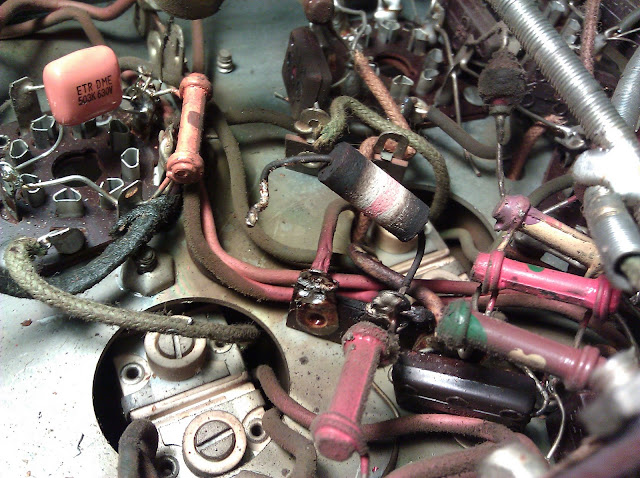
I began replacing capacitors one by one, mixing radial or axial styles depending on the location, and came to a resistor that had burned out – just to the right of the red clip I’m using as a marker.
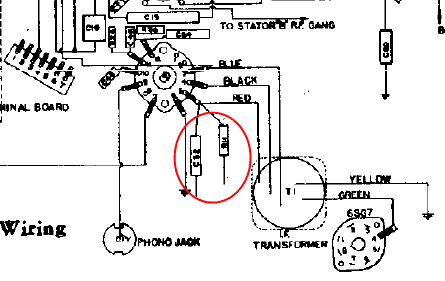
My copy of the schematic wasn’t very readable, but another hobbyist was able to supply me a better scan and I ended up purchasing the complete set of high-resolution media as a result of seeing this sample.
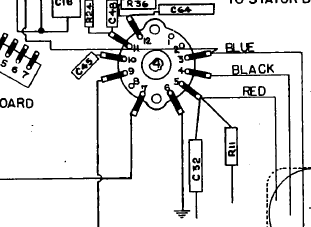
With this wiring snip, the full schematic diagram, and some confirmation from another hobbyist I was able to identify the burned out resistor as R-11, 2.2K Ohms 2W, which supplies B+ voltage through IF transformer T1 to the plate of the 6SG7 converter. Capacitor C-32, a 0.02uF coupling capacitor, was shorted which passed B+ directly to ground and caused it to burn up quickly. This obviously happened at least once in the past, as C-32 was a replacement as was that resistor.
Capacitor replacement followed pretty unexcitingly, assisted by my Hakko for cleaning up terminals. I rebuilt the above-chassis capacitor block in Part 3, linked from above. It’s slow going due to the large amount of brittle, crumbling rubber wire and tight quarters. Many restorers advise either replacing or covering with heat shrink this wiring as if it crumbles, it could short out. Mine is mostly intact, and by taking extra care not to bend – just to push – the wiring around I’ve avoided having any crumbling accidents so will not be doing that time-consuming step unless it turns out later that it’s absolutely necessary.
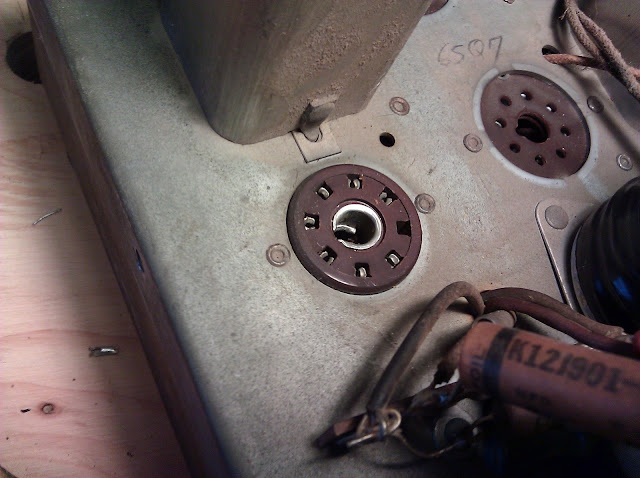
Very unfortunately, though, a tie point snapped off the socket below the molding while trying to replace one of its connections. These loctal sockets seem more fragile than the octal sockets used in 9 of 11 tubes in the radio. I ordered a set of brand new ceramic loctal sockets from Angela Electronics who boast “Since 1977 we’ve supplied thousands of hard to find items to musicians and tube audio enthusiasts worldwide.” Hard to find no question, as they’re the only site I’ve found that sells loctal sockets – as well as brand new ceramic 5- and 6-pin sockets! On this fact alone, they’ve got all my business for new sockets going forward.
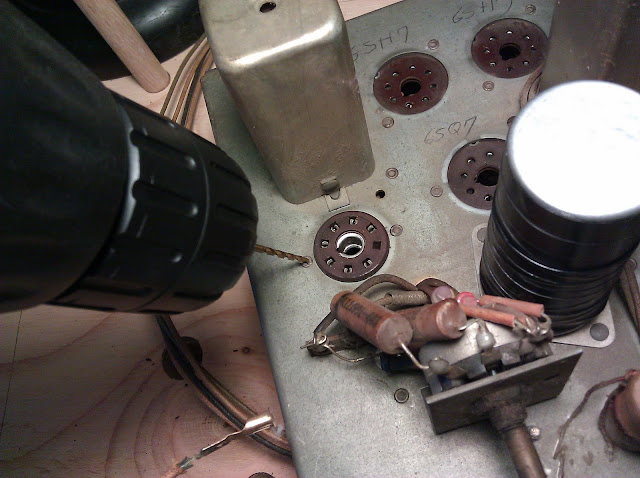
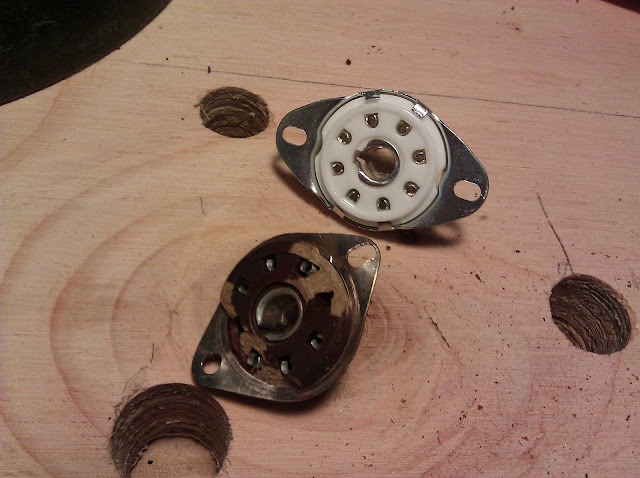
The socket arrived; I carefully remove the wiring from the terminals and drill out the rivets for the socket to replace.
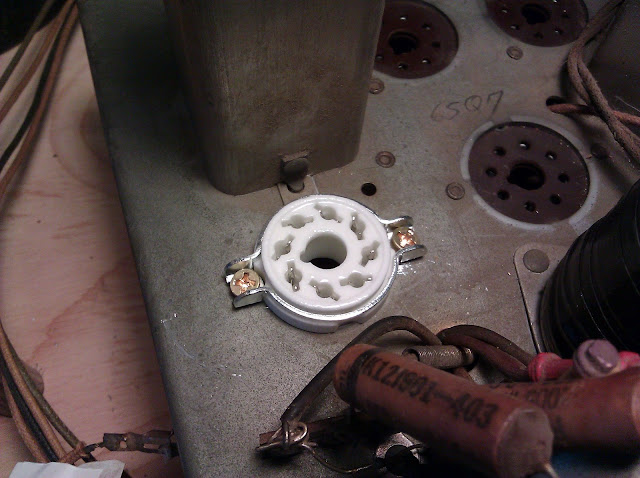
Ceramic sockets are nice and durable. But, naturally, there was another issue: the mounting tabs on the 7K7 socket weren’t spaced evenly with the chassis holes AND unless I wanted to mount with rivets instead of 6-32 screws, I wouldn’t be able to get the tube to seat properly – the mounting was interfering with the base. At this point, my significant dislike for loctal sockets was solidified and I said forget it, grabbing an Octal socket from my parts bin. I mounted the octal socket above the chassis held in by the retaining clip to ensure there’s enough space to seat the tube properly.
A 7K7 tube would go into the loctal socket; for the octal socket, the same tube is labeled 6AQ7GT. I don’t have one of those in stock so ordered from eBay for $2. They’re both double-diode/triode tubes, serving as discriminator and phase inverter for the audio output. And, annoyingly enough, they’re laid out somewhat differently. Whether this was for any particular technical reason or just a rivalry between companies, I don’t know but the socket required re-wiring beyond just hooking the leads back up.
7K7(Pin) 6AQ7GT(Pin)	Description	Visual
1	 8		Heater		Grey Resistor/Ground Tie
2	 6		Triode Cathode	Orange Resistor
3	 5		Triode Plate	Orange Cloth-Cov. Wire
4	 4		Triode Grid	Orange-Drop Cap and Res.
5	 1		Diode 2		Green Cloth Wire into Can
6	 3		Diode 1		Green Rubber Wire into Can
7	 2		Diode Cathode	Cloth Wire into Can
8	 7		Heater		Black Rubber Wire to Tubes
With that mapping completed, it was time to re-wire. This required slightly extending some of the wires coming from the discriminator transformer.
(June 2026: Now, at the time I made this post, this was a personal hobby for my own enjoyment only, and several years before I started taking any commercial work. Not pictured here, I added insulating tape. I wouldn’t do it this way today.)
This radio is by far the most frustrating to recap of any I’ve worked on yet. It might actually be the most complex one I’ve worked on so far anyway, but the construction – layers upon layers of tight components with sensitive lead dress requirements buried deep inside the radio. Much of the time I was replacing some of the deeper components with a pair of needle-nose pliers in each hand, and I even had to remove the output transformer from its mounts to replace three capacitors located basically under it.
A resistor bypassed with a capacitor. The resistor itself is a 1.2K 5% resistor, but it’s actually drifted by about 10%; I’m hoping this won’t be a significant issue but if there’s an issue around the oscillator circuit, this’ll be the first place I revisit. If I’d noticed the tolerance marking before reconnecting, I’d have replaced the resistor outright as well.
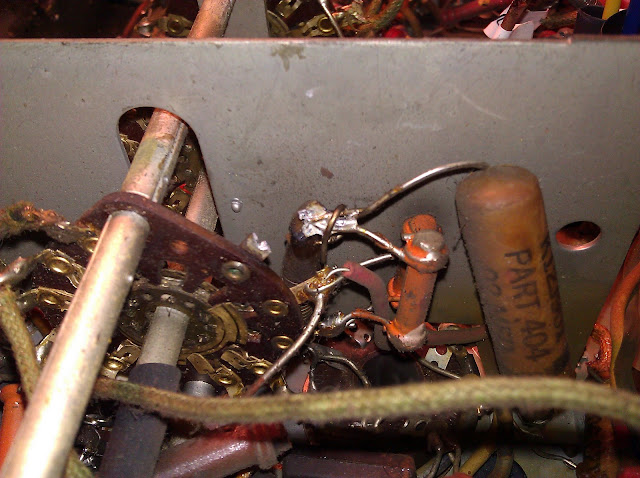
Naturally, it was bound to happen that something else would break during this process. I heated this joint with my Hakko to clear some solder, and the lug cleanly separated the instant I did so – it was held on by solder alone, it seems, the underlying metal having broken from thermal stress or a past workman’s abuse sometime during the last 69 years.
Fortunately, very very fortunately, this is just a tie point – it’s not connected to the actual switching pads. I soldered a jumper to the rivet for physical stability and replaced the capacitor as normal. If this had been an active switching lug, this could have potentially permanently crippled or even rendered the radio unservicable.
Finally, I reattach the rebuilt can capacitor. I ran the common to the can’s mounting lug, then a jumper from there to a near-by ground tie point and soldered the lug to the chassis, the wire to the lug and the jumper to the lug as well. This ensures a solid ground even in the event the chassis soldering didn’t take very well. I ended up using my Hakko as a soldering iron in this case, as the thermal mass of the tip allowed it to heat the chassis to soldering temperature without cooling; the iron I use for adding solder to most connections is a thin point that cools too quickly when heatsinked.
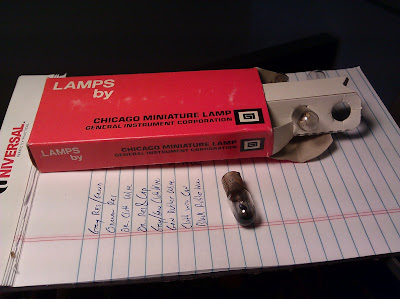
I did a tube-less power-up to make sure there were no immediate shorts, such as a stray piece of solder, and found that the Beam of Light lamp was burnt out. Fortunately, I have #44 dial lamps on hand:
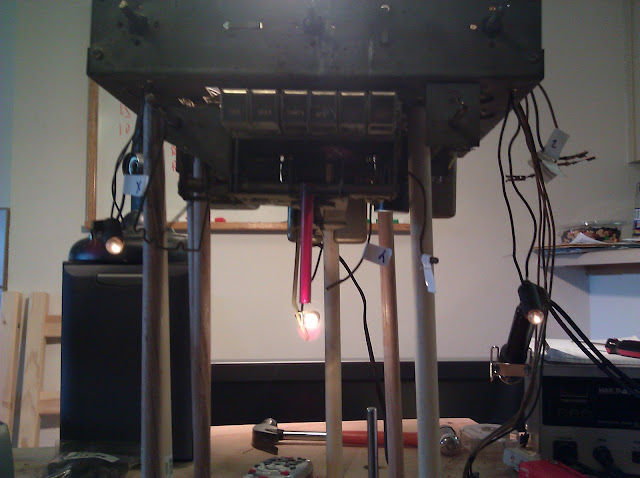
With the radio’s electrics fully serviced, now I can continue on to the first power-up just as soon as the tube I need arrives. Stay tuned!




Unboxing my Sharp PC-4501 classic Personal Computer
It’s 1987 and I’ve been needing a new laptop. After a careful process of comparison shopping I settled on my Sharp PC-4501 from Montgomery Ward. Let’s open it up and take a look!
For only $699.99, it’s a state of the art machine. A 7.16MHz processor, 640KB of RAM, and mine comes with an optional second 3.5″ floppy disk drive! Now I can work on a program and save its data at the same time. It was designed to be especially easy to use.
Good thing they provide unpacking instructions inside the box.
It comes with an instruction manual and the operating system disk.
I’ll make sure to return the warranty card.
Power up…time to go through the BIOS setup!
One thing I don’t like so much is the screen is front-lit with ambient lighting, and is glossy. Makes it a challenge to see what’s being displayed sometimes.
We’ll try out a productivity application.
Looks productive!
I can’t wait to begin editing documents and spreadsheets from my own home. It’ll be so much easier than my old typewriter!
Share this: