1940 Philco 40-185XF Antique Radio Restoration

I had the privilege of working on a very well preserved Philco 40-185XF recently. These are top performing pre-war sets featuring 8 tubes, an RF amplifier front-end and push-pull audio output into a 12″ speaker. Definitely worth fixing up! This radio had been its owner’s family for years – first in his grandparent’s home, then with his parents, before it passed on to him. After serving as a conversation piece for many years, it was time to get it going again.

This model had been sitting silently since the 1970s and was ready to come back to life. It came to me for a complete overhaul, including testing all the tubes to replace as needed, re-stringing the dial, replacing hardened rubber mounts and eroded pushbuttons, and a precision alignment.

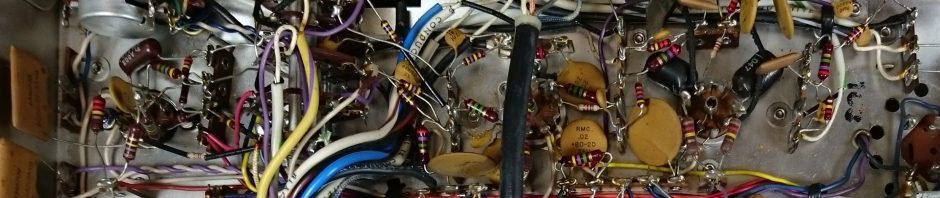
The underside is nicely laid out and pretty easy to work on. There’s a few capacitors which are buried, but most are easily accessible. The output transformer, top left, is mounted under the chassis instead of on the speaker as was more common on earlier sets.

Component replacement was initially pretty straightforward. The preset assembly was held in by two screws and had plenty of slack to fold it up and out of the way to allow easy access to the components beneath it. There were several small capacitors and an electrolytic can mounted under the pushbutton assembly.

The power cord was in dire need of replacement, so it received a new polarized plug and new X1Y2-rated safety capacitors on a newly mounted terminal strip.

With component replacement complete, it was time for a first power-up and a test signal. All seemed to be good at first for a bit…but then the radio sputtered a bit and cut out entirely – then some faint smoke started to appear! Bad, bad sign. I killed the power quickly to avoid damaging anything and carefully inspected the fault.

On this schematic snip, the resistor circled in red was the one which was overheating and smoking. This resistor feeds the high voltage to the front-end of the radio; overheating means excess current drawn. I pulled those tubes, but it continued to smoke, so further investigation was necessary. First, I replaced that resistor with a new one which hadn’t been heat-damaged.

It’s a bit faint, but the insulation had cracked off the wires leading into the IF can and were shorting to the chassis. That’d be the problem! Time to pull the IF can:

Some wires were cloth and some rubber-coated; some of the rubber coated ones were fine, and some were brittle and cracking. I sleeved the damaged wires, then reinstalled the transformer in the can and mounted it back up. One problem solved! The short circuit was fixed, but there was still no audio output – even when injecting directly into the audio amplifier circuit.

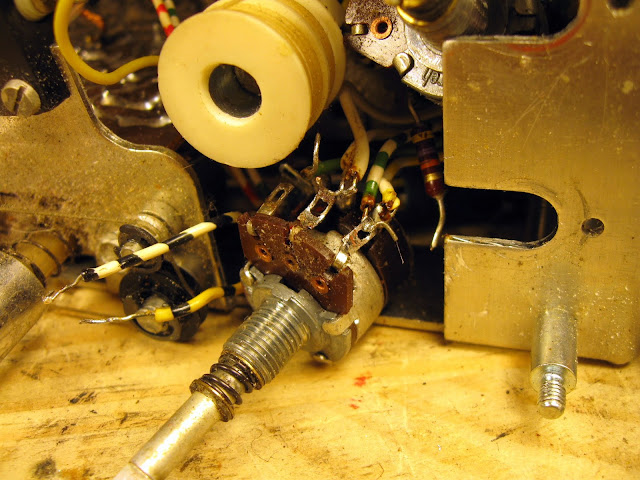
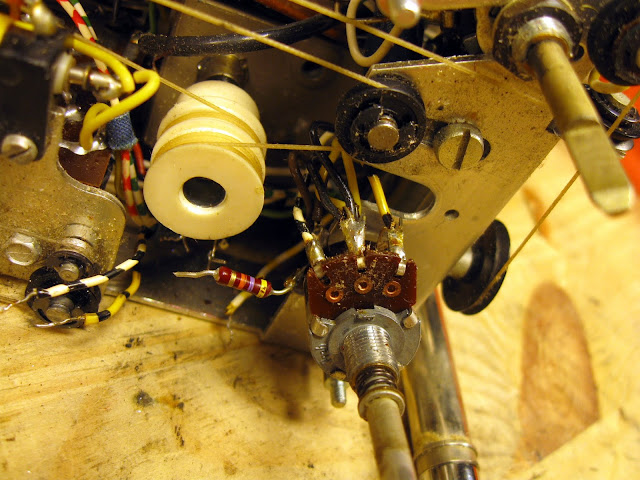
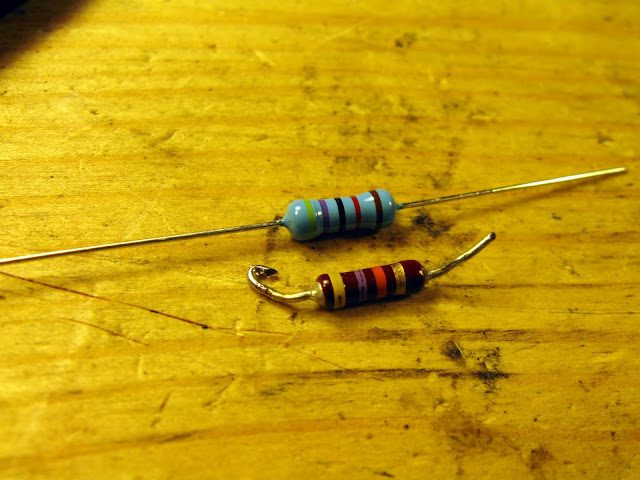
There were some clicks when I’d touch certain resistors with a probe. The resistors had overwhelmingly tested within tolerance so most were left original, but something happened along the way. I pulled the suspect resistors to replace, and examined the old one:

It’s tough to see – but the body of the resistor is cracked! This was a new problem. What happened is: carbon composition resistors absorb moisture from the atmosphere over time. In this case, the radio is 74 years old, and 44 of those years it sat without being played. Resistors also dissipate heat when they’re operating. This combination caused the absorbed moisture to expand and escape by cracking the body of the resistor and causing intermittent opens. Not good for performance! I replaced nearly all the remaining resistors at this point.

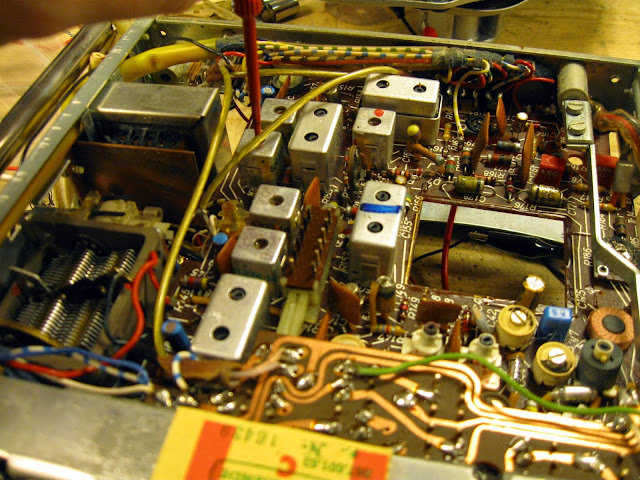
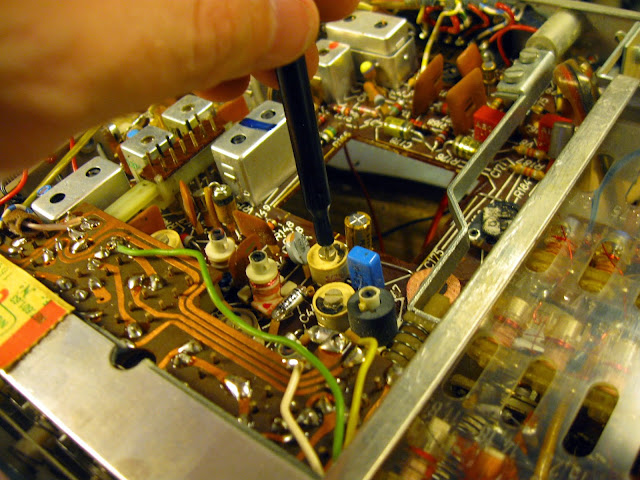
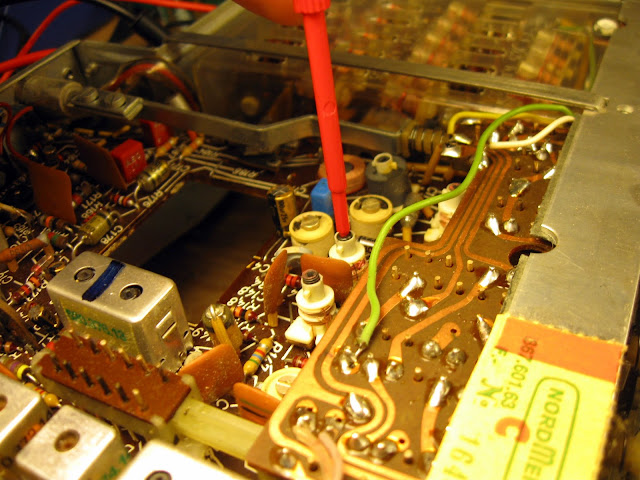
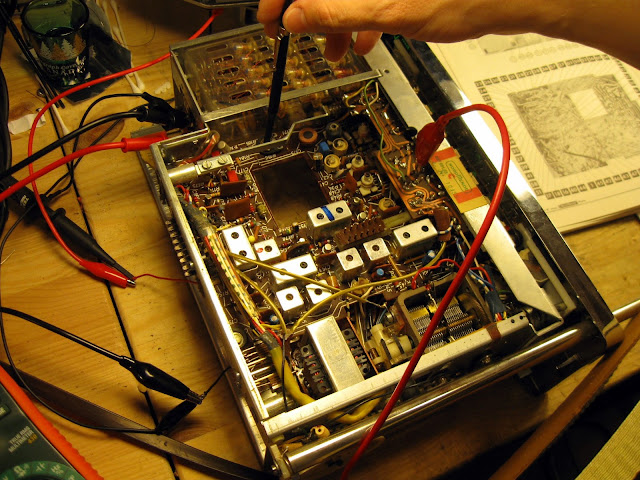
The replacements are 1% tolerance precision metal film resistors which should last for a very long time, and don’t absorb moisture the way carbon resistors do. Now, I was able to get audio, but no radio reception. Testing the front-end verified the radio was operating, but it wasn’t tuning a signal. Time to investigate the band switch – which, surprise, was badly gunked up! The mechanism wasn’t allowing the tuning capacitor to engage, and all the contacts were badly corroded which was killing the signal.

You can see how much gunk and oxidation had caked up onto the switch contacts – on the left, not processed; on the right, cleaned and scrubbed.

With that, the radio roared to life and picked up stations loud and clear across the dial! There were a lot of problems, but they were all able to be corrected. I peaked up the alignment using my standard signal generator, then did final inspection checks.

Finally, it was ready for the trip home! It sounded even better installed back in the cabinet.

The owners had the cabinet refinished while the radio was in the shop – it’s a perfect pairing! New pushbuttons and new rubber mounts and the radio is nearly as nice as they day it left the showroom floor.

This family heirloom is back in running shape and is going to serve faithfully for many years to come as a beautiful piece of functional furniture. Just look at it!

Posted in Projects, Radios and Tubes, Vintage | Tagged , , , , , , , , , , , , | 3 Comments

1938 Zenith 5-S-220 eBay Tune-Up Special

I’ve had the opportunity to work on several very nice Zenith radios lately and this one is especially interesting. It’s the Zenith 5-S-220 Cube. This is the first time I’ve seen one of these in person, they’re somewhat uncommon. Electrically, it’s a nice 5-tube radio with a broadcast and shortwave band, and the cabinet is very compact with the speaker firing vertically through the top of the cabinet. The black dial in the face is very easy to fine-tune.

It was sold as in running condition, and it worked okay on the standard broadcast setting, but with the switch on the Treble Cut tone setting the set picked up bad warbling low-frequency interference, called motor-boating. It also just didn’t sound that good, and Zenith radios are known for their excellent tone even from their small radios.

The chassis is supported on small risers to replace compressed paper spacers. It’s fairly cramped in there,but the chassis slides out easily when the spacers are pulled out and the speaker socket makes service easy.

Underneath, the solder joints were all very good in fact. Mostly original resistors retained.I tested the resistors and many were well outside of their specifications; there were several other problems as well.

The previous service had replaced all but one of the original vintage tubular capacitors that are candidates for replacement in any vintage radio.

The resistors were all original. This frequently isn’t a problem – vintage resistors can still test within tolerance, and if so, don’t need to be replaced – but these were almost all bad. I found some which measured as much as 250% of their marked values. The radio actually played like this, it just goes to show you how robust these tube circuits were. They’d tolerate a lot of abuse and still sound passable.

I replaced the vintage capacitor and many resistors but the motor-boating persisted. Throughout all of this, the volume is lower than I’d expect, too. I went about replacing the Micamold capacitors which can frequently go leaky and exhibit odd symptoms. These are in fact paper capacitors in a molded package – not true mica capacitors which tend to hold up well even today.

While poking around at those connections, an entire solder blob moved – the ground connection had broken off entirely:

I replaced this one with a true mica capacitor and a solid ground connection. A few tweaks to the alignment later, the motor boating was gone, but the low volume persisted. Even on the normal position it was still lower than it should have been. I examined the tube line-up versus the schematic. This radio had a 6V6GT tube installed when the radio was designed for a 6F6G tube.

In general, those tubes are “fairly” close and you can often plug them into each other’s sockets. The radio will play, but with more distortion and lower volume, as they do have distinct design characteristics. The mismatch will get you significantly lower volume as a result, too. I had a 6F6G which tested like new in stock and made the exchange:

With this, the radio roared to life with perfect volume. It sounds absolutely fantastic, especially for such a small cabinet and speaker. It also goes to show: be cautious buying radios on eBay. They might even work, but often may have hidden problems like this. It’s worth it to ask for under-chassis photos to check the amount of work that was done.

With the feedback problem corrected, I performed a precision alignment and the dial tracks in perfectly.

Overall, to bring this radio up to standard I replaced many resistors, replaced several capacitors with modern technologies, repaired a broken ground connection for the capacitors, aligned the radio using a standard signal generator,  and replaced a wrong tube. Now it looks as good as it sounds – practically brand new.

Posted in Electronics, Projects, Radios and Tubes, Vintage | Tagged , , , , , , , , , , , , , , , , , , , , | Leave a comment

The Speaker Spotter – Speakers of Craigslist – March 21st, 2014

There’s always something interesting for sale on Craigslist, especially in Seattle. Here’s a selection of especially notable vintage speakers and other audio products for sale on the local Craigslist. I’m not affiliated with any of these sales, but if you’re interested, you should contact the seller through the respective Craigslist page! Do click through each of the titles – the original postings contain a lot more information and many more photos, along with the seller’s contact information to request more information. If the ads are removed, the speaker probably sold, so don’t be alarmed if some links don’t work. Try searching for the keywords as sometimes they expire or are reposted.

Today we have several unusual boutique hi-fi speakers, plenty of vintage JBLs, and an interesting set of Klipsch La Scalas designed for stage use.

Cerwin Vega Speakers – $125 in Olympia

Cerwin Vega Speakers

Cerwin Vega speakers are known as great rock speakers that can handle a ton of power and pump out a lot of bass. I’ve owned a pair and they are great performing, general use speakers. The iconic red foam surround and solid wood grain are very attractive and eye-catching, too.

DCM TimeWindow 1A Speakers – $200 in Ballard

DCM TimeWindow 1A

I understand DCM Time speakers to be nice and accurate, if a bit understated, but I’ve not heard them myself. Based on the cabinet design I expect these might be bipolar speakers? Looks worth investigating!

JBL 4330 Custom Studio Monitors – $3000 in Eguene, OR

JBL 4330 Custom Studio Monitors

If you’re into music production, or just like an extremely accurate listening experience, these might be for you. They feature the iconic biradial “butt cheeks” horn and what looks like it could be a 15″ woofer. I’m sure this is both powerful and great sounding.

JBL LE-8 Vintage Speakers – $299 in the Renton Highlands

JBL LE-8 Speakers 1

JBL LE-8 Speakers 2

A throwback from the modern reference quality JBL above, these are very vintage JBL bookshelf speakers with a single full-range driver installed. I’m sure they’d sound very warm with a matching vintage tube amp or low powered transistor amp up to a couple dozen watts, but might not have the same clarity and definition you’d get with a slightly newer, multi-driver speaker system.

Klipsch La Scala LSI – $1500 in North Bend

Klipsch Lascala LSI 1

Klipsch Lascala LSI 2

The Klipsch La Scala is another of their high-end folded horn speakers; these are the LSI variant which are designed to be stage speakers with detachable treble horn cabinets. The seller claims these were never hauled around to gigs, though, and are in great shape. The same great sound from a Klipsch folded horn, but in a bit more industrial of a package.

Revox AX5-4 Speakers – $295 on Seattle’s Eastside

Revox AX5-4

Revox AX5-4 2

From 1977, I’m not familiar with this brand, but they’re reportedly using high-end German manufactured drivers; a 3-way design with dual woofers can probably offer plenty of bass. The mid driver resembles the Infinity polymer dome, too. Rated for 100 W power handling at 4 Ohms, 91 dB efficiency these seem like they’d be worth checking out. I’d love to listen.

Snell C IV Speakers – $399 in the Renton Highlands

Snell C IV Speakers

These Canadian hi-fi speakers have some interesting engineering in them, including a zero diffraction grill which is designed to be more sonicly transparent, and an interesting dual tweeter design with a front-firing tweeter on a fourth-order crossover, and a rear-firing dome tweeter on a first-order crossover. This combination apparently delivers great accuracy from the front while the rear – which can be disabled – fills out the volume lost due to the steep crossover slope.

Totem ARRO Speakers – $800 in Auburn

Totem ARRO Speakers

These no-frills 2-way audiophile speakers look like as much of a decor statement as a music piece. They’re “wife friendly” and yet regarded for excellent bass response and well defined imaging. I’m not sure it would match every decor but it’s very pretty.

Universal CX-300 Hi-Fi Speakers – $140 in Everett

Universal CX-300 Hi-Fi Speakers

Universal CX-300 Hi-Fi Speakers 2

These early ’60s drivers throw back to the coaxial design which was more common at the time. With 25W of power handling and meeting the DIN Hi-Fi spec of 40-18,000 Hz frequency response I bet these sound great with a period tube amp like they would’ve used originally.

Vintage JBL L88 Nova Loudspeakers – $400 in Tacoma

Vintage JBL L88 Nova Loudspeakers

Vintage JBL L88 Nova Loudspeakers 2

These are beautiful speakers which look to be from about the early ’70s. I’m sure they sound fantastic like most JBLs, especially vintage JBLs, and would make a perfect vintage hi-fi bookshelf or desktop system that would look great in almost any room.

More Speaker Spotter

Posted in Audio, Collections, Photos, Speakers, Stereo, Vintage | Tagged , , , , , , , , , , , , , , , , , , , , , , , , , , , , , , , , , , , , , , , , | 1 Comment

Craigslist and eBay Antique Radios – Be Careful!

It’s not uncommon to run across antique or vintage radios on Craigslist, eBay and other sales site which are advertised as “working”, “repaired” or “restored”. Many times these are in fact professionally reconditioned items – just like you read about here – but occasionally, there are some critical hidden problems to look out for. Let’s take a look at an underside photo which was included in the for sale posting: Echophone-2

Not too bad! It looks like there’s some new capacitors carefully installed – but there’s a problem. Can you spot it?

Echophone-3

Again, with a hint this time! Several original paper capacitors look to be installed in the radio. It’s even believable they might work – by and large they’ll be well past their service lifetime, but through dumb luck you do occasionally find vintage capacitors which are still technically operational. Even if one is working now, though, they are universally all completely unsafe for operation for any length of time. Old vintage capacitors like these can spontaneously fail and short out, which can damage the radio or even start a fire! A repair like this is not in compliance with the best practices for antique radio repair, and I wouldn’t let one out of my shop in such a condition, that’s for sure!

If you’re buying an antique radio or vintage radio and have the opportunity, ask for photos of the underside of the chassis or ask to inspect it personally and check for old parts. If you’re having your old radio serviced, make sure to choose a reputable repair shop or service technician who will follow best practices and replace all components which are subject to spontaneous failure – not just the ones which are bad “right now”. Your radio – and maybe your home – depend on it!

Posted in Commentary, Electronics, Photos, Radios and Tubes, Vintage | Tagged , , , , , , , , , , | 3 Comments

The Speaker Spotter – Speakers of Craigslist – March 14th, 2014

There’s always something interesting for sale on Craigslist, especially in Seattle. Here’s a selection of especially notable vintage speakers and other audio products for sale on the local Craigslist. I’m not affiliated with any of these sales, but if you’re interested, you should contact the seller through the respective Craigslist page! Do click through each of the titles – the original postings contain a lot more information and many more photos, along with the seller’s contact information to request more information. If the ads are removed, the speaker probably sold, so don’t be alarmed if some links don’t work. Try searching for the keywords as sometimes they expire or are reposted.

It’s a good week for rare and unusual speakers in Seattle this week – several Electro-Voice vintage speakers, and the Altec Lansing Voice of the Theater!

Bose Speakers and Amplifier – $300 in Port Orchard

Bose Speakers  Amp

This looks like a ready-to-go kit of Series IV or V speakers, Active Equalizer, and an unknown amplifier with two very large power meters. These also sound fantastic. Series III+ speakers used a design with resonant acoustic cavities as opposed to the acoustic suspension enclosure of the Series I/II and also sound fantastic. It’s worth double-checking the foam on Series III+ Bose drivers, though.

Bose 901 Speakers with Equalizer – $250 in Port Orchard

Bose 901 SpeakersEqualizer

This is a great price for a set of Bose 901 Series I/II speakers with a working equalizer, and of course Bose 901s are a very musical and life-like speaker to buy. Series I/II have cloth rubber surrounds on the drivers, as well, so you don’t have to worry about refoaming 18 drivers.

Electro-Voice Regenecys – $400 in East Wenatchee

Electro Voice Regencys

E-V speakers are pretty rare, they stopped making consumer gear in the ’70s. They made some of the finest speaker drivers and their finished speaker products are incredible as well. These feature 15″ woofers, T25 mid horns and T35 tweeter horns. Very similar driver compliment to a Klipsch Cornwall, for example. I bet these sound fantastic!

Electro-Voice Hi-Fi Speakers – $250 in Bellevue

Electrovoice Hi-FI speakers

Electrovoice Hi-FI speakers 2

I haven’t seen these before, but they look very interested. It looks like they have the SP12 extended response 12″ woofers, the T-25A midrange (same as on the Regency), but are missing what was likely a T-35 tweeter. You’d probably need to spend $100-200 on the missing drivers, but I bet these would sound very good complete.

Klipsch KG4 – $120 in SeaTac

Klipsch KG4

Despite some water damage, these speakers are a bargain – featuring an exponential horn, two 8″ active woofers and a 12″ passive radiator on the rear. They sound great and are very efficient – my pair sound fantastic. The water damage on these looks like it’d be pretty easy to refinish, too.

Klipsch Speakers – $600 in Granite Falls

Klipsch Speakers

Always a good find, these black Heresy II speakers look like they’re in great shape. They’re one of my favorite little speakers.

Pair of Vintage Wharfedale Speakers – $100

pair of vintage wharfedale speakers

These look like they’re from the 1960s, possible a little earlier. I’ve never heard any Wharfedale speakers, but being a high-end brand from the golden age of hi-fi, these are almost certainly worth listening to and the price seems pretty fair.

Sansui S-1117 Tower Speaker System – $100 in Tacoma

Sansui S-1117 The tower speaker system

These get a listing because they’re “interesting”, although they don’t have a reputation for good sound. With a pair of 12″s in each cabinet, though, they probably can deliver a decent amount of bass and they sure look very visually impressive. It’s unfortunate one has a replaced woofer.

Speakerlab SKO Speakers – $750 in South Seattle

Speakerlab speakers (SKO)

I think this is the late-generation Speakerlab Corner Horn after they moved away from the Klipschorn-inspired design. These have been mounted angled slightly back on speaker stands. I’m not sure what to make of the whole thing, personally, but given the 15″ woofer inside the folded horn and the T35 tweeter, I’m sure they can deliver.

Electro-Voice “The Duchess” Speakers (1962) – $900 in Lynnwood

Speakers The Duchess Speakers 1962

Very rare speakers, but these are missing some parts, and I’m unclear from the description whether they are functional with the modification. Might make a good, if somewhat expensive, project to have a very desirable vintage speaker.

Vintage Akai SW 177 Speakers – $40

Vintage Akai SW 177 speakers

I’m sure these would make a great garage speaker – a 15″ woofer, mid, dual tweeters, and durable butyl rubber surrounds on the drivers.

Vintage Sansui SP-100 Stereo Speakers – $55 in Edmonds

Vintage Sansui SP-100 Stereo Speakers

I just love the look of Sansui vintage speakers with the scalloped wood grills and solid wood cabinets, often with heavy dampening inside. These are a very early series with a woofer, mid-range, and a horn tweeter. The crossover will certainly need to be rebuilt for best performance, but you’d have an inexpensive vintage hi-fi setup with warm and rich sound.

Vintage Wharfedale W-35 Speakers – $400 in West Bremerton

Vintage Wharfdale W-35 speakers VG condition 2

Vintage Wharfdale W-35 speakers VG condition

A bit smaller than the other Wharfedale speakers, and a bit more expensive, I’d love to know more about the features and differences of those two models.

Altec Lansing Voice of the Theater Speakers – $50,000 in Redmond

Vintage Altec Voice-of-the-Theater Speakers

Vintage Altec Voice-of-the-Theater Speakers 2

“A better investment than a Porsche” these holy grail speakers out of Redmond, home of an unlimited amount of tech money, aren’t for everyone but they might be right for you. Originally these were high-end PA Hi-Fi speakers for movie theaters, etc. they feature large an powerful woofers mounted in flared horn enclosures and enormous multi-cell horns coupled to compression drivers. They’re known as being incredibly efficient, absurdly powerful speakers and might actually be a better investment than that sportscar.

If you’re interested in any of these speakers, click on the title to visit the original Craigslist posting to contact the seller!

Do you know anything about those Wharfedales? Or own a pair of the speakers listed here? Leave a comment!

More Speaker Spotter

Posted in Audio, Collections, Photos, Speakers, Stereo, Vintage | Tagged , , , , , , , , , , , , , , , , , , , , , , , , , , , , , , , , , , , , , , , , , , , , , | 2 Comments

1939 RCA K-60 Console Radio Repairs

This beautifully preserved RCA K-60 radio came to me after a Golden Retriever puppy got a little too up close and personal.

Otherwise, it’s been beautifully refinished in the past, and was fully overhauled in the late ’90s according to a stamp on the rear of the chassis and the replacement speaker.

Replacement grille cloth is somewhat hard to find these days, but the pattern was almost a perfect match. It’s much cleaner, too! The speaker must have failed at one point, because it had been replaced. I’d have picked a different substitute driver myself, but this one seemed to work well enough.

On the rear, the output transformer and speaker lead connections were relocated to the basket.

Unfortunately, during transport, the field coil (which had been retained but relocated) wasn’t securely mounted and ripped from its mounting point, damaging the speaker voice coil leads in the process.

I carefully peeled back the paper and soldered new, stronger leads; then reinforced the structure with Gorilla tape. The new coil checks out – about 1K Ohms resistance, and 2.3 Henry of inductance. That’s a lot! Any further back of a break would have been much more complicated to successfully fix.

Before this repair, the field coil was just hanging from a peg with exposed metal clips into the coil – a major shock hazard, with several hundred volts present on an externally exposed, uncovered piece of metal!

And, all set!

After a short power-up to make sure the field coil repair was sound, she’s ready to go home! Hopefully the puppy has learned a few lessons about the proper handling of antiques in the past few weeks so we can avoid a repeat performance.

Posted in Projects, Radios and Tubes, Vintage | Tagged , , , , , , , | Leave a comment

The Speaker Spotter – Speakers of Craigslist – March 7th, 2014

There’s always something interesting for sale on Craigslist, especially in Seattle. Here’s a selection of especially notable vintage speakers and other audio products for sale on the local Craigslist. I’m not affiliated with any of these sales, but if you’re interested, you should contact the seller through the respective Craigslist page! Do click through each of the titles – the original postings contain a lot more information and many more photos, along with the seller’s contact information to request more information. If the ads are removed, the speaker probably sold, so don’t be alarmed if some links don’t work.

This issue of the Speaker Spotter covers both interesting finds in Seattle and Portland since last week. And so:

Vintage Allison One Speakers

Allison OneAllison One (2)

I bet these have a very wide sound stage from the bipolar angled design.

Bose 601 Series III Speakers – $700

Bose 601 Series III (2)

Bose 601 Direct/Reflecting speakers produce a very wide, warm, rich sound that’s very life-like. The 601 speakers feature a pair of 8″ woofers and 4 tweeters arranged in a reflecting pattern. When properly set up in a room they sound excellent.

Used Speakerlab K-Horn DIYs – $250

DIY K-Horns

These speakers started out as the flat-pack kit Speakerlab K-Horns, but the builder took some liberty with the designs. Instead of the same driver compliment usually found on the Klipschorns, with the pair of Electro-Voice mid and high horn drivers, they seem to have elected to build the bass cabinets and use alternate mid and high frequency drivers in separate enclosures. This would make the base of an interesting frankenhorn system, perhaps paired with an Altec or JBL multicell horn on top?

Vintage Fisher XP95B Speakers – $50

Fisher XP95B

From before Fisher went a bit downmarket, these look pretty interesting and might perform well. The seller reports the woofers (12″ or 15″) have been refoamed, and the phenolic ring tweeters typically appeared on higher end equipment, including speakers made by Altec Lansing and Marantz.
Infinity Kappa 8 Speakers – $300

Infinity Kappa 8 

Vintage Infinity speakers aren’t especially common in my experience. These are shallow 4-way designs featuring a pair of Emit planar tweeters (one in front, one on the rear) with dome midrange drivers. The Emit tweeters are bright and crisp, I bet these have a lot of definition in the high end.
Vintage Infinity RSe – $140

Infinity RSe

With what looks to be 8″ woofers and horizontally mounted Emit planar tweeters, these vintage Infinity bookshelf speakers probably sound great for near-field listening.

Two Pair Vintage Kenwood Speakers – $180

Kenwood Family

Kenwood Family (2)

I rather like the vintage wood lattice grille Kenwood speakers. In this case, this is a pair of KL-777As, 4-way/6-driver, and a pair of 333D 3-way/3-driver speakers. These are known for being very lively and musical and would make an excellent, affordable vintage quad system.

Marantz Speakers LS-20 – $300

Marantz LS-20 (2)

I don’t run into Marantz speakers very often and haven’t heard a set myself, but I know they have a reputation for being able to thump and in general sounding excellent. These look like they’re from the ’80s, a bit flashy, but worth checking out!

Sonab OA-14 Speakers Made in Sweden – $850

Sonab OA-14

Sonab OA-14 (2)

These are pretty rare vintage hi-fi speakers from Sweden. They have an interesting reflecting design that reminds me a bit of the Bose 601, with angled upward-firing woofers and four tweeters. It’s a very interesting design, I’m curious how they sound!

Speakerlab Corner Horns – $1600

Speakerlab Corner Horns

These have been on Craigslist a few times in the local area in the last year. It looks like they’ve changed hands since the last time, and the price is considerably higher. These have the 15″ woofer inside the folded horn and an Electro-Voice tweeter, but feature a 6.5″ midrange driver instead of a midrange horn. I believe this was the last year Speakerlab sold the corner horn design, which had moved away from the Klipsch-inspired design of the Speakerlab K.

Speakerlab Six

Speakerlab SIX

Speakerlab SIX (2)

You don’t see these very often, the Speakerlab Six is one size down from the Super 7s. The main difference is the Six lacks the 10″ passive radiator found on the Seven, and accordingly different driver placement.

If one of these speakers looks interesting, click through to Craigslist and contact the seller!

Previous issues of the Speaker Spotter.

Posted in Audio, Collections, Photos, Speakers, Stereo, Vintage | Tagged , , , , , , , , , , , , , , , , , , , , , , , , , , , , , , , , , , , , | 1 Comment

Ohm Acoustics Model D Speaker Refurbishment

Classic speakers are always a delight to work on, and speakers have capacitors and other parts which require service, too. Over the years those components can fail and result in poor sound and even potential speaker damage.

In this case, the speakers on the bench are the Ohm Acoustics Model D. Ohm is more well-known for the Walsh speakers which produce an interesting omnidirectional sound from a vertically oriented cone; these Model D speakers were a more economical version that still offers warm and rich sound, especially known as being great for rock and roll music.

Ohm is still in business making boutique hi-fi speakers, and these speakers which originally cost $400 a pair in the early 1970s are still worth a $400 trade-in credit towards a new set today. They feature a 10″ woofer and a phenolic ring tweeter packaged in a solid hardwood cabinet with a resistive port. A resistive port is half-way between an acoustic suspension enclosure and a reflex enclosure, it’s not the most common design. Inside, there’s a 2 uF and a 20 uF crossover capacitor, an inductor, and a rheostat to adjust the tweeter level.

These speakers were used for only a few years in the ’70s, picking up only the tiniest of nicks and dings, before they were put back in their original boxes and stored for the next 40 years. Even with such careful storage, though, the woofer foam had degraded and was due to be replaced – so the first order of business was new foam surrounds.

Then it was to address the crossovers.

Bad capacitors mean bad sound! And this one certainly was bad. It’s supposed to measure 20 uF, but instead is measuring 0.0013 uF. That’s no good at all.

And this one’s showing more ESR than I’d like:

Beautiful classic speakers like this deserve nothing but the best, so I used brand new audiophile grade film crossover capacitors which are exceptionally stable and have a low dissipation factor for unmatched performance.

It was rather interesting – these were purchased as a pair, but inside, used slightly different capacitors. Both of the same value, but one used a single 20 uF bipolar capacitor and the other used a pair of 10 uF in parallel.

Now, it’s time to put the woofers back into the cabinets after cleaning up the gaskets:

Finally, time to package it all back up!


Posted in Audio, Hi-Fi, Projects, Speakers, Stereo, Vintage | Tagged , , , , , , , , , , , , , , | 1 Comment

1945 Westinghouse Little Jewel “Refrigerator” H-126 Radio Repair

A local client brought me a radio which was in the family for many years, a cute little “fridge radio” made by Westinghouse from 1945-1947. The same year Westinghouse released this new model of home refrigerator, they also released this Little Jewel radio in the same style as a companion. Many examples of this radio found their way into homes and kitchens over the years and are a great little collectible from the post-war era.

This little radio is a 6-tube AC/DC radio with a series-string tube line-up, 12SK7 12SA7 12SF7 12SJ7 35L6 35Z5. It has an integral tuned loop antenna and an RF Amplifier for great performance.

They sure packed it into here, too. The radio is held in place by two chassis bolts, one in each side and a rod which stabilizes it in place.

The dial scale has badly warped with age, but the grille cloth is nicely intact.

This radio’s owner mentioned that it had been playing but recently cut out. No surprise why – the original parts under the chassis looked to be in pretty bad shape!

Melted, leaking and blown capacitors will cause all sorts of issues – no wonder it wasn’t running like it used to! This radio was pretty cramped underneath the chassis, but there was enough room to install both electrolytic filter capacitors and the cathode bypass capacitor on the output tube under the chassis instead of needing to re-stuff the can on top.

I had a reproduction dial scale made up to replace the warped original, and replaced some tubes which were testing weak.

Finally, it was time to test it out and tweak the alignment trimmers, then back together! It sounds a lot better than I’d expect with such a small radio – the case makes an interesting vented enclosure. On 880 KIXI, you can really hear the low notes, and the vent on the top seems to serve as a port for the speaker.

After being refurbished electrically, this radio is going to perform beautifully for many years. It’s got a rich tone and great audio clarity even more than you might think from such a small speaker.

Posted in Projects, Radios and Tubes, Vintage | Tagged , , , , , , , , , , , , , , , , | 7 Comments

1962 Zenith MK2670 Classic Tube Hi-Fi Console Stereo Repaired

A version of this article appears in the October 2014 issue of Nuts and Volts magazine.

I recently got to work on something a little bit different – a tube hi-fi stereo console! This particular one, a 1962 Zenith MK2670, was a very high-end unit back in its day. It’s a dual-chassis unit with 19 tubes total, using the 12K25 stereophonic FM tuner and 7K31 stereo amplifier chassis with EL84 outputs. All housed in a beautiful mid-century modern cabinet with built-in stereo speakers featuring 12″ woofers and mid- and high-end compression drivers and horns.

With 19 total tubes, this model features hi-fi integrated speakers with high-efficiency 12″ woofers and mid and tweeter horns, push-pull EL84 output tubes for each channel, and built-in FM Stereo Multiplex decoding for true stereo hi-fi reproduction.

This hi-fi’s owner reported it was working well for several years but started to go downhill shortly before she got in touch to have it fixed. It was taking longer and longer to warm up and sounding more and more distorted, no longer delivering the rich warm sound of a classic hi-fi console. It was good she got in touch – waiting any longer could have led to catastrophic consequences such as component failure or even a fire. I visited her home to test the tubes and pull the chassis, then it was back to my shop for repairs. And what a job it was!

This unit had been serviced a couple of times in its life – there were some ’70s era film capacitors installed, and some of the output tubes had been replaced. Most of the tubes were original Zenith fittings and tested strong, though, so very little needed to be replaced. Since it came into the shop in working condition, too, it made the diagnostic process much easier!

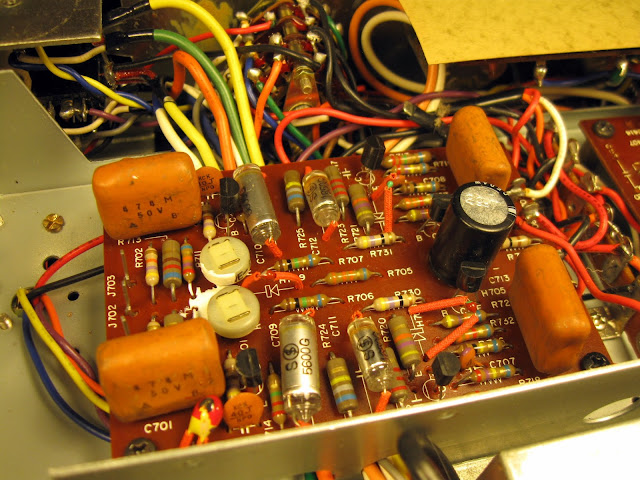
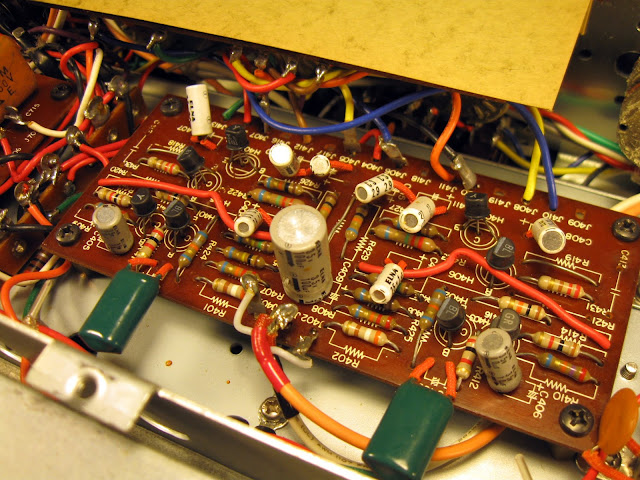
The amplifier circuit is a bit different than most I’ve seen. The negative phase of the output transformers was connected to chassis, and there were two positive phased taps each connected to half of the speakers. It’s an odd arrangement, certainly, which would have let Zenith use woofers of different impedance then the mid/tweeter network without an expensive and complicated impedance matching network. Underneath, though, it’s pretty easy to work on:

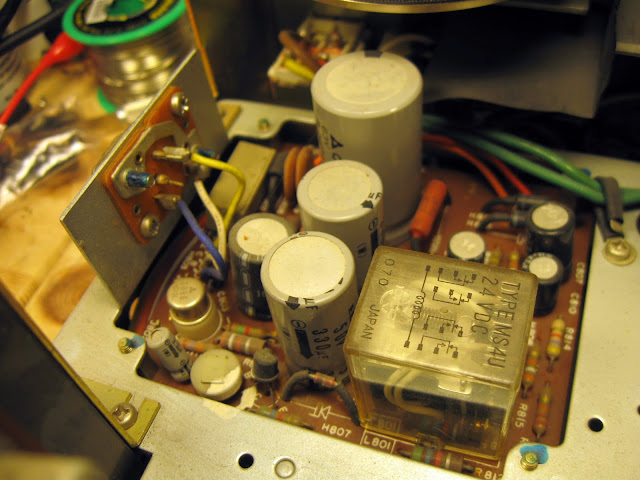
Right away there’s some visible damage. This molded ceramic capacitor blew a piece of the ceramic clean off from overheating. It’s unlikely it was doing much of its job at this point. Despite a nice ceramic body and epoxy sealed ends, it’s still an acid-paper/foil capacitor inside subject to failure, and fail it did.

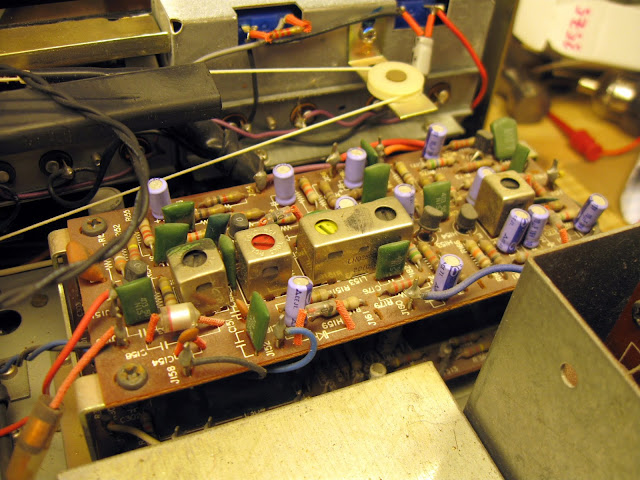
With the amplifier chassis sorted, it was time to move onto the tuner. It’s nicely shielded on the bottom.

And there’s a lot going on inside.

Now  it was time for a power-up test. This particular radio uses an odd multi-tapped output transformer arrangement with drivers hooked up to both taps in the cabinet, so I ended up hooking up 4 distinct speakers for testing.

It fired right up and sounded great! There were a few minor issues to resolve, though. For one, there was a bad volume-invariant hum on the AM band only. This was due to a small short which was corrected. The volume controls were behaving pretty erratically, though, which took some investigation.

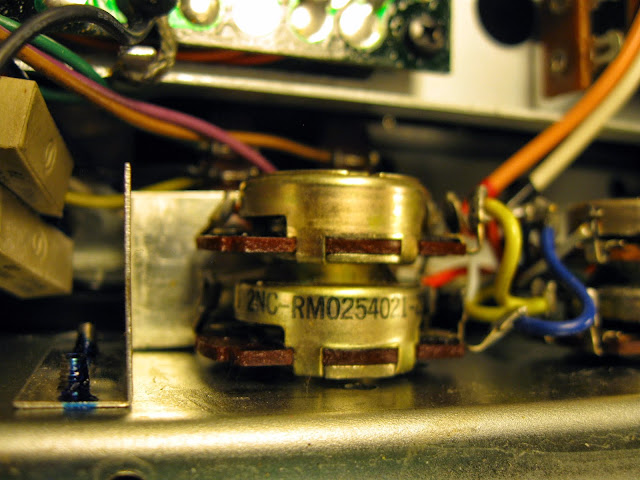
The unexpected behavior turned out to be due to a control scheme I hadn’t run into before. The “balance” control isn’t an actual fader; instead, the volume controls for the left and right channel are ganged together with a friction clutch. Turning the outer ring turns both together – but turning the inner ring adjusts the friction clutch allowing one to be turned independently to achieve the left-right effect. At the new set point, then, the outer ring will turn both volume controls together to adjust the loudness equally after the fade is applied. It wasn’t a popular control scheme, being replaced after a couple of years, because many consumers found it to be annoying and counter-intuitive.

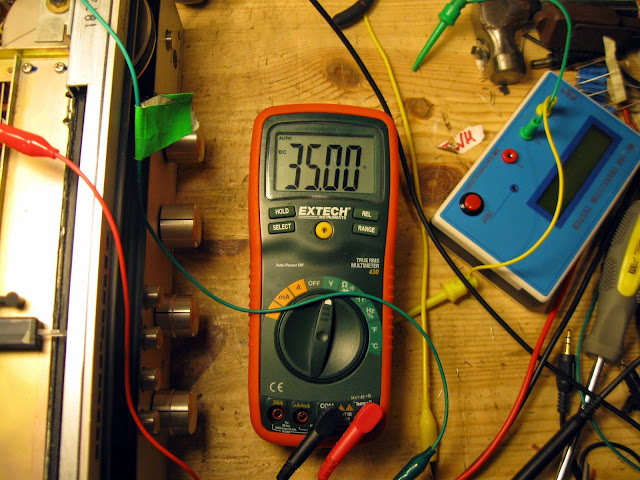
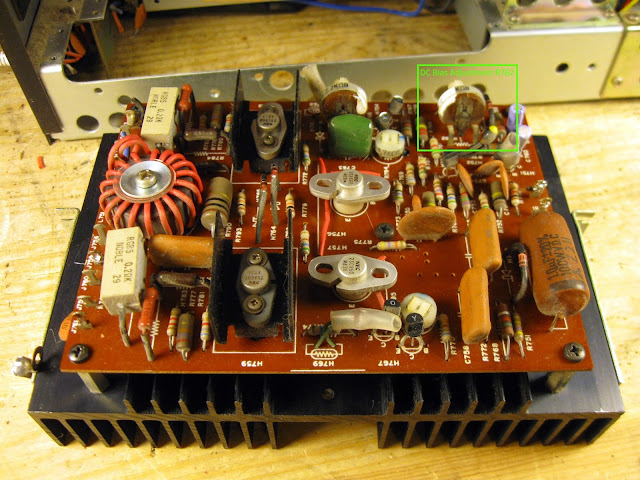
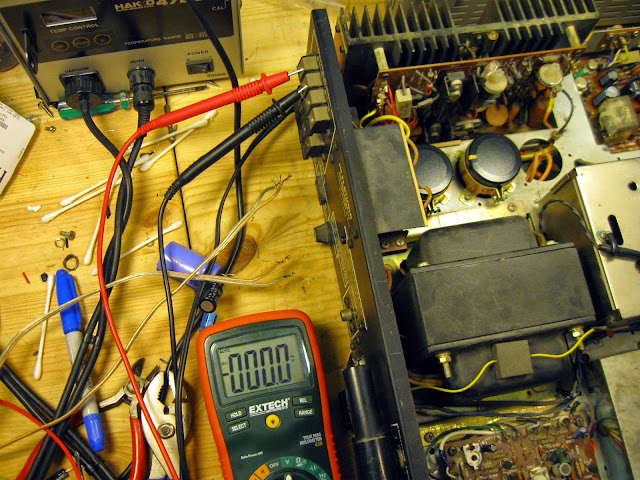
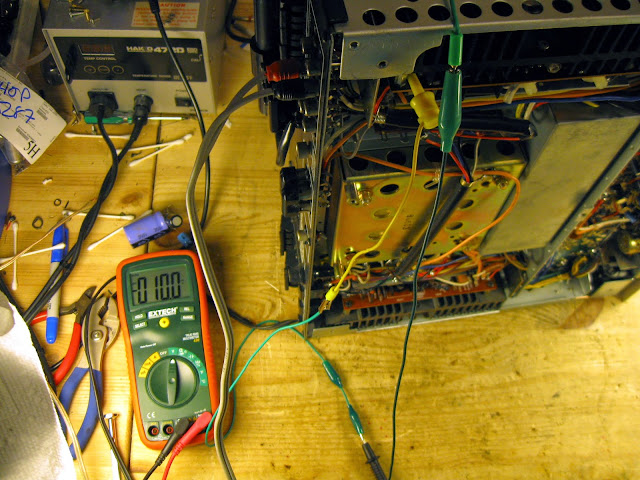
After understanding how it worked, however, it turns out that it wasn’t gummed up, it was actually working properly. So, on to the next steps! Adjusting the bias on the channels:

RF and IF Alignment:

Lots of parts came out of this one!

This radio is going to continue to serve faithfully for many years, pumping out a warm and rich hi-fi sound and be a beautiful family heirloom to pass on. They just don’t build them like they used to!

Posted in Audio, Projects, Radios and Tubes, Stereo, Vintage | Tagged , , , , , , , , , , , , | 26 Comments