The Bose 901 Direct/Reflecting Speaker System is as polarizing as it is interesting, a unique system from the golden age of hi-fi experimentation. It’s less about perfect sonic accuracy and more about the experience of listening to your music. And that’s one of the things I love about it!
While cleaning up some of my archives to save cloud space, I found that I’ve serviced nearly 500 Active Equalizers which are the important heart of these speaker systems. I’ve distilled some of the knowledge from all of that experience here, to help anyone else who wants to keep these systems running, and get good info from someone who actually has any clue what’s going on.
There is a truly staggering amount of AI slop out on the Internet about these speakers, ranging from slightly wrong to utter nonsense. In contrast, this article was written by a human who has owned and listened to all of these systems, and serviced and studied hundreds of them over thousands of hours.
This article covers the Bose 901 Series V Speaker System and the Active Equalizer. Keep on reading for all of the details, including schematics, repair tips, original documents, and direct links to buy all the parts you need for the 901 Series V repair on Mouser.com.
This article is part of a series. Scroll all the way to the bottom for the others.
- Bose 901 Series V Speaker System Background
- Bose 901 Series V Speaker Drivers
- Bose 901 Series V Active Equalizer
- Series V Active Equalizer Parts List
- Series V Gotchas
- Conclusion & Postscript
- Other Resources
Bose 901 Series V Speaker System Background
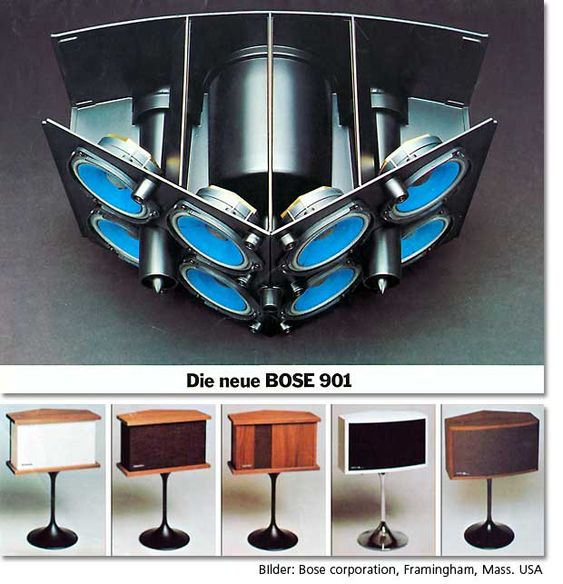
The Bose 901 Series V speaker system was introduced in 1983 and ran up until 1987. It’s the successor to the Series IV in the long series of 901 Direct/Reflecting Speaker System designs that spans more than 60 years from the earliest introduction in 1968. This photo from a German advertisement shows their evolution leading up to the Series V:
As with the others in this family, they’re based on research suggesting that most of the sound you hear in a live performance arrives indirectly through reflections. Dr. Bose designed the speakers with nine small, identical full-range drivers instead of a traditional woofer or tweeter. Eight on the back, one on the front, with no crossover components inside and all frequency shaping done on the external Active Equalizer box.
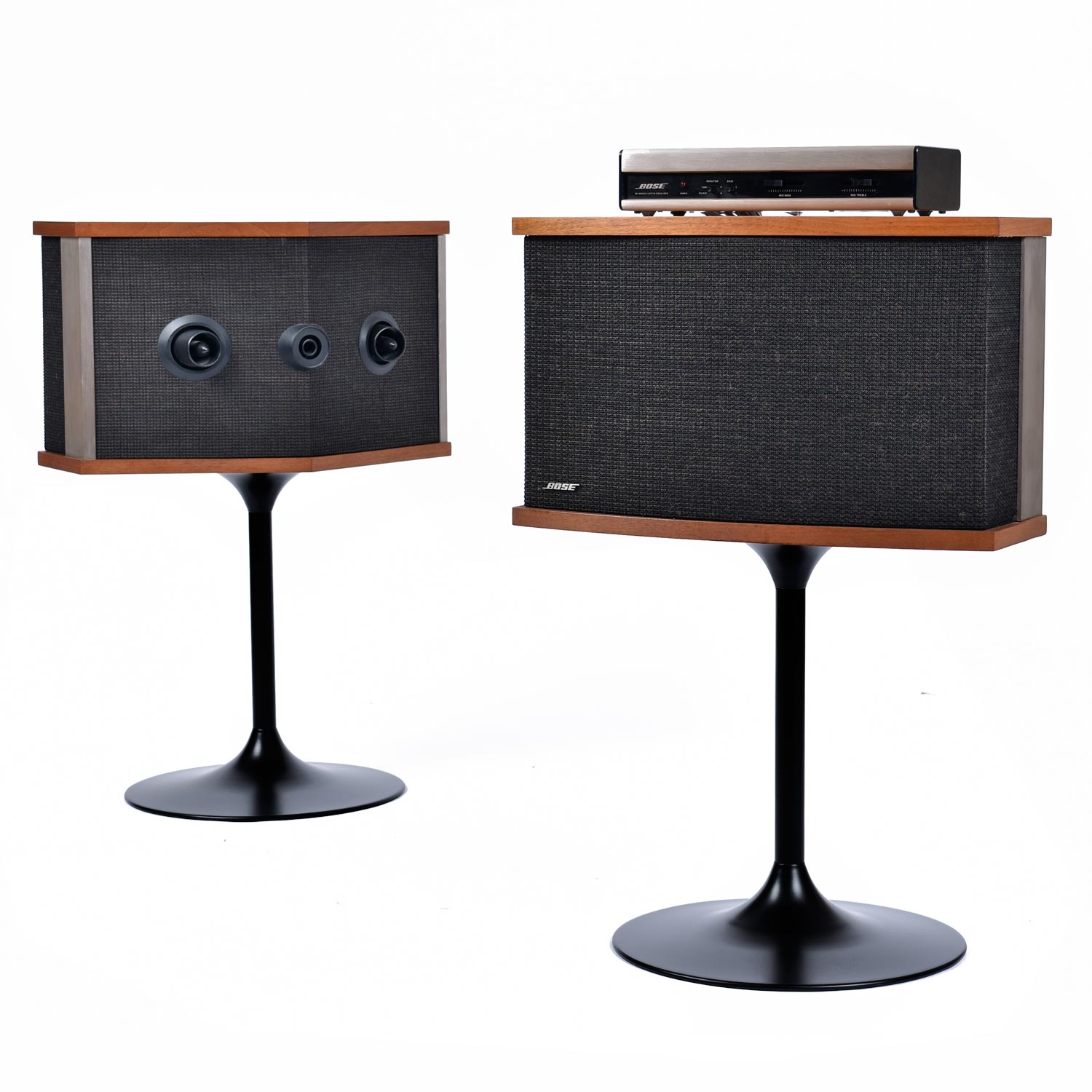
The Series V keeps the ported cabinet and 4″ helical voice coil drivers from the Series III and IV, with a handful of changes to the cabinet: it’s now an aluminum shell with plastic sides, the speakers feature a round cup for the speaker terminals on the bottoms, and now there’s poly fill behind each driver for some better damping.
Bose also finally dropped the extra * terminal that showed up on the Series III and IV which was designed for exclusive use with the Bose Spatial Control Receiver, and made the speakers ambidextrous rather than having a defined Left/Right that were found on some of the earlier speakers.
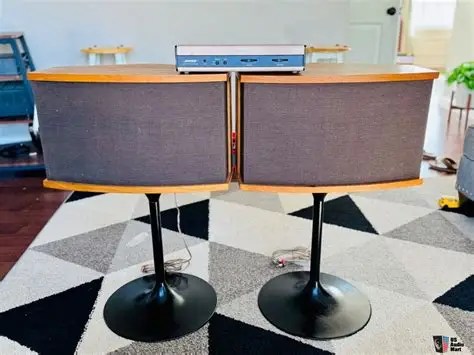
As with all 901 speaker system generations, the equalizer really is necessary to get the best sound out of the system – and sadly, it gets lost or damaged a lot of the time. Without it, the midsized drivers don’t get the drive power they need on both the low and high ends of the frequency range to perform properly and you end up with the derogatory description, “No Highs – No Lows”.
If you’re absolutely in a pinch, you can crank the lowest bass and highest treble adjustments on your amplifier up as high as they’ll go, but like the Series III and IV, the Series V uses a summed complex curve that’s very difficult to replicate. You’ll need a multi-band EQ at a minimum. Find yourself a real one, or a mini-DSP replacement, for best results.
The Series V is the most efficient 901 family speaker yet: the owner’s manual calls for a miniscule 10 watts per channel. For optimal listening, Bose recommends that the point of the “V” on the back grille be 8-16 inches away from the rear wall, with a minimum of 18 inches and 2-4 feet recommended from the sides, floor, and ceiling. They specifically caution against putting the speakers exactly halfway between the floor and ceiling as this could cause some unpleasant multipath distortion. Take a look at the Owner’s Manual for all the details:
Bose 901 Series V Speaker Drivers
Starting with the Series III and continuing through the end of the series, Bose used a more pliable and faster-responding foam surround on the drivers. This helped with the efficiency, but unfortunately foam does crack with time. As of September 2026 when this article was published, reports are mixed – some examples have good foam surrounds, others are cracking. You’ll probably need all 18 drivers to be reconed after some listening, if not immediately. Kits are readily available on eBay and from other vendors, and while it’s not a fun job, it’s more tedious than difficult.
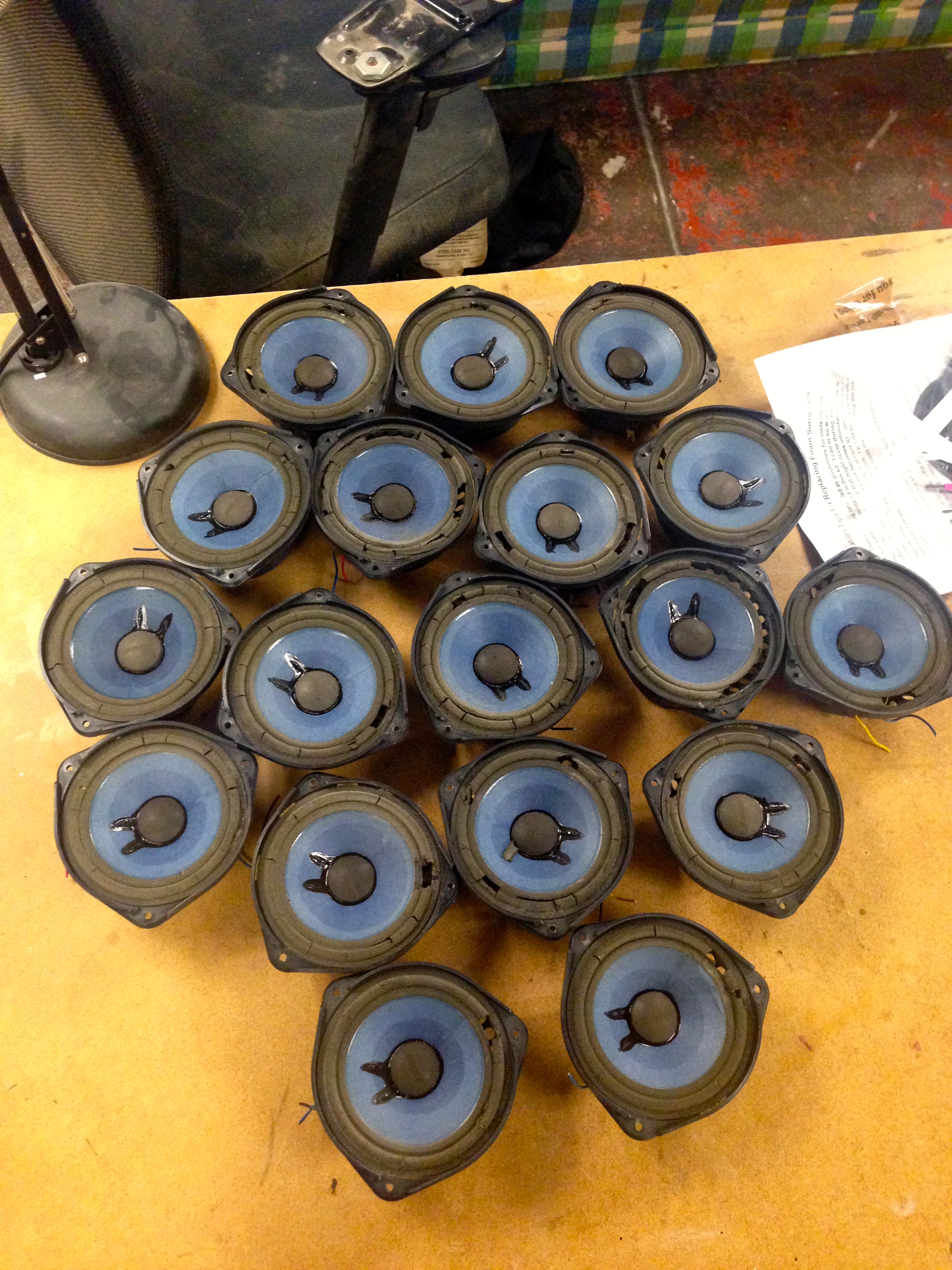
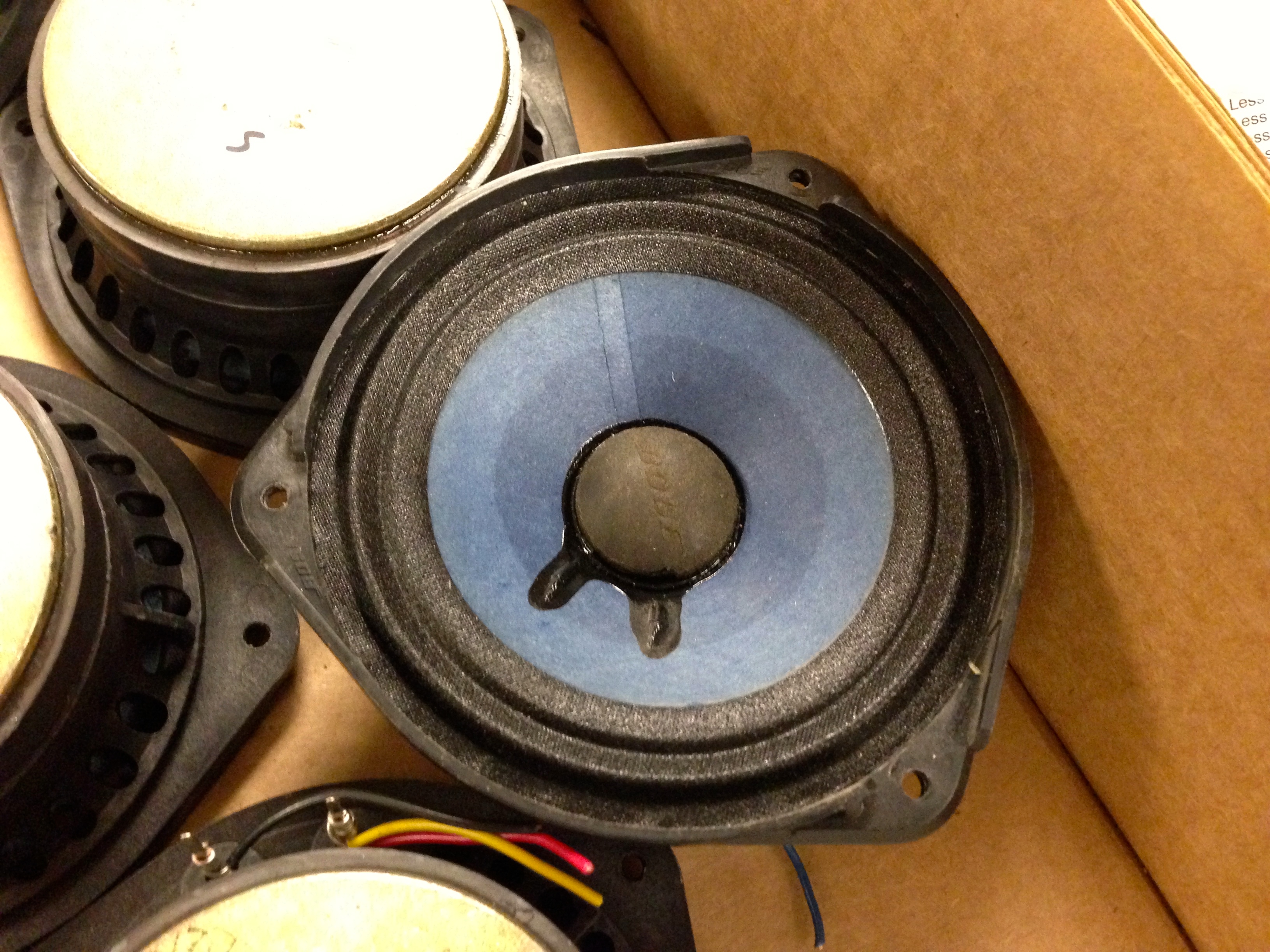
Those are photos from a Series III speaker, but it’s substantially similar.
Partway through the Series V run, Bose reportedly switched the surround material from polyester foam to polyether foam to cut down on rot, starting around 1986. These hold up better, but at this point they’re still 40 years old, so your mileage may vary. If the foam is bad, don’t run the speakers other than just for basic testing or you’ll burn out the voice coils which are otherwise highly reliable.
Bose 901 Series V Active Equalizer
The Bose 901 Series V Active Equalizer is doing the heavy lifting to shape the signal and provide the depth of bass, clarity of treble, and wide soundstage the 901 speakers are known for.
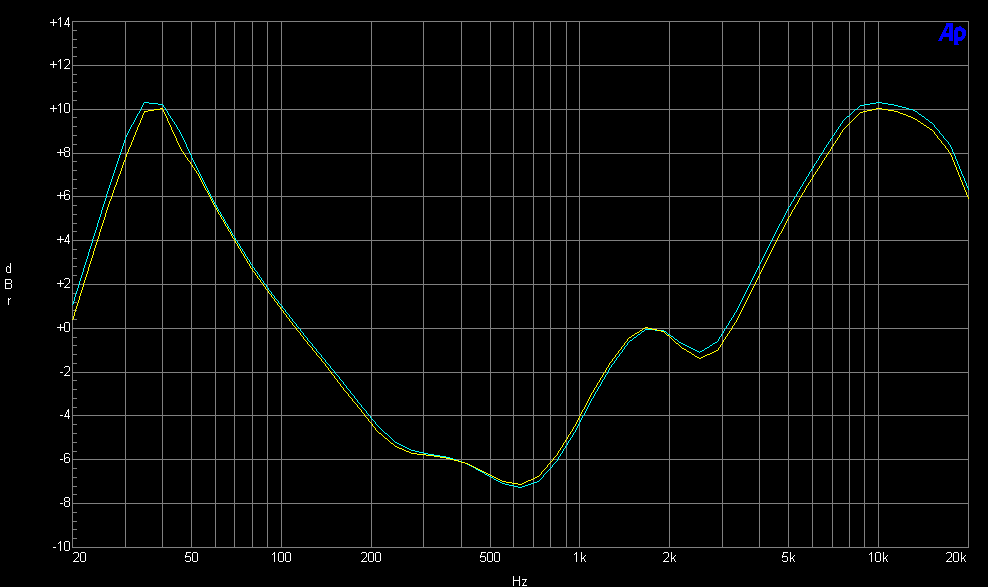
The speakers look pretty similar, but the extra efficiency and revised porting design mean that it’s a substantially different curve from the Series IV and earlier – the maximum amplification provided at bass and treble frequencies is only about +10 dB, compared with as much as +20 dB on some earlier models. The overall shape is somewhat similar, so in a pinch I’d be willing to substitute a Series IV or III with the bass and treble turned down, but that wouldn’t be highly recommended. The curve is identical on the Series VI, so that’s a good drop-in substitute as well, and may be more readily available due to its younger age.
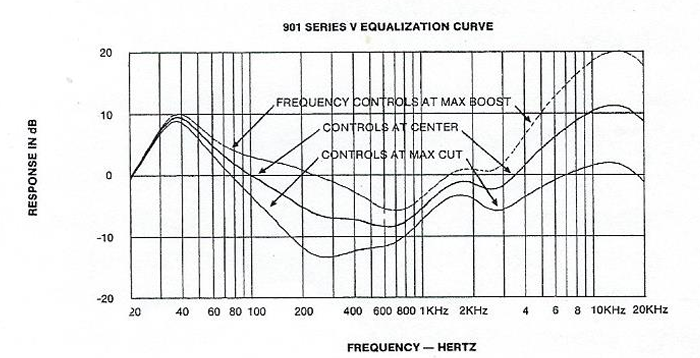
The less intense curve is also good for electrical reasons – +20 dB on a 1V signal would be getting up to about 10V RMS, which is close to clipping an op-amp on its supply rails, so there wouldn’t be much headroom. This series was released around the same time as CD players started to enter popularity, with their higher standard signal level, and so everything is designed to play nicely together.
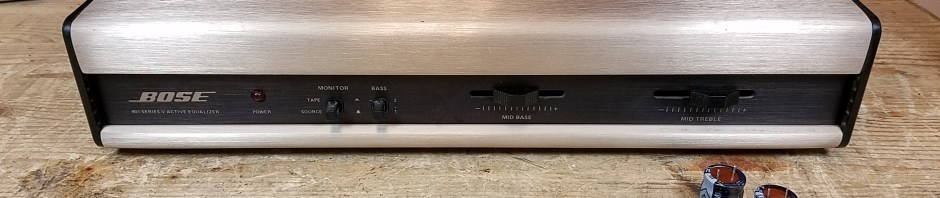
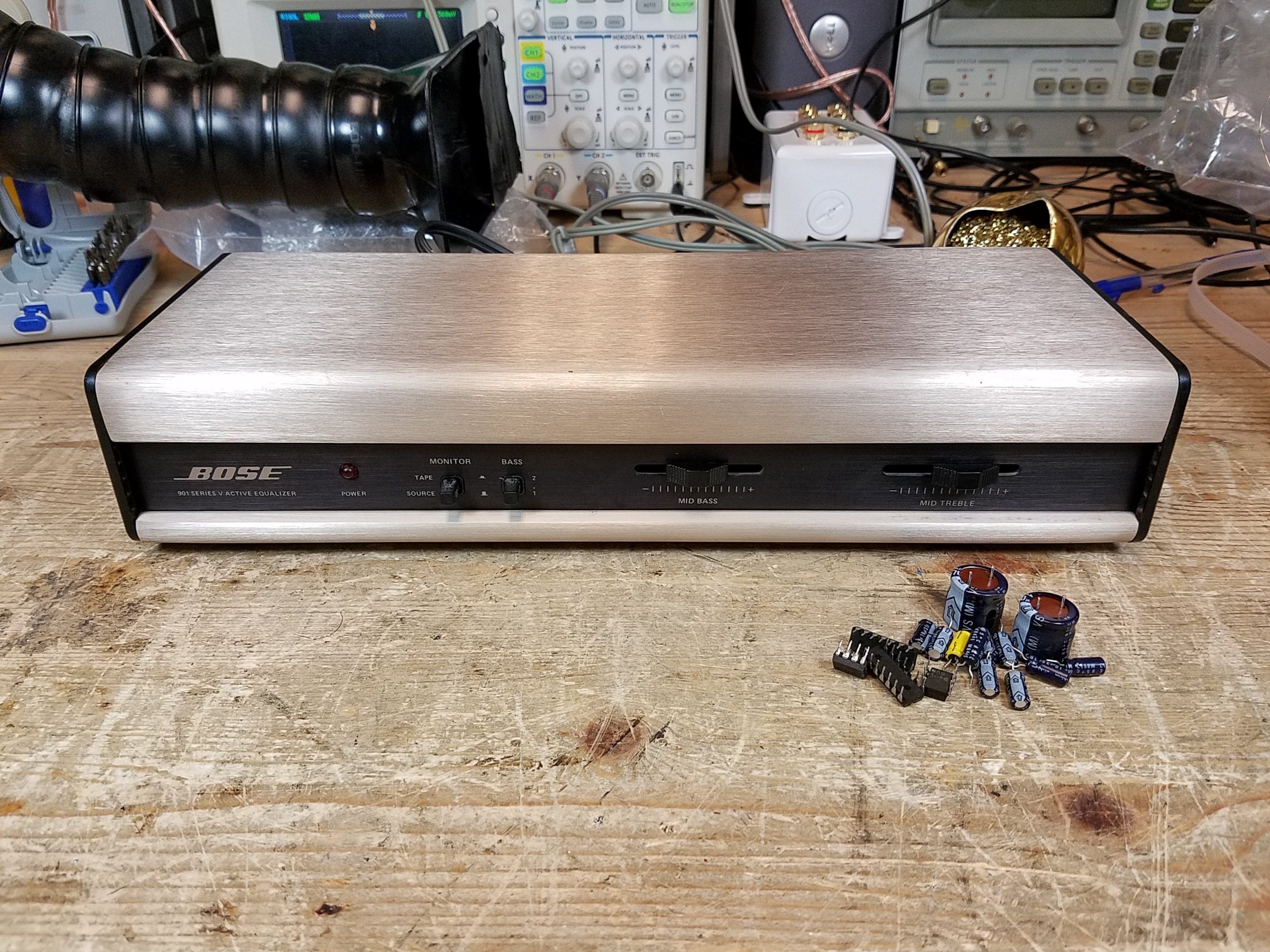
In addition to some electrical changes, starting with this series the equalizers have adopted the more modern look of a metal-cased device, and are basically fully modern internally. The case is now a wide aluminum chassis with a black control area, two pushbuttons, the Mid-Bass and Mid-Treble sliders, and an LED power indicator in place of the old neon bulb. The Bass switch has two positions, and position 2 gives an alternate low-end curve with reduced bass response which could be handy if you’re in a boomy room with a lot of echo.
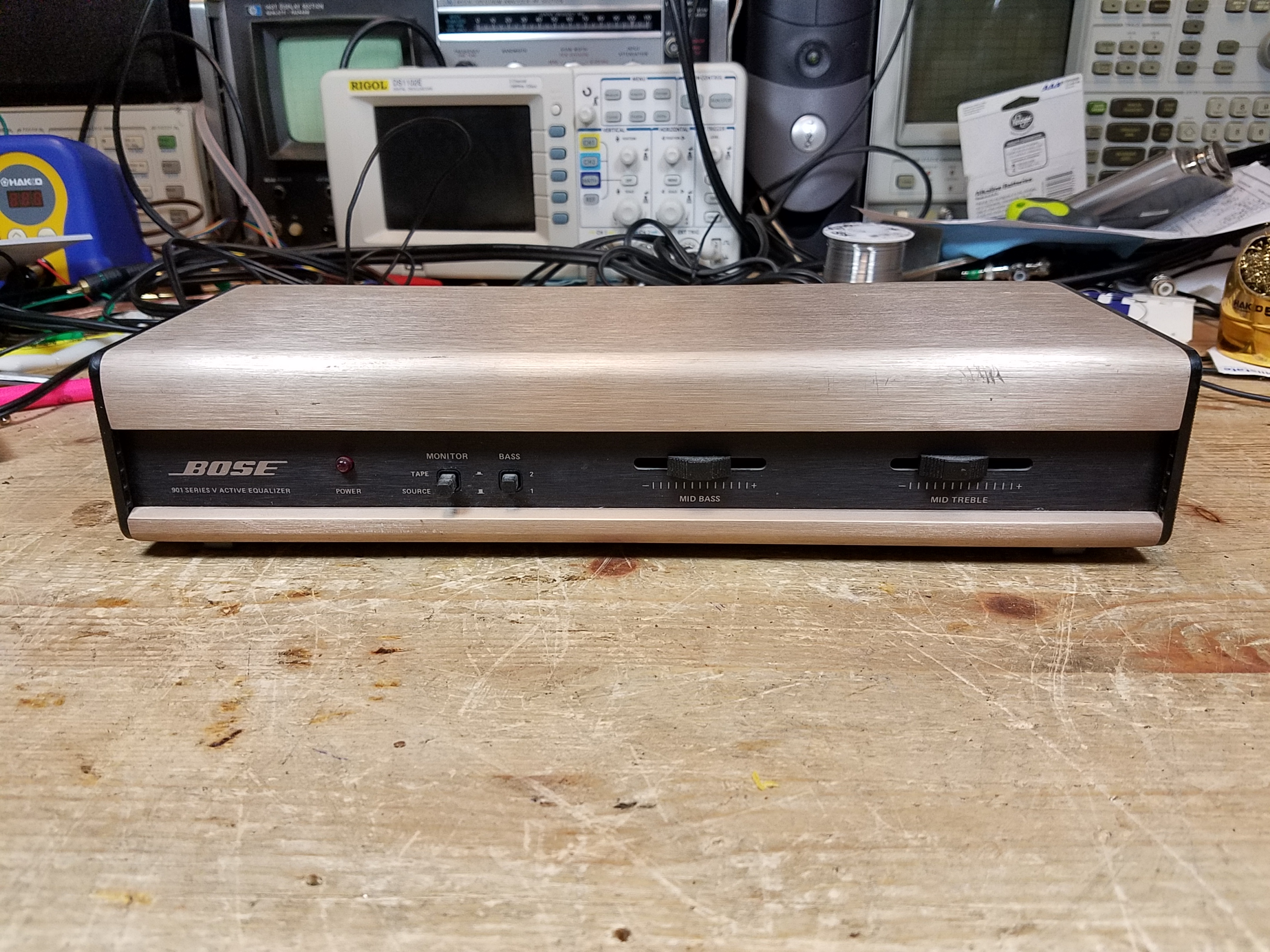
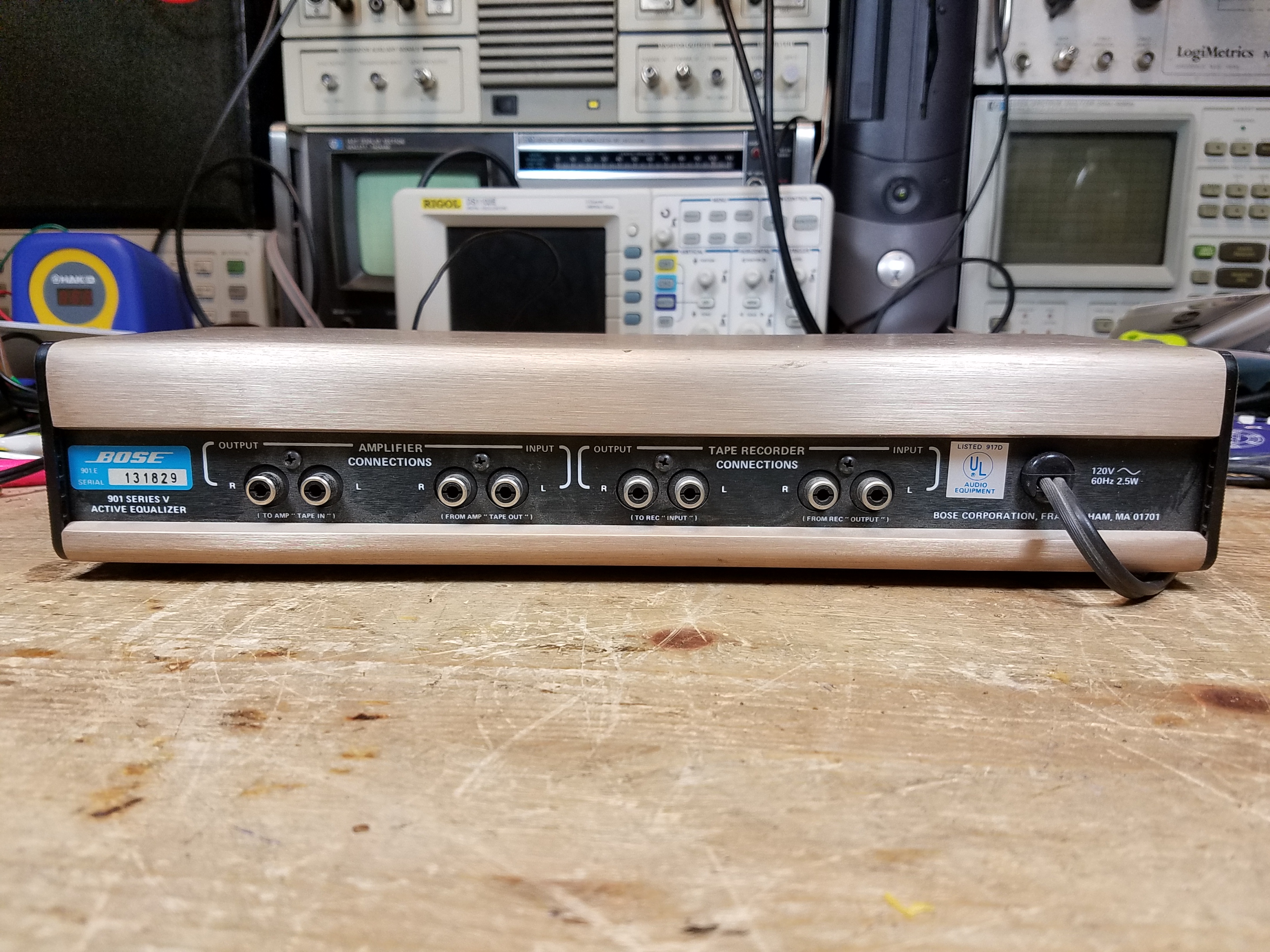
We’re using a fully modern, op-amp-based design in the Series V and later along with a regulated power supply for stability. The biggest change is the power supply: the Series V moved from the unregulated supply on the previous generations to a regulated supply for both the positive and negative rails. (If you’ve read the Series IV article, this is the same power supply that showed up on the late production “Series IV B” boards.)
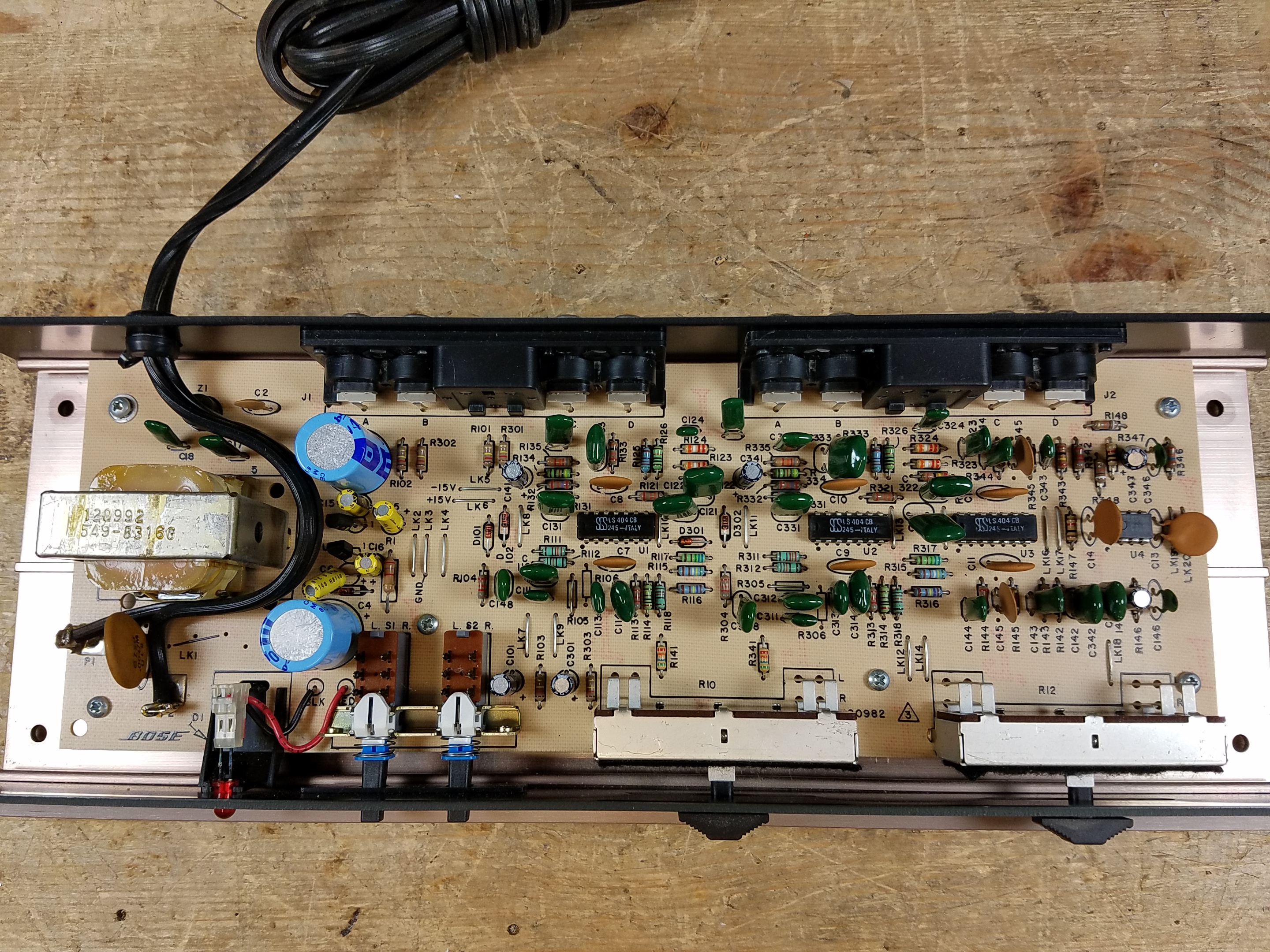
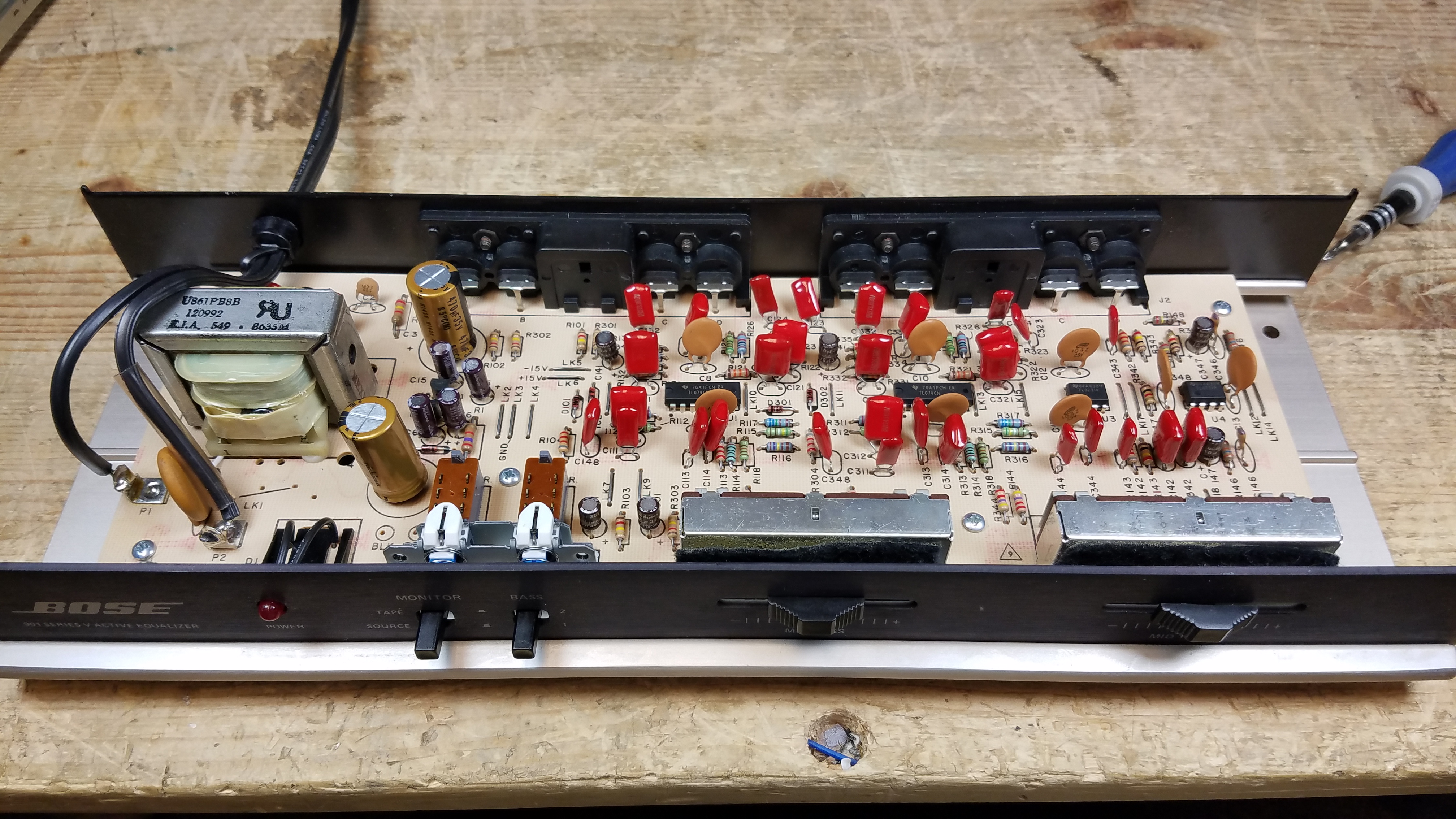
It’s quite easy to remove the board from the case to access the underside for soldering, just remove six screws and it pops right out with nothing further needed.
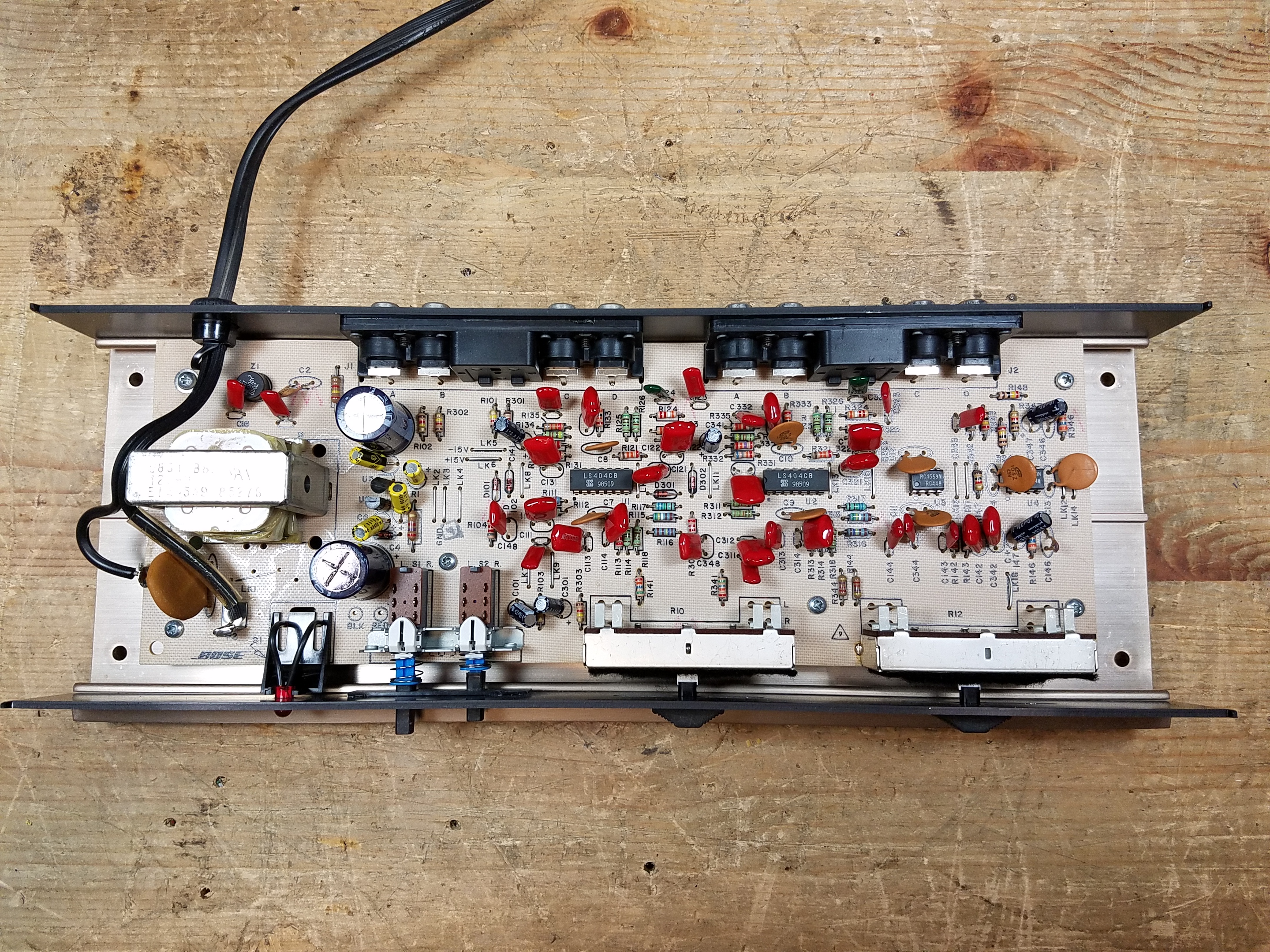
In general, you’re going to want to replace the electrolytic capacitors on these boards as parts that are around 40 years old fail, leak, and cause the equalizers not to work anymore. Each successive model uses fewer and fewer capacitors, so there are only 12 total to replace in this unit: 2 main filter capacitors, 4 power regulator bypass capacitors, and 6 in the signal path.
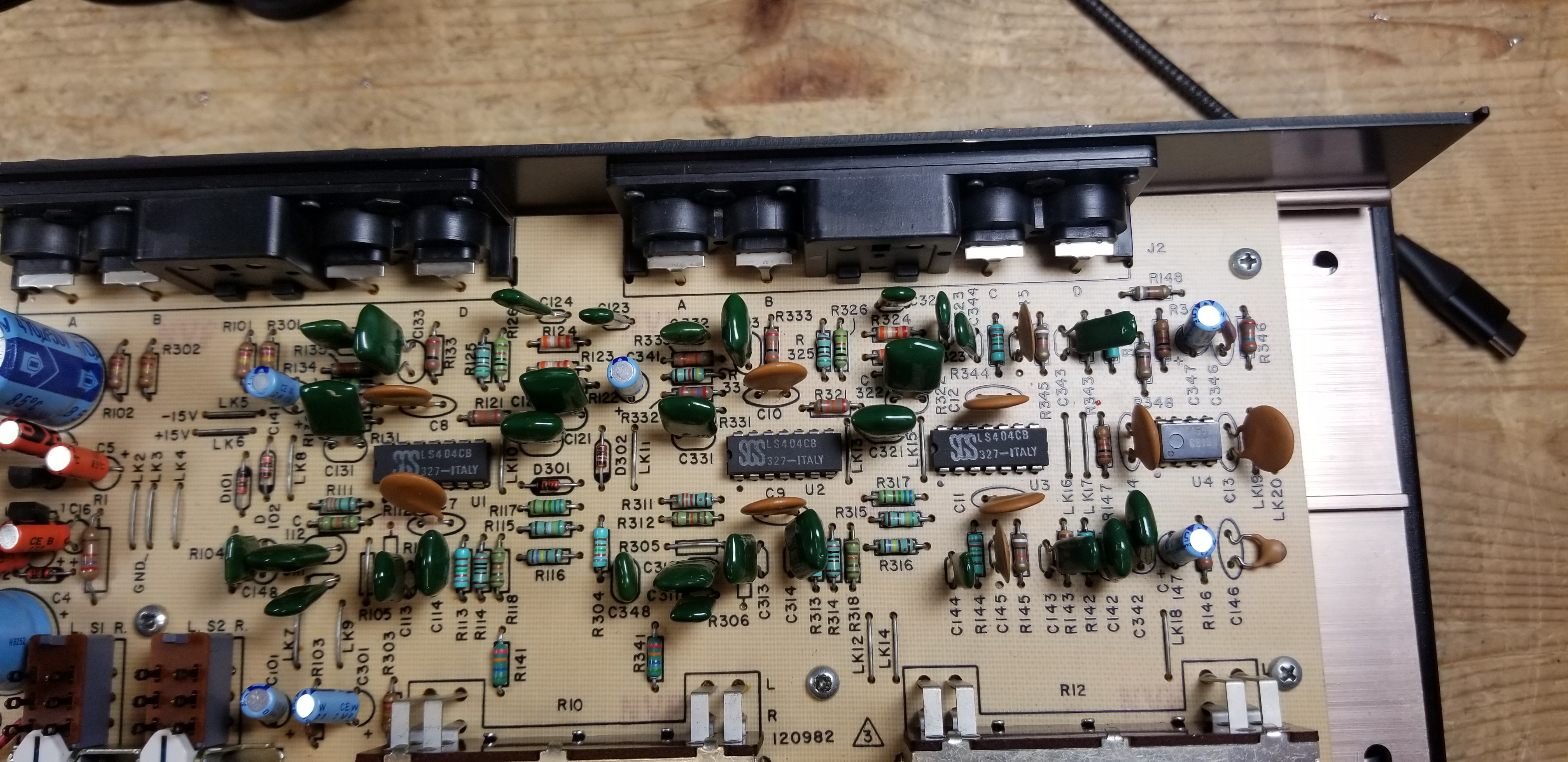
The Series V does also have one “gotcha”: the larger, LS404CB quad op-amps are highly prone to failure. Every single one of the 16 units I’ve serviced suffered from a high noise floor and popping/static in the outputs. For good measure, you should replace both quad op-amps and both dual op-amps while you’re in there. Use the TL 074 and TL 072 respectively.
Finally, I recommend using control cleaner on the switches and sliders and working them through their travel several times, then apply fader lube to the sliders to keep them in good condition.
With everything replaced, here’s what it may look like:
This is the final equalizer curve from a properly working Active Equalizer:
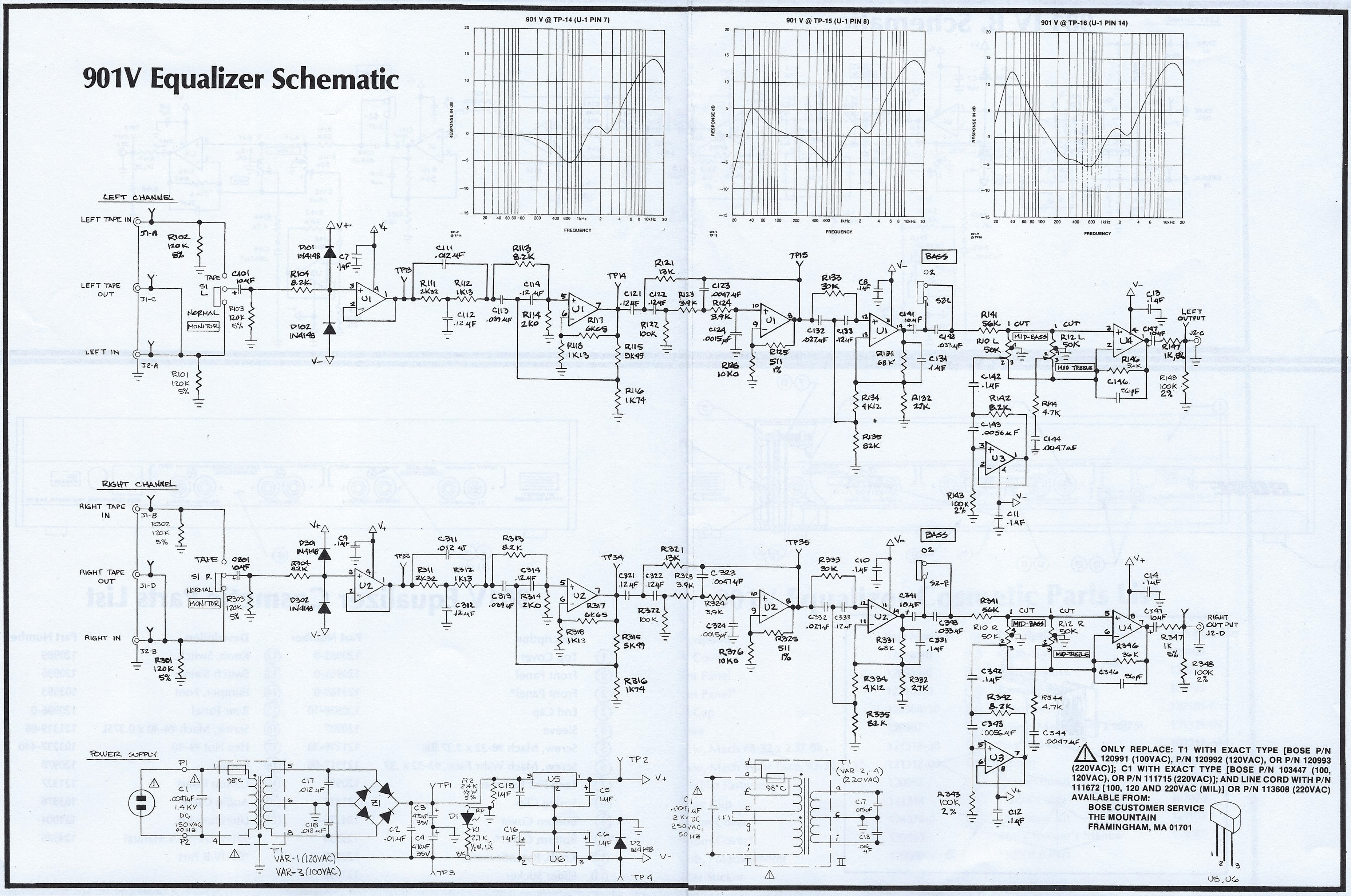
The service manual is available on HifiEngine, but I’ve reproduced it here as they’re often down or have registration blocked for new users:
The schematic is spread across a couple of pages, though, so I’ve edited it together into a single sheet which is easier while tracing signals. Click to expand.
Series V Active Equalizer Parts List
Here’s the parts list:
Mouser links were current as of 10/6/2026.
Series V Gotchas
Other than the LS404 op-amps needing to be replaced, there wasn’t really much to note for this series:
- RCA jacks: Generally stable, but I did run into one set where the solder connections to the board had cracked. Inspect and re-solder as necessary.
- By this point, these units used separate 120V/240V transformers and can’t readily be converted. (If you’re handy with Ohm’s Law, you could figure it out, but your best bet at that point would be a small step up/down transformer.)
The Series V is by this point expecting levels closer to the modern standard 1V line vs. the prior standard 150 mV line, so you’re less likely to run into sensitivity mismatch issues like clipping or excessive volume here, but there was a lot of variability in the stereo world at the time so it could crop up.
Other than that, the Series V is one of the simplest and easiest repair jobs you could run into – just a few caps, and the ICs, and you’ll probably be back in business. I never saw any with a more complex problem.
Conclusion & Postscript
Many Bose fans would argue that the Series V was the beginning of their corporate decline, as happened to many companies in the late 1980s. I only serviced 16 of these models over the years, compared with many more from before and after, so it’s not likely they sold super well. Bose was pivoting towards car audio and more inexpensive pieces by this time, and I had trouble finding much in the way of original advertising for this series.
I am not accepting repairs currently, but I hope this will help you with yours.
Mouser parts were correct and current as of publishing (October 2026). They may change over time. I’ve selected good quality replacement parts which I’d be happy to receive if I paid for the repair in another shop, and which I’d confidently use if I were doing commercial work at the moment.
A lot of modern amps don’t have a tape loop anymore, and there can be some issues with sensitivity mismatch on modern gear if you use the Bose EQ in the pre/main loop. That’s the only real downside. These speakers and their companion amp are best used as part of a vintage system. If you’re planning to use them with a modern system I recommend you first try using a modern EQ or the EQ functions built into your gear and crank the bass/treble; if not, a MiniDSP-based solution would be an OK bet but can require a little bit of know-how to program.
Leave a comment if you have a question, and I’ll try to answer as best as I can.
Other Resources
You can find my other articles about different 901 systems here:
Do you need a Bose Active Equalizer to go with your speakers? They turn up on eBay regularly. If you search and buy with our referral link, we’ll get a small commission on the sale to help keep the site running. Click Here to see what’s available right now.

