Flammable cargo was prohibited under the Washington State Convention Center on I-5 last weekend according to the large Smarter Highways signs along SR-520 in Washington, as there’s some sort of maintenance happening. There’s a highway advisory radio station on 530 AM and I tried to tune in to see what it had to say about it.
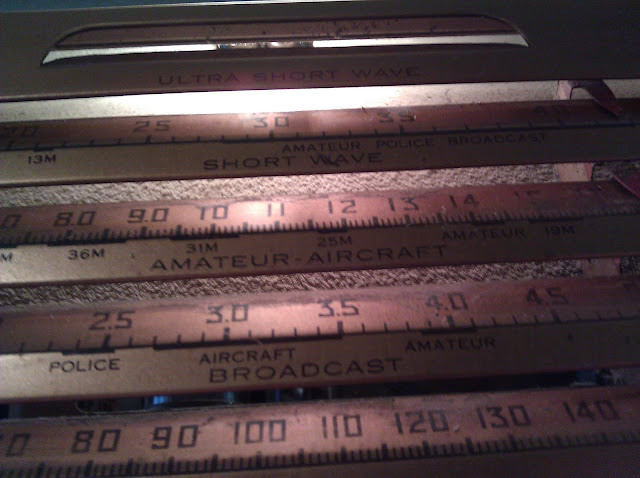
As it turns out, the station was completely unintelligible due to bad interference. I could just barely make out the fact it was a highway message, but not the contents, in my car radio. With my GE F-135 radio, I couldn’t pick up either so it was time to break out the big guns, my Hallicrafters 8R40 attached to an 85′ helical antenna and managed to bring it in quite clearly.
The station beat very closely with 530AM in my receiver making a very obvious beat note, but they identified themselves as a CBC station a couple of times and were playing PRI’s The World. Some digging about where CBC stations are located, and I was able to identify the interfering station as CBK AM 540, a 50 kW station broadcasting out of Watrous, Saskatchewan – about 1100 miles away!
High power stations can definitely propagate that far, especially at night – or further, an experimental station in the 1930 was able to cover the entire western hemisphere and was known to take requests from as far away as Buckingham Palace. There’s nothing that can be done in this case as the interference is coming from a licensed user in another country and happened due to natural atmospheric conditions. I guess the right thing to do is just hope there’s no important traffic information being broadcast during the nighttime DX window.
CBK-AM is the furthest distance AM broadcast station I’ve yet received. I should probably keep a map of some kind.
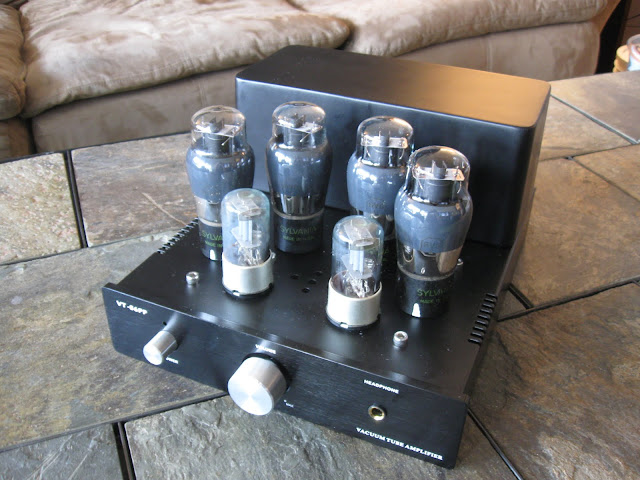
About a year ago, someone left a comment that really looked like spam on one of my pages advertising a web store selling tube audio gear and parts for guitar and audio amplifiers. Against everything I’ve ever learned about behaving on the Internet, and my better judgement, I ended up actually buying a kit from that vendor Mable Audio located in Shenzhen China. They have several kits available with a few options: 6V6 or EL84 for output, 6SL7 or 12AX7 for the input stage and also a beefier EL34/12AX7 amplifier for about double the price. They have a ton of components and guitar amplifier parts and kits as well.
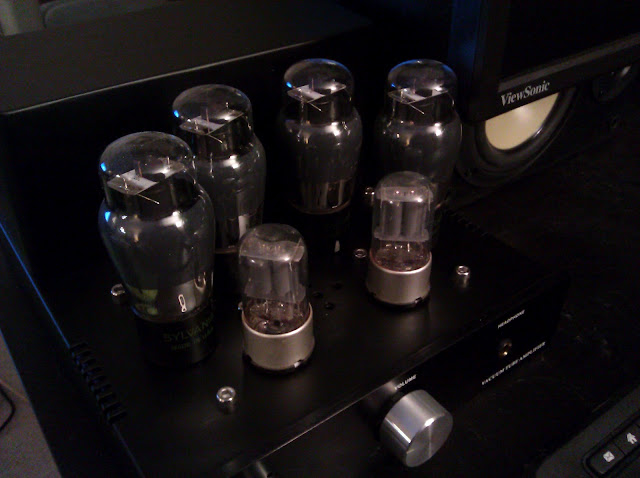
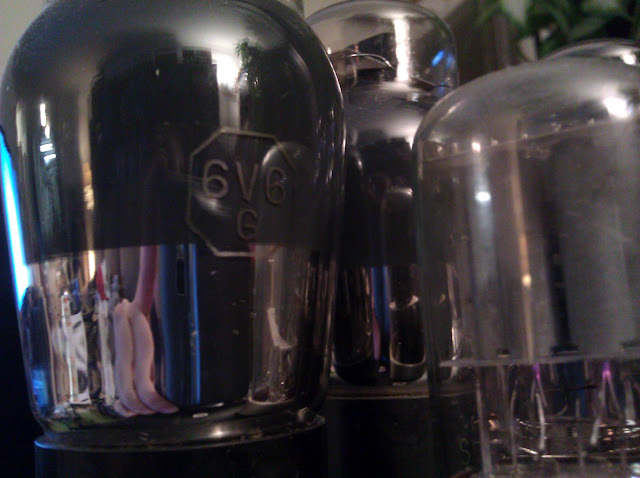
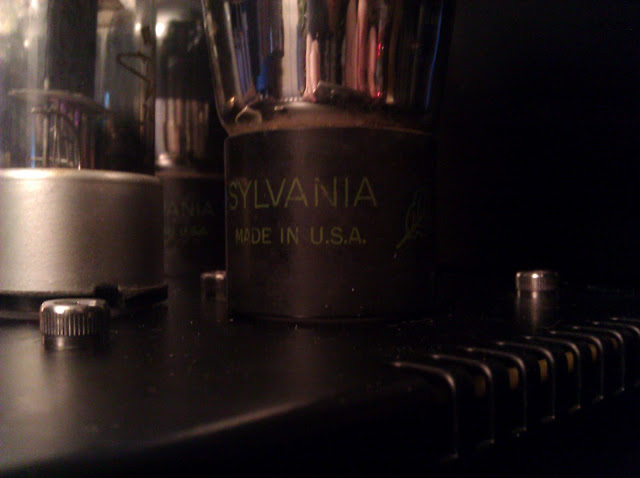
I selected the 6V6/6SL7 kit because I like the larger tubes, and had a set of 1937-issue 6V6G tubes that look more interesting than the small GT-style tubes it came with.
The kit arrived as a box of miscellaneous parts and the chassis. There was no particular documentation included, but the schematic was sent to me via e-mail. Also, the silver decorative plate (in the center of the photo) is no longer included in these kits despite being pictured, as I was told after I purchased. Not the end of the world, though. The kit included a large power transformer, two output transformers (23% Ultralinear), two huge 470uF 450V filter capacitors, all the needed tubes, signal capacitors, connectors, controls, high quality ceramic sockets and lengths of 600V-rated wire to assemble it all with.
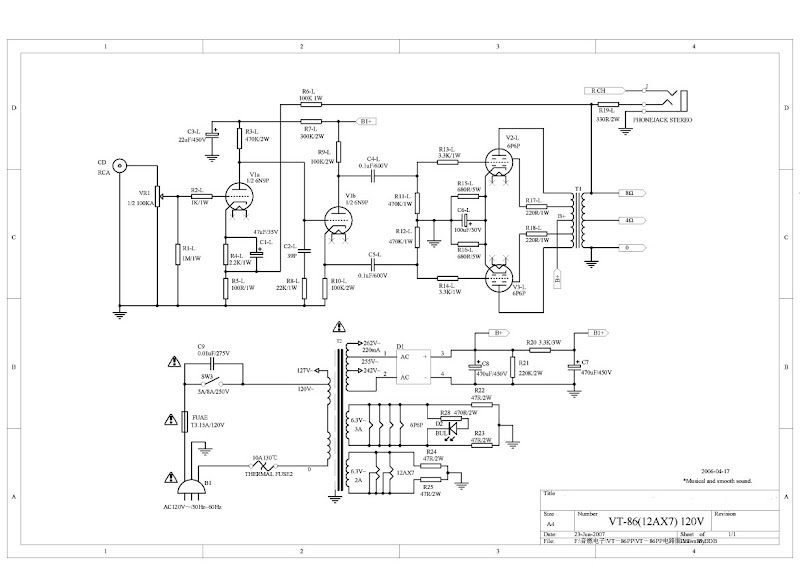
The amplifier itself has decent schematics, on paper anyway, although the output impedance is inaccurate on the datasheet: the datasheet, schematic, and transformer color code documents all specify multiple taps but the provided hardware only supports an 8-ohm speaker. This is acceptable, though, as most home theatre speakers are 8 ohm anyway.
INPUT IMPEDANCE : 100K ohm(RCA)
OUTPUT IMPEDANCE: 4ohm – 16 ohm 8 Ohm
OUTPUT POWER: 12w x2/(ultralinear)class AB P-P
DAMPING FACTOR : >3
FREQUENCY RESPONCE: 20Hz-20KHz(REF.OUPUT)
TOTAL GAIN: 28dB
INPUT SENSITIVITY: 300mV-600mV
S/N: >89dB (HUM NOISE <3mV
CHANNEL BALANCE: <1dB 20Hz-20KHz (MAX.VOLUME)
CHANNEL SERPRATION:>65dB 20Hz-20KHz
TUBE COMPLEMENT: 6P6P(6V6) X4
6N9P(6SL7)X2
POWER REQUIREMENT: AC220V OR 110V OR 240V + -5% 50~60Hz
Assembly wasn’t terrible, but the build quality of the chassis was marginal at best. The top surface of the chassis bolts to the chassis pan itself to hide mounting rails and dividers, and the holes on the top panel didn’t perfectly line up with the socket locations on the bottom panel. This meant that after mounting the sockets to the bottom where they belong the top cover wouldn’t slide over them because it was interfering by about 1mm on one of the sockets. It took significant pressure to force it on and made a very loud snapping noise when it did so, but the socket and cover were all intact. It’s definitely not coming off again, though. Additionally, the cover over the transformers is supposed to mount using several screws at the corners, but only two screw holes lined up.
The sockets are ceramic and the sockets gold-plated, and the transformers look appropriately sized, though, so it’s on to building past mounting up the parts. This project was a long time in the making, as I mounted the sockets and chassis up on July 12th 2011 and then did no further work until March 2012. I worked my way through the schematic, roughly right to left. This amplifier is a power supply, and two identical amplifier channels. I’d highlight on the schematic as I completed both mirror halves, and this made it easy to keep track of where I was going.
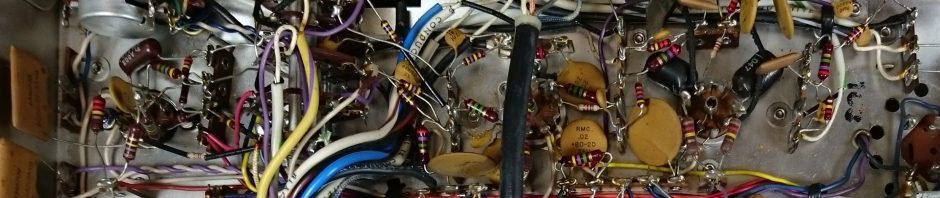
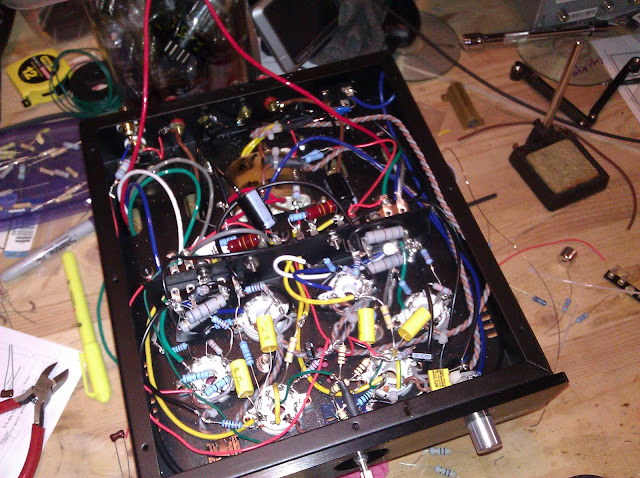
Some photos showing filling in the components:
After assembly, I had a few left-over parts:
A really weird assortment of leftover parts at that. I declined to connect the headphone output (on advice that it was probably not safe for any headphones that I might actually like due to the connection – not unique to this amp, many other circuits have similar issues) which accounts for 2 of those resistors, but there’s still 13 more + a small capacitor that weren’t called for anywhere. And there are two extra panel-mount RCA input jacks. And a ton of extra wire. But for all the extra they did include, there were 4 resistor types (8 resistors total) that were not included, I had to run down to a local hobby shop for a few replacements. Not sure what to make of that.
I elected to replace the LED power indicator with an NE-2A neon bulb instead, so it would be the same color as the glow of the tube heaters.
There is a minor issue with this one, though. There is an anti-arcing capacitor across the switch. I placed the NE-2A between the switched side of the switch and the AC neutral (it runs directly from AC mains through a 150K 1/4W resistor). With the switch turned off, the capacitor allows AC leakage of a few mA to pass to the cold side of the switch. The current leakage is less than the excitation current of the transformer, so the transformer appears “open” to the low signal as it’s entirely eaten because it’s not strong enough to set up a magnetic field. This causes the current through the 150K resistor and neon….so the bulb lights up when the power is off, now. With the power on, the capacitor is out of the circuit and the transformer is an extremely low impedance, so all the current goes through the transformer primary and none into the 150K resistor and the NE-2A bulb. The result? The power switch indicator is backwards. The light comes on when the device is turned off, and goes out when you turn it on. I intend to fix this at some point, but am not entirely sure what the best approach might be. The volume control itself is abysmally low quality, probably the only part in the kit I actually think is just plain “bad”. The return spring is weak and the switch touchy and it binds up easily.
There was also another issue: I wired the volume control backwards. “Right” is lower, now, instead of “Left” as is the convention. I evaluated fixing this problem, but while poking around one of the volume control’s pins started coming out of its molding and I didn’t want to risk destroying the control, so that’s a problem that won’t be fixed in this iteration.
I did a quick visual for obvious shorts and powered it up the first time with the 6P6P (Chinese 6V6GT) tubes which were included, as I didn’t want to risk my classic tubes. If there’s going to be a problem it’d be on first power up, for any amplifier from anywhere. The transformers all made a great *THUNK * noise when they energized for the first time, but quickly de-energized again. I poked around some more and found I’d missed a solder connection on the bridge rectifier. I soldered it back on and tried again and everything was fine! First power-up successful, with no re-work needed.
Then again on the test bench with the 6V6G tubes:
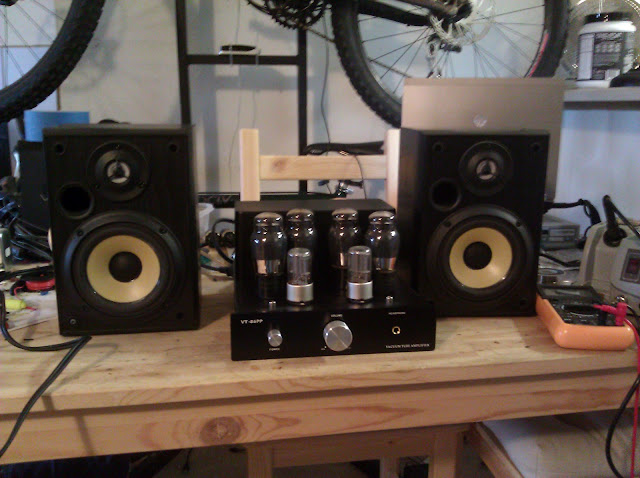
Still good! And for some post-production glamour shots:
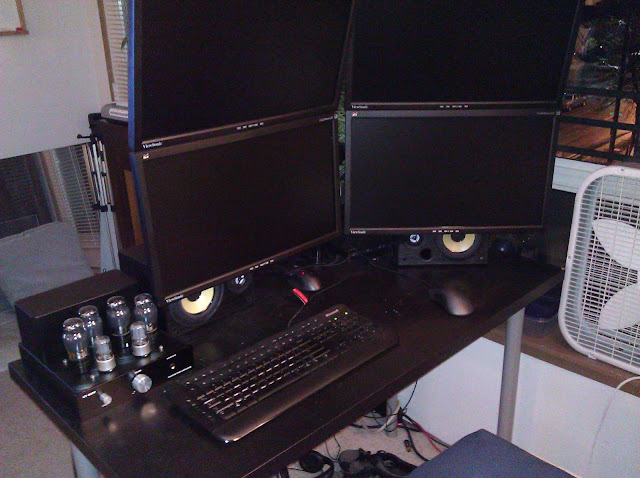
Now, I’ve moved the amplifier onto my desk and will use it for personal stereo when not using the Surround Sound receiver.
In conclusion: Mable Audio is a reputable supplier. Their product sounds great, and was of acceptable build quality for an entry-level amplifier. The chassis and platform itself will be a great starting point for more modification projects in the future. I rate this kit as a 3.5/5 due to the mechanical issues with the chassis fit and the power switch, but the electronics quality and circuit design seem to be solid. I would recommend this kit to anyone who wants to build an inexpensive tube amp from parts – but, given the complete lack of instructions or documentation beyond a schematic and some color code diagrams, make sure you go slowly and check your work and are somewhat familiar with how to read electrical schematics.
Pro: Inexpensive for what it is.
Pro: Good quality components, for the most part.
Pro: Attractive styling.
Pro: Fairly straightforward build.
Con: Terrible quality power switch. Just terrible.
Con: Mechanical fit on mine wasn’t the best.
Con: Only 99% of the parts in my kit were the right ones.
For $175 + shipping from China, it’s not a bad deal. Similar kits from more well-known sources, or U.S./European makers, run at least double the price. Once assembled, it’s very attractive and has a lot of potential for future upgrades. This was a fun and rewarding project and a nice change of pace from vintage gear while still keeping the tube connection.
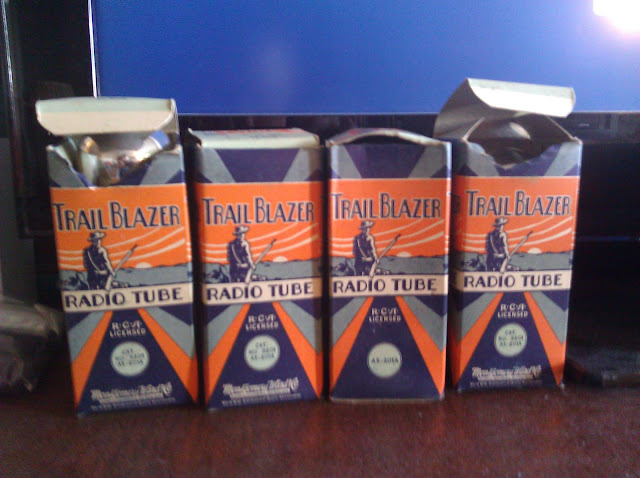
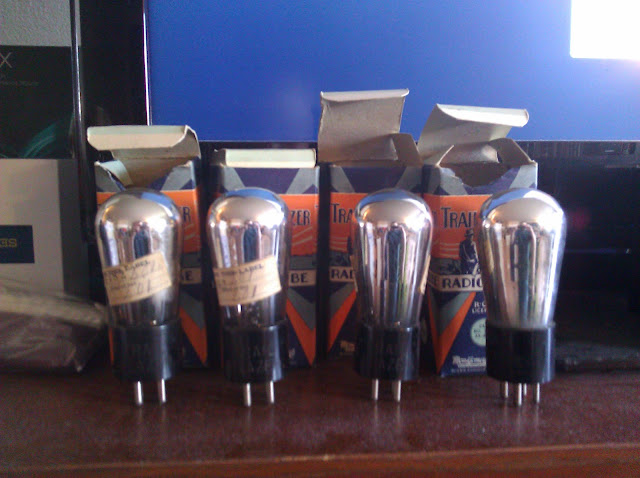
I took a gamble on a box-lot of parts from Craigslist, and it turned out to be an excellent find. One of the things I found was a collection of tubes in their original boxes from 1926.
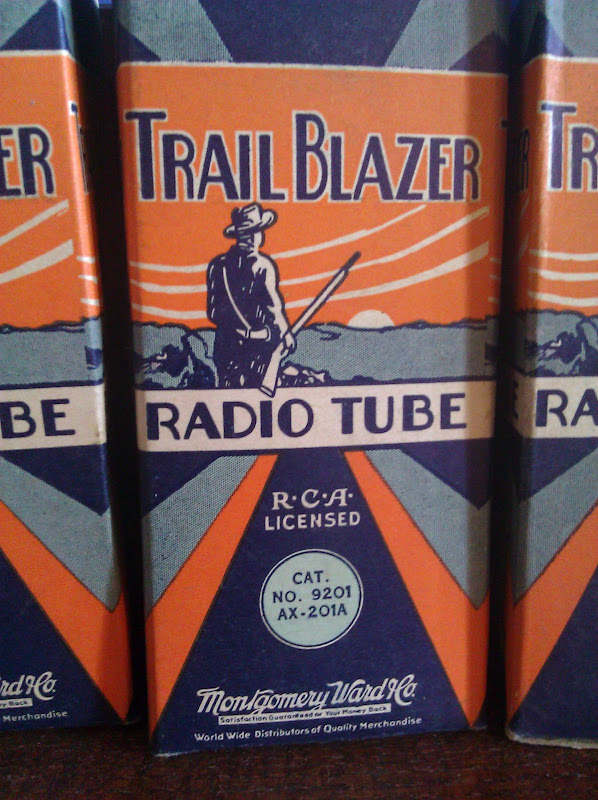
That doesn’t happen often. The art is in great shape. Back in the ’20s tube box art was a lot more eye-catching than when tube industrialization had completed by the ’30s and this is just one of the examples.
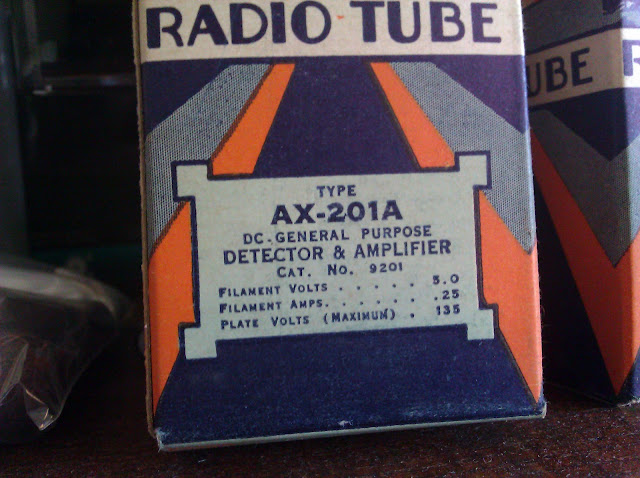
The RCA UX-201A was one of the first mass-produced vacuum tubes released to the public and was in common usage through the ’20s. Back then, companies were able to copyright the number sequence so many tubes had different first numbers and prefixes…Cunningham made a CX-301A, Arcturus had a 401A, Montgomery Ward licensed RCA’s number and called in an AX-301A…you get the idea.
I started this radio a few days ago in Part 1. I left off with the radio up on the bench ready for service. It had a lot of issues with the power supply – and as I discovered while working, some shipping damage: the volume control wires, and one wire from the power switch, had snapped. There was a fair amount of bad workmanship in the radio everywhere which contributed to that happening…you can’t expect much from a 50-year-old cold solder joint after all. I repaired it back to schematic along the way.
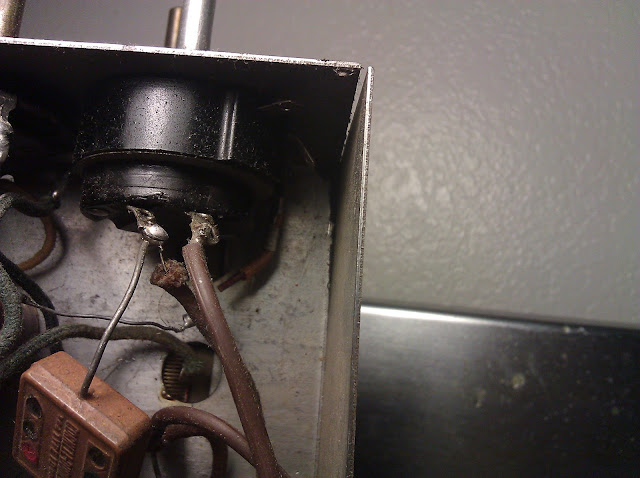
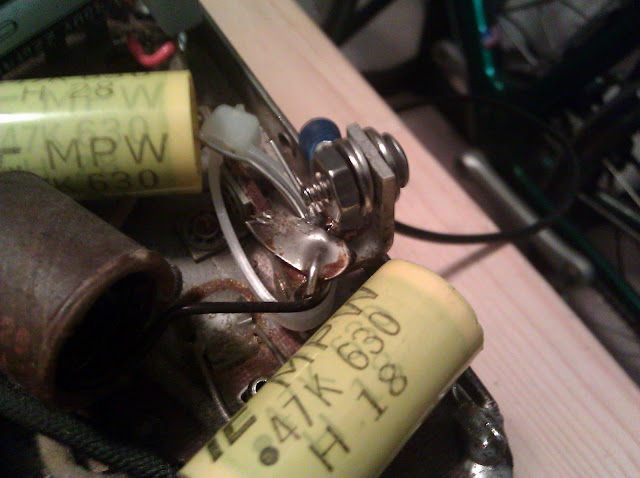
You can see some of the damage here where a 150 Ohm flex resistor broke. This could have been shipping or age but the combination sure didn’t help it.
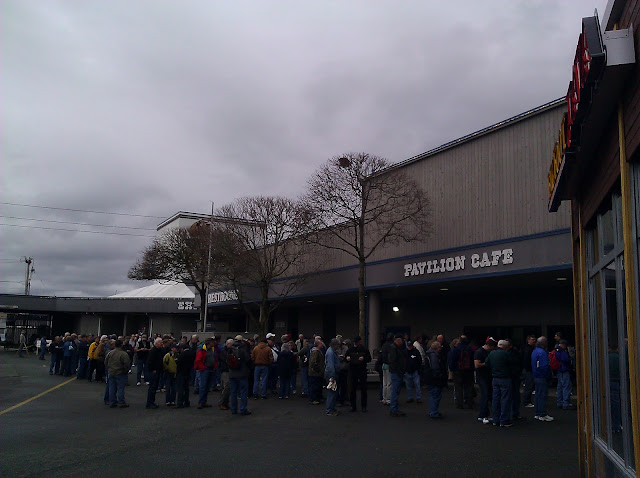
I went to the Mike and Key Electronics Show and Flea Market today down in Puyallup to replenish my stock of parts and hopefully find some new ones…actually, I’m pretty disappointed. I had a very long list of parts I was hoping to find, the sort of things that are in everyone with a real workshop’s stockpiles. Quite a few had some elsewhere, or didn’t think to bring any, but I ended up not finding anything. I did pretty well though getting four front end sets (6A7 6D6 75) and four of each #41 and #42 output tubes, as well as a bunch more of various numbers mostly from $1 working-pulls bins. I don’t have any photos inside, but here’s one of the line to get in.
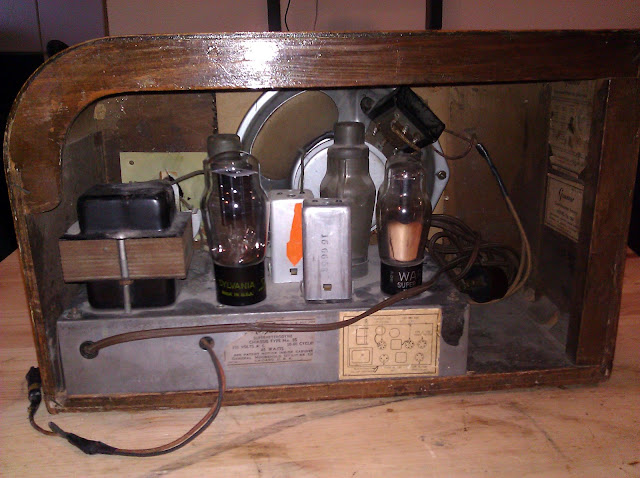
I pulled out quite a bit from the radio.
And for the first power-up.
I wish I could say it worked at this point, but it didn’t. I took the tubes out to test and found a 6A7 that tested just marginal but with no other issues. This really should not have been a show-stopping issue, but it seems it was as when I replaced it with one of the tubes I’d picked up earlier in the morning it fired right up.
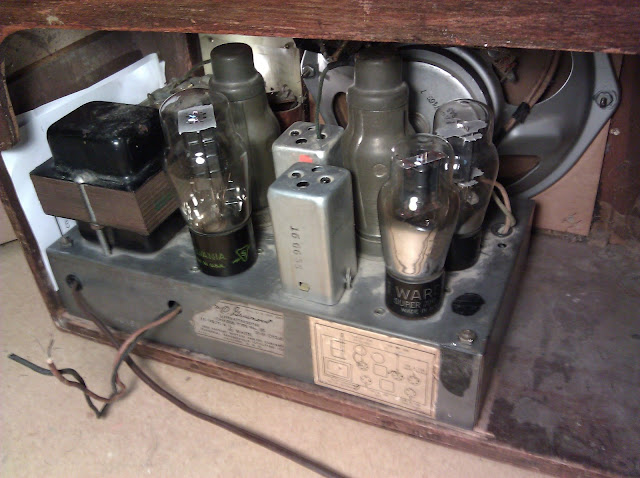
Another shot for fun of the bottom:
At one point in the radio’s past, the IF transformers were replaced with service parts – in this case with Meissner universal coils. They work just fine and I’d really like to know what happened to the radio to need both replaced. It’s the first radio I’ve worked on which was in the shop so many times for what looks like major surgery.
Time for an IF alignment. I decided to broadly tune these for a little better fidelity at the expense of some selectivity which was going to be bad anyway. I tuned the secondaries to 465kHz and the primaries to 455kHz. This should give about 10kHz of bandwidth to pass as much of the signal as possible.
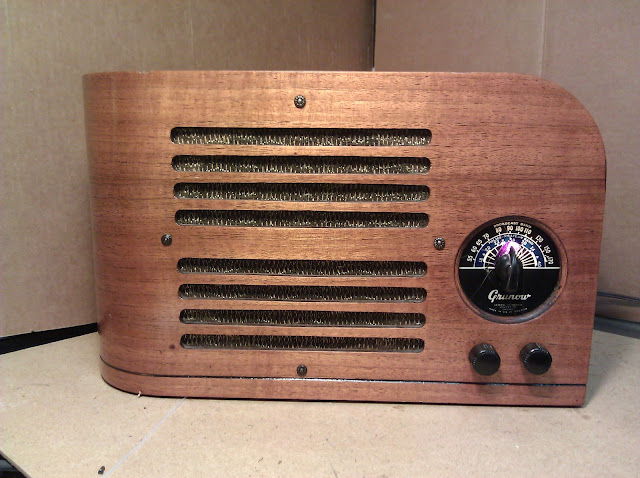
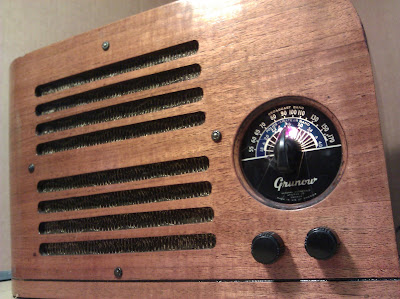
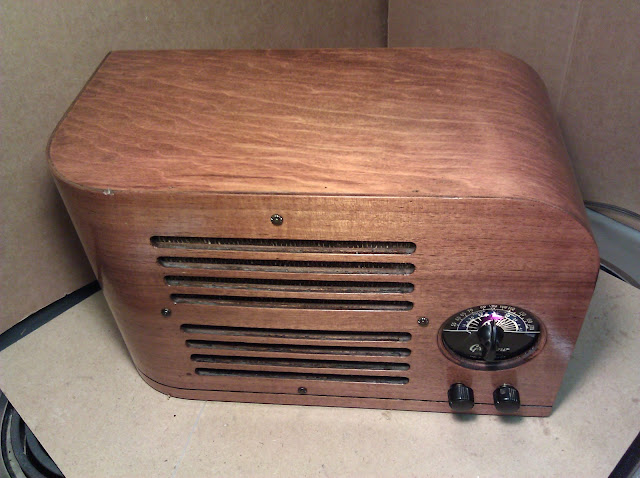
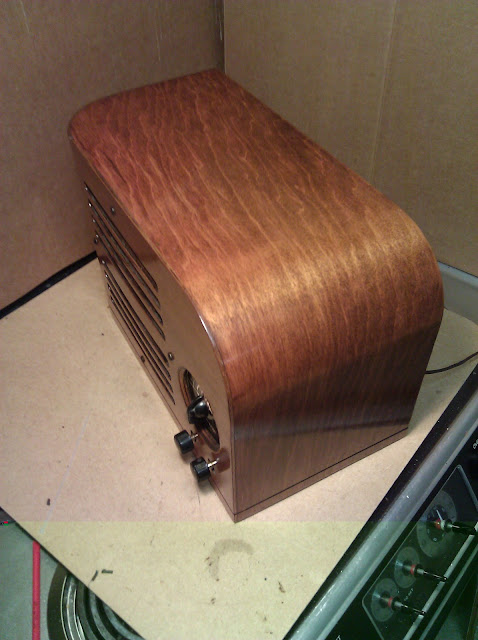
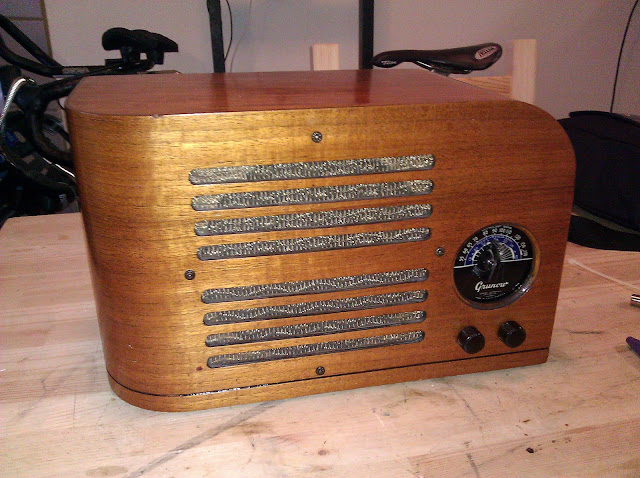
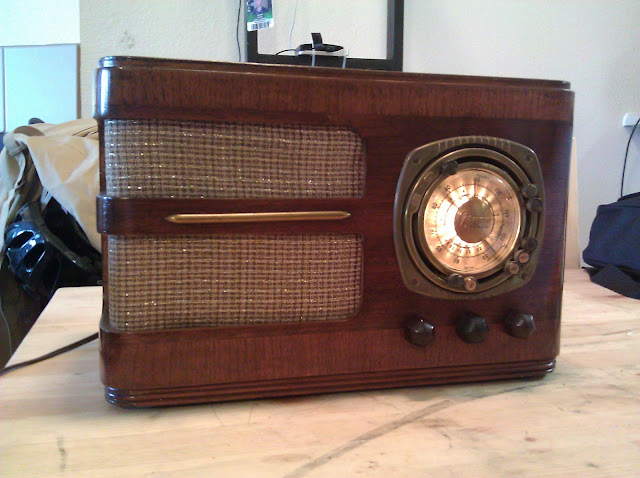
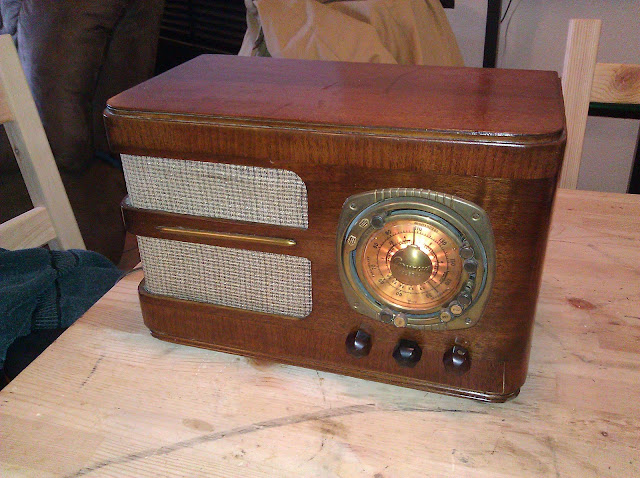
With that, I reassembled it and took some photos in front of a makeshift backdrop made out of cardboard boxes.
This one came out with an interesting camera glitch, but it’s below the radio itself so I’m leaving it.
This one needed some interesting troubleshooting to get it to work but most of the issues were things I spotted while looking it over initially, so I didn’t waste a lot of time on it. The radio has a really big speaker and is very powerful and sounds as good as it can sound so I’m glad I broadly tuned the IFs. This was a fun project with the bit of detective work involved in fixing mistakes.
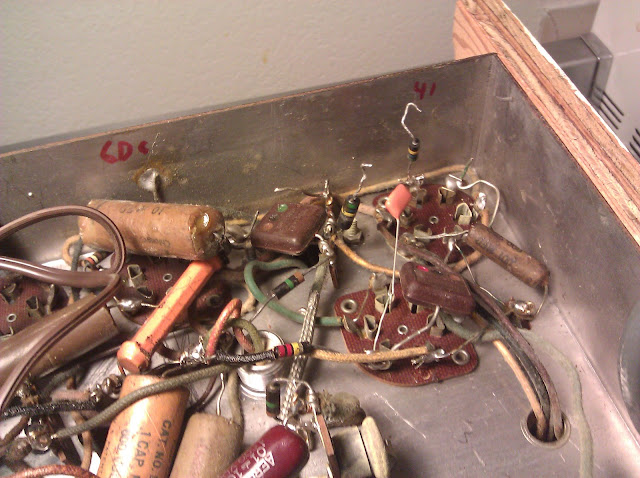
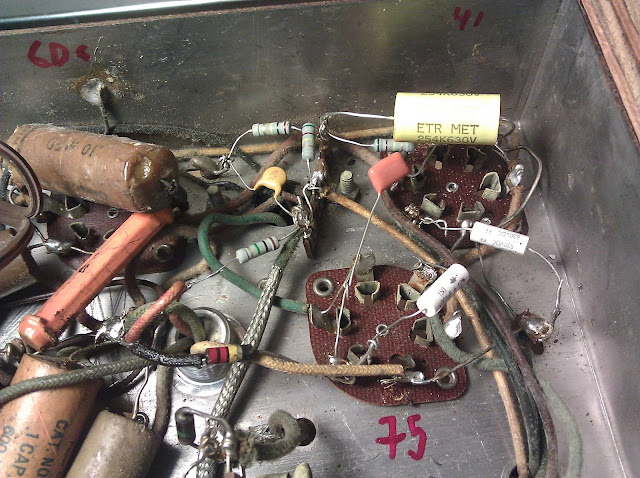
I’m off to a good start for my March projects, fixing up the Grunow 588. Next up is my Grunow 566 from the year before, from 1936. I picked this one up from eBay in shockingly good original condition – it looks almost brand new. Digging into it, though, it turns out I have a bit of work ahead of me. Someone’s been in this one – several times – and has made several modifications of somewhat questionable workmanship, to put it nicely.
This one is an even simpler radio than the model 588; it’s still a superhet but this model has no AGC (automatic gain control) on the front end. The tube line-up is 6A7 6D6 76 41 80. Most of the other radios I’ve serviced have a #75 in the 3rd position (a double-diode + triode tube); the #76 is a single triode only. The lack of the two diodes accounts for the lack of AGC. This does make it a simpler circuit to work on, though, as there are several fewer capacitors and resistors that would otherwise be on the AGC line.
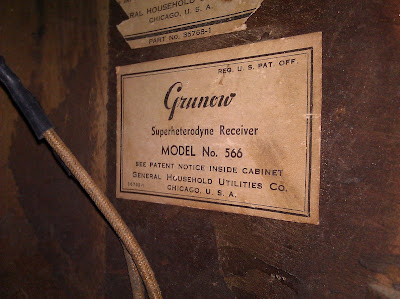
The chassis is very clean and both tubes that need shields have the originals present. Finding missing tube shields is a real pain. The chassis tags are in good shape too, this was the only model to use the chassis 5-S:
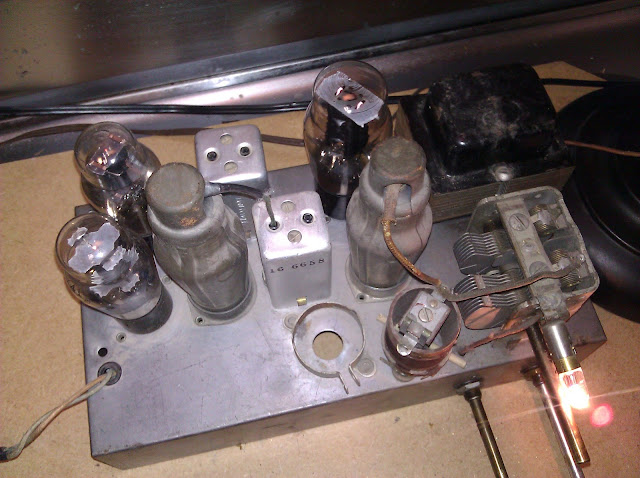
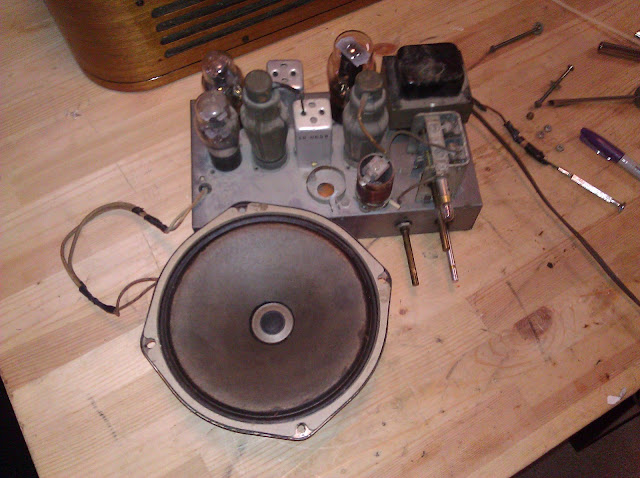
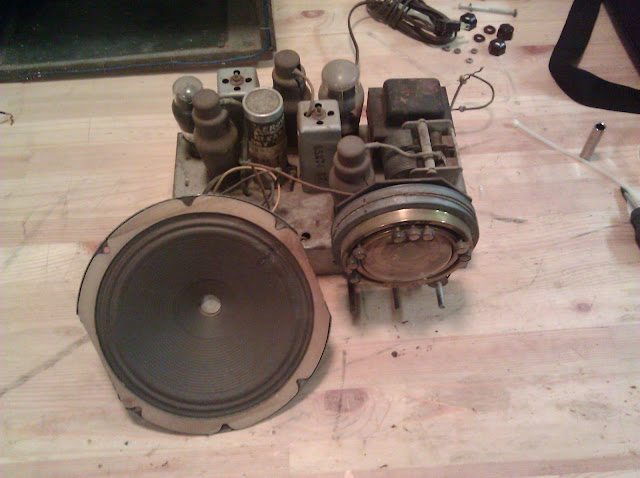
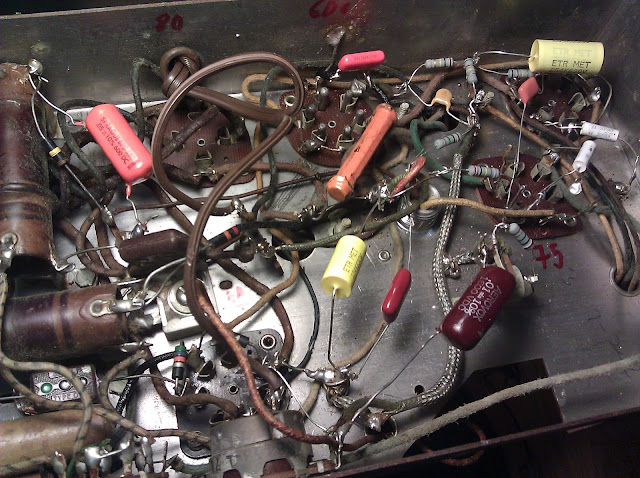
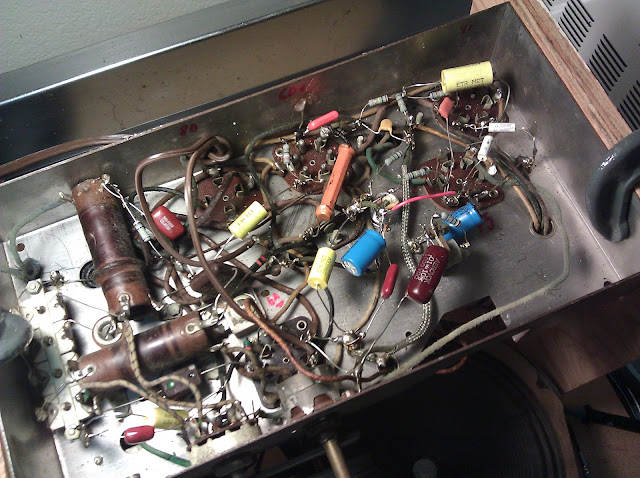
Pulling the chassis out, it’s easy to see what I mean about it being messed with before. The electrolytic cap which usually clamps to the top of the chassis is missing to the left of the front coil:
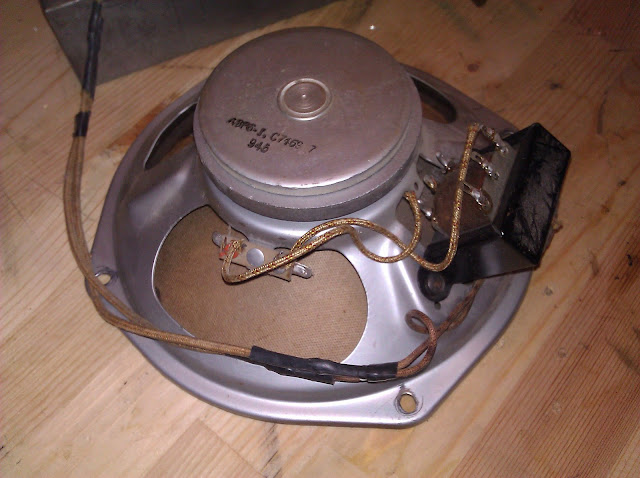
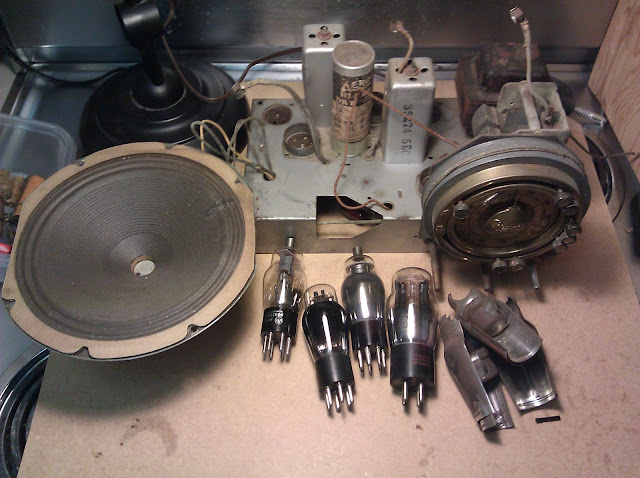
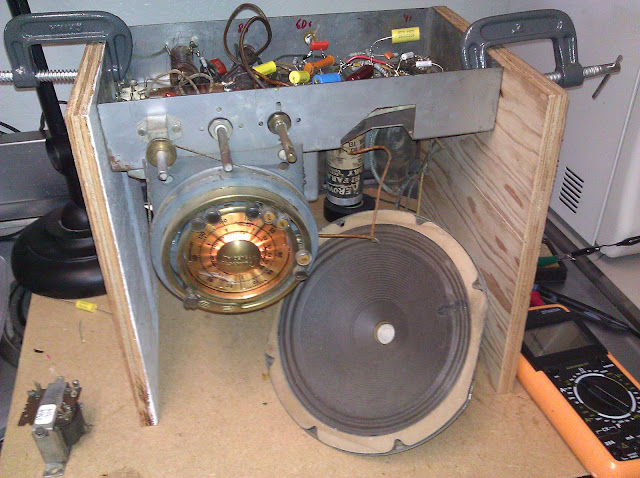
There’s also something about that speaker…it’s been replaced! The original, correct, speaker for this model is an electrodynamic speaker with a field coil. Field coil speakers were used before materials science advanced to the point of giving us reliable and powerful permanent magnets, where the magnetic field for the speaker was powered by a high voltage passing through a large coil. Electrodynamic speakers required four wires to operate (two for the field coil, two for the voice coil). This one only has two!
Someone replaced the speaker with a rather large permanent magnet speaker. The original speaker had a hum-reduction coil which doesn’t exist on this speaker, so it’s been eliminated as well. Granted, this one might actually sound a little better than original, but it’s a big change. Swapping a field coil speaker for a permanent magnet speaker also leaves the issue of the field coil, which is a part of the power supply circuit and is necessary for the radio to work.
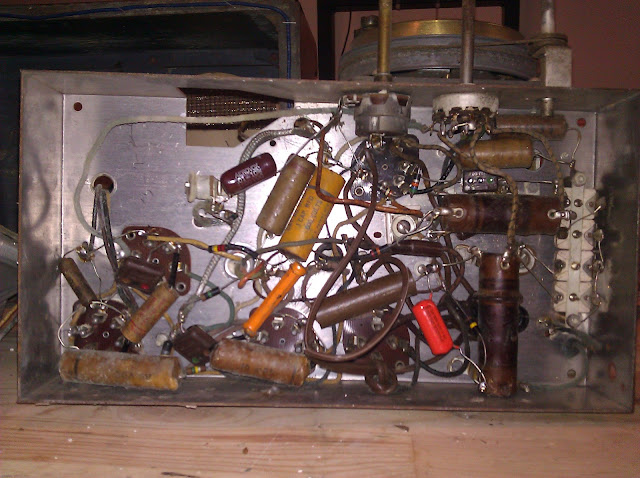
The previous owner replaced the field coil with what looks to be a much-too-small resistor in its place:
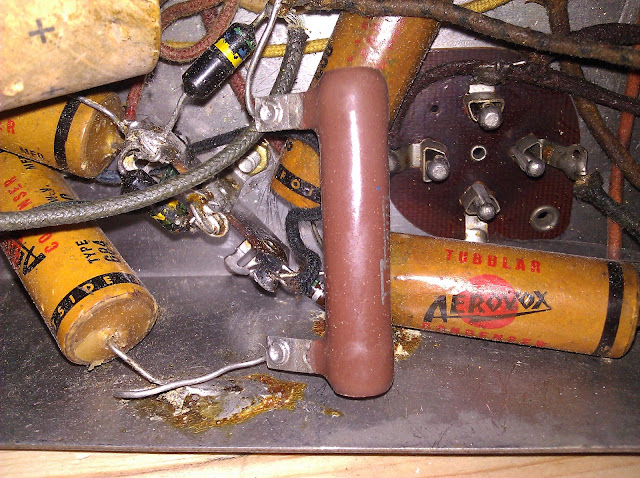
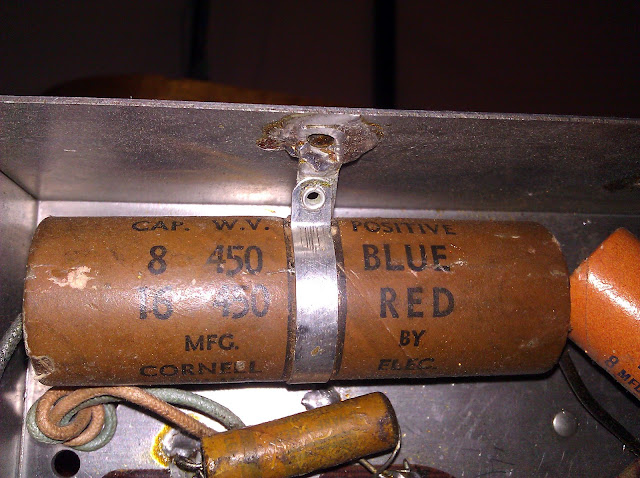
I’ll have to check the tube datasheets to see what kind of current they’re drawing, but that may need to be replaced for safety and reliability. Even worse than these mods, though, is what happened with the power supply. Parts failed a lot back then, it was just a fact of life. When the filter caps died the first time, the external filter was replaced with one under the chassis:
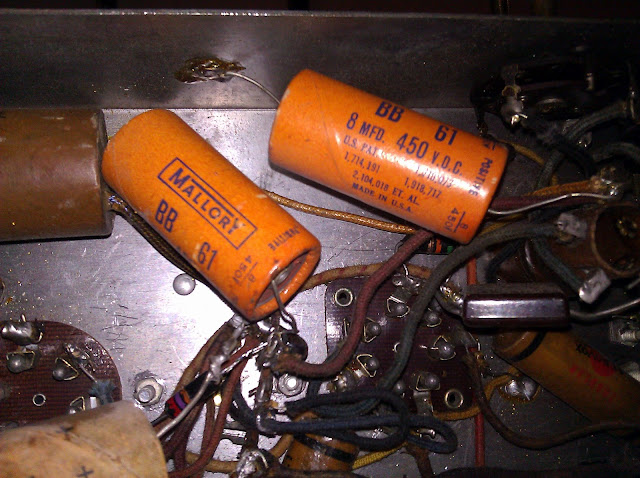
When this cap failed, it was replaced by two more caps – put in the circuit across the old caps, without removing them.
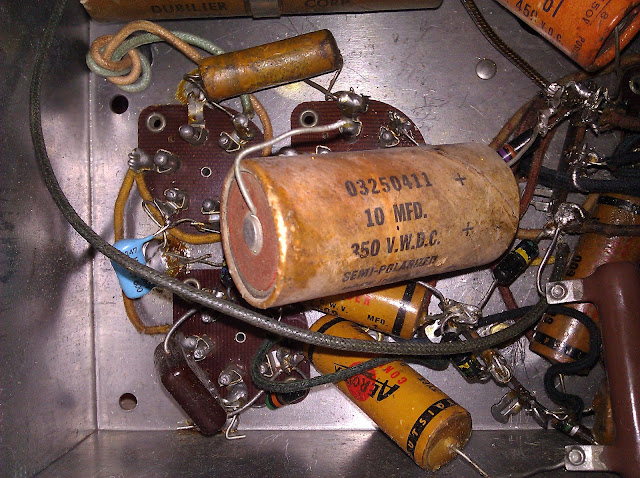
When one of those caps started failing, it was replaced by another also just tacked in across the failed point. And arriving with one end broken off.
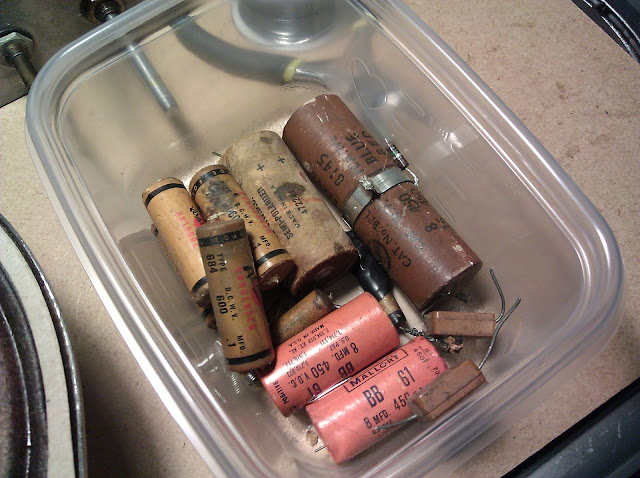
I’m somewhat curious what “Semi-Polarized” means, but suspect it’s just a quirk of older manufacturing methods. Regardless, though: this radio which is supposed to have only two electrolytic filter capacitors currently has five installed. I’ll be cutting them all out and sanity checking the entire power supply.
The age of the parts used in these repairs leads me to believe it was modified like this sometime in the late 1940s up through the ’50s, which makes it somewhat authentic if not original. I’m going to fix it up as well as can be but don’t plan on reversing the speaker-swap and we’ll see how it goes. Stay tuned!
I finally had a free day with no major commitments and was able to finally get some work done on my projects – it’s been a productive day.
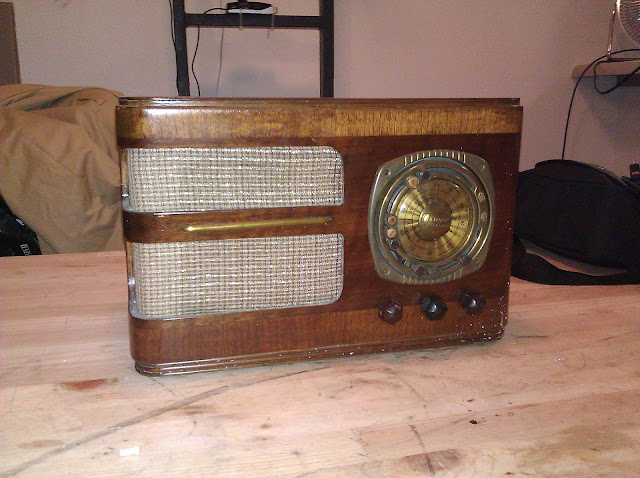
I picked up this nice example of a Grunow 588 “Teledial” radio from the General Household Utilities Co. a few weeks ago and finally got a chance to work on it after a busy month. It’s a nice little five-tube radio that shares a lot in common with the Grunow 589s I’ve serviced in the past. It has a very nice original finish, original knobs, pointer and dial cover in good condition although covered in bits of packing material.
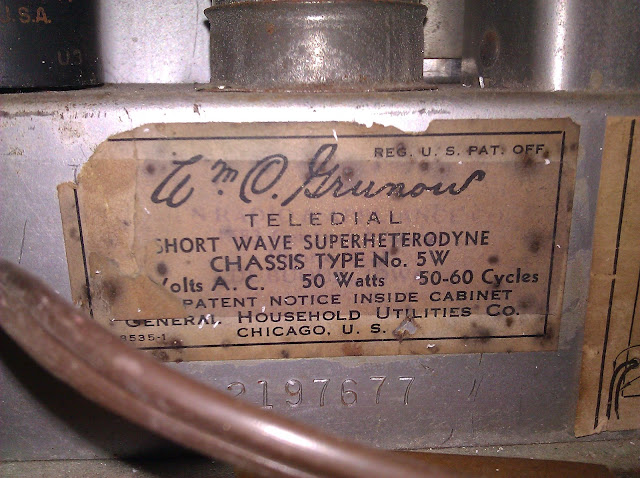
The Grunow 588 uses Chassis 5-W, which is also shared by Grunow 583, 585, and 586 radios. The tubes are 6A7 6D6 75 41 80. Nostalgia Air has the schematic for free from Rider’s 9-2.
The labels are in good condition for the most part:
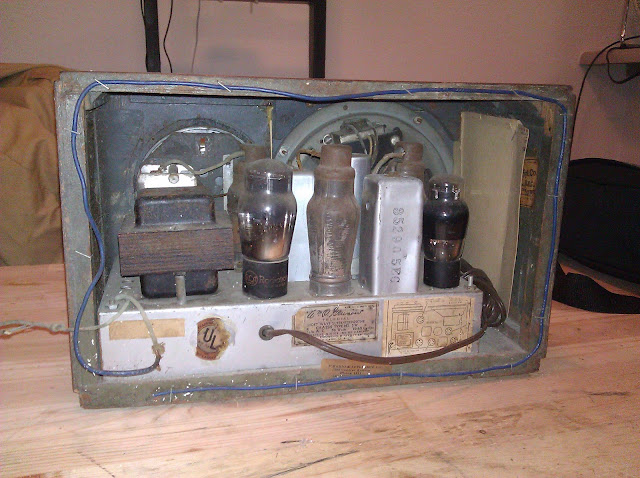
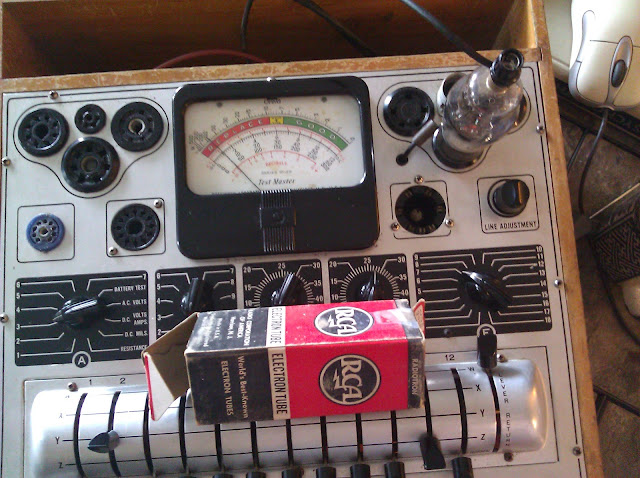
The radio has all the tubes and shields intact. I tested the tubes and found 4/5 of them to be good, and the #75 tube had a good triode section but one marginal and one weak diode. I grabbed a NOS #75 from my stock but am keeping the used one as it probably has enough life left to be a bench sub.
The chassis is a little dirty but has been stored well for the most part, not much rust and no evidence of critters.
It’s been repaired a few times in the past. There are some ’40s, ’50s, ’60s and a ’90s capacitor present and a few different style resistors.
I tested the coils and found everything to be good, fortunately, so it was right onto replacing caps and checking resistors. Most of the resistors needed replaced as did all the caps.
I replaced all the paper and wax capacitors, and the 8×8 electrolytic with two 10uF discrete caps. I also eliminated the bias cell and associated 1M resistor and replaced them both with a single 10M resistor to provide bias. Bias cells were only needed for a couple of years, it wasn’t long before engineers figured out how to eliminate them.
Now, time to reassemble:
Back upside down for some final voltage checks from the bottom:
Now, time for alignment! For IF, I used the signal generator at 465KHz; for the oscillator adjustments I used known frequency stations at either end of the dial as it’s a bit faster that way. It was fairly out of alignment – I’d say I probably doubled the gain through the IF, and the RF was way off: 880 was coming in about 930! I was using a shorter antenna so didn’t pick much up on shortwave, but that’s to be expected.
Now, to put it all back in the cabinet!
This one was fun. These Grunow radios are easy to work on, have straightforward but well built circuit designs, and come in interesting styles. This Teledial table radio is unique for the era and it looks great on my shelf.
Feel free to write in or leave comments with questions!
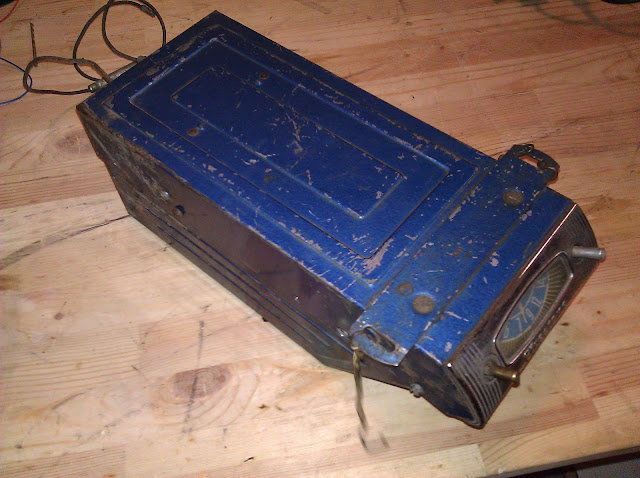
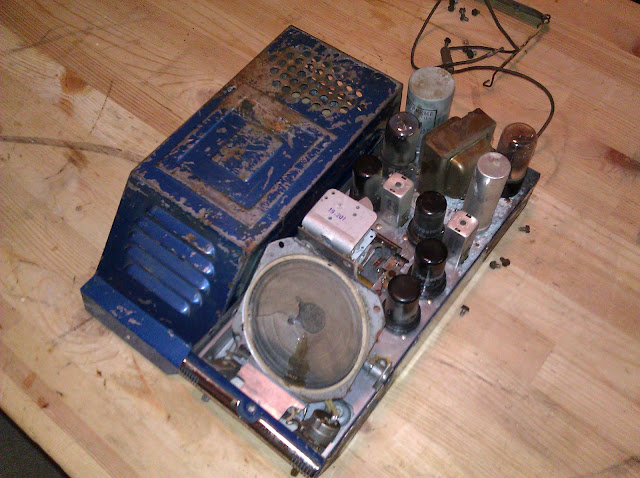
A local friend is building a rat rod out of 1920s-1950s parts, a custom collection that ultimately will turn into a very fast car powered by a huge V8. He found a vintage car radio to go with it, the perfect addition and gave it to me to fix up. He requested to leave the metal cabinet alone so he could paint it to match after the car’s color scheme is finalized, so don’t worry too much about the finish.
This radio, the 4-B-31 “Roamer” was built by Firestone Tire & Rubber, the same company that today makes tires interestingly enough – they used to have a bigger product line when consumer buying habits favored combination stores. It’s a six-tube radio with a broad RF amplifier stage. Most likely the radio bolted up under a pickup truck’s dash and connected in the back to the firewall.
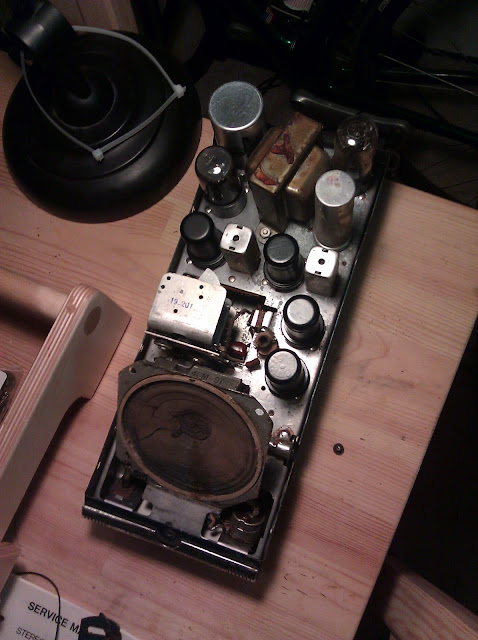
The tubes are 6SK7GT 6SA7GT 6SK7GT 6SQ7 6V6GT 6X5GT. The radio operates off a 6V car battery. With the low voltages it’s only about 1.2W of output power so will never be that loud, but when highways were new it was a lot quieter on the road and probably sounded better.
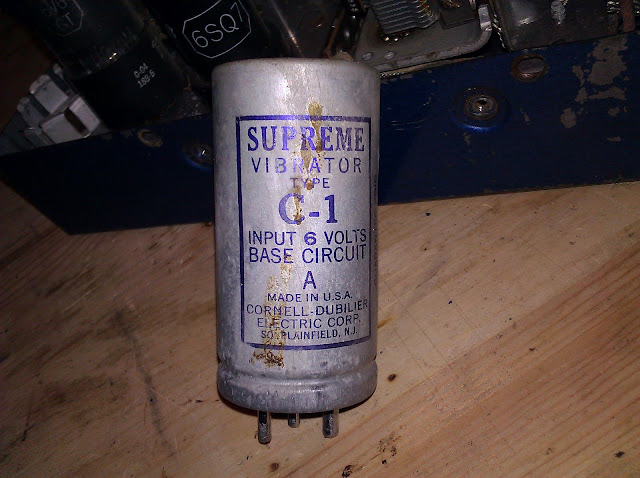
The battery directly powers the 6.3V filaments of the tubes, and the high voltage is provided with the help of a vibrator power supply. The 6V is fed into the electromechanical device which rapidly vibrates between two contact points turning the DC into a square-wave AC which is fed through a transformer to step the voltage up, then into a conventional rectifier power supply.
One of the pins was broken on this original vibrator, so it was the first to go. I replaced it with a solid-state replacement that uses a few transistors in a multivibrator circuit to accomplish the same effect, and should never need to be replaced again. I also replaced the 6X5 with a pair of 1N4007 diodes in an octal tube base, although this isn’t shown in any photos.
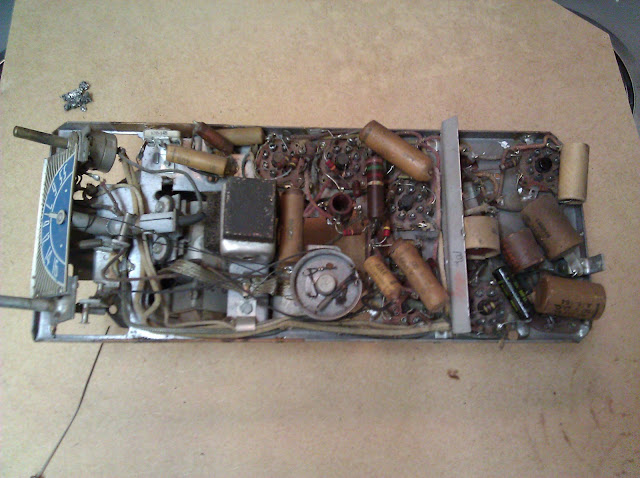
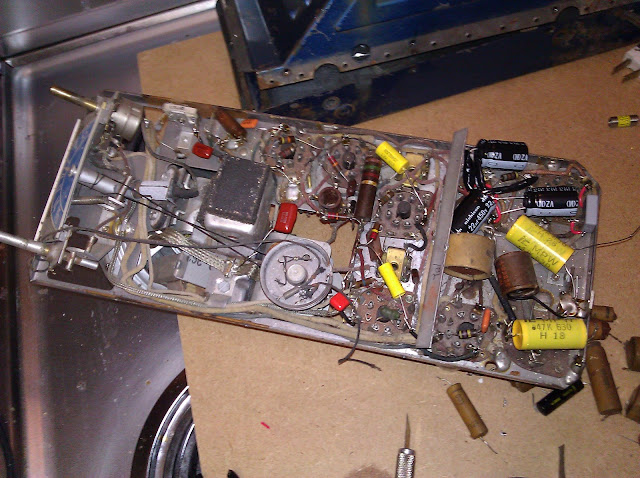
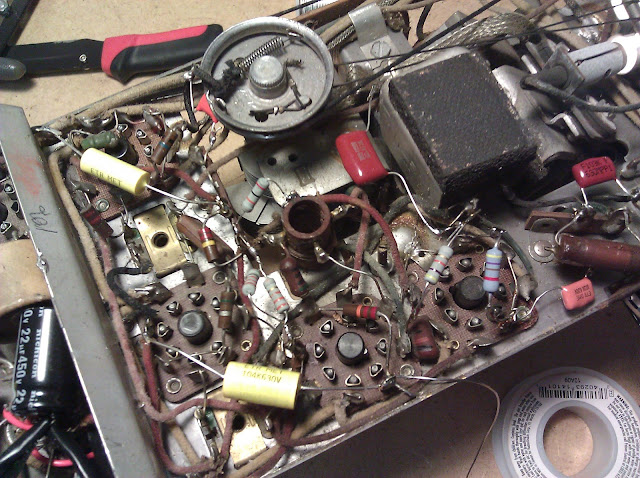
The chassis was decent to work on. It had open sides which made it easier to get things in with tight tolerances. The resistors tested decently, but all caps did need to be replaced as always. Several had blown their ends off already.
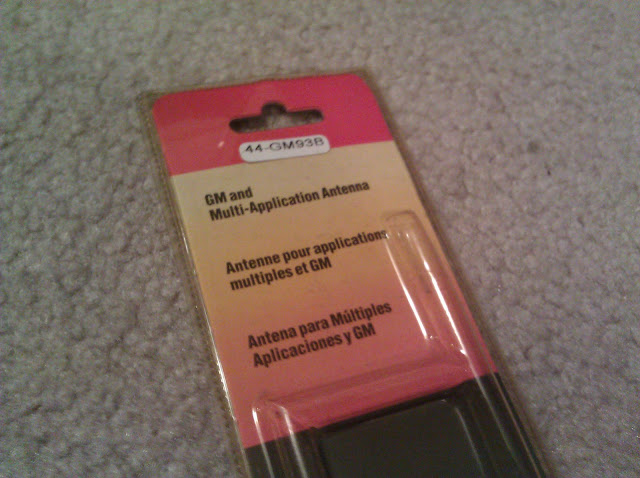
This radio was of course designed to be used in a car, and that means used with a car radio antenna which is a specific length and has certain transmission line characteristics – not quite as simple as just stringing out a long-wire. It’s a standard antenna, though, so I ordered a replacement that cost something like $10 with free shipping from Crutchfield.
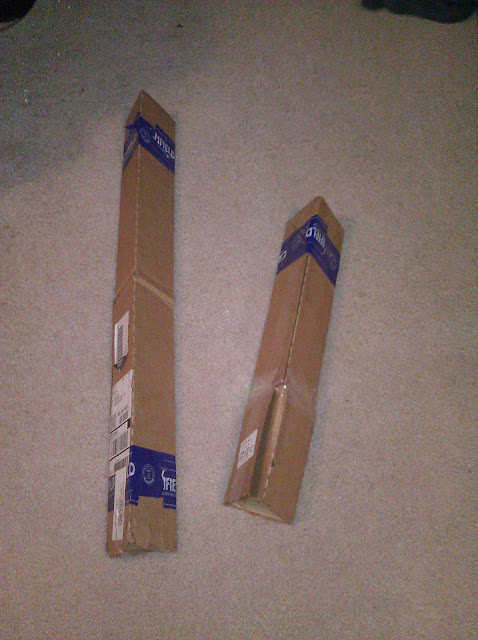
It arrived in interesting packaging. The box was clearly broken in half, but both halves made it to my door without actually being connected somehow.
The antenna was in the bigger section. Go UPS?
A terminal strip in the radio was broken. This was a problem because the broken terminal happens to be the positive power lead-in and it couldn’t be salvaged. Only one terminal broke, though, so I improvised, screwing a screw lead to the mounting bracket and securing as shown, then running the wire out of the case.
Reassembled and testing with a bench power supply that was okay to check functionality. The switching power supply introduces too much hash to receive any stations, but it was good enough to do an alignment with a signal generator by injection. I then switched to a lantern battery for final tweaks which had a disappointing life of about 10 minutes. Clearly these were meant to be run off lead-acid batteries or linear power supplies only. It draws around 4A.
I also rewound the dial indicator. The dial tuning drum was still wound properly but the dial indicator string had broken so the pointer no longer moved. I used string that was a bit too thick but it worked out okay and is perfectly functional. No photos of that available though, it was pretty quick. The service manual had a full dial string diagram and pointer adjustment procedure. Unfortunately I ran into a problem as I was reassembling everything: the volume suddenly dropped off massively even with the control maxed out and it wasn’t coming back for anything. A check of the voltages showed that I had tens of volts on the screens of most all the tubes, where there was supposed to be a few hundred. I was at a loss about why this happened and finally resorted to the poke test.
The poke test is what it sounds like: poking or tapping on pretty much every part in the radio. I gave decent raps on all of the solder joints, tube pins, tie points and finally came to one that would make the volume cut back and forth: R7, the B+ dropping resistor for the screen voltages, a 15K 1W carbon resistor. Apparently it was internally cracked or otherwise defective. I replaced it with two 30K resistors in parallel to form a 15K 2W resistor, and a few others that shared the same tie point or were otherwise looking rattier than I really like even if they were in spec.
With that repair completed, the radio fired up perfectly with loud volume. This was a fun project, but power supply issues mean I don’t think I’ll take on too many of these in the future.
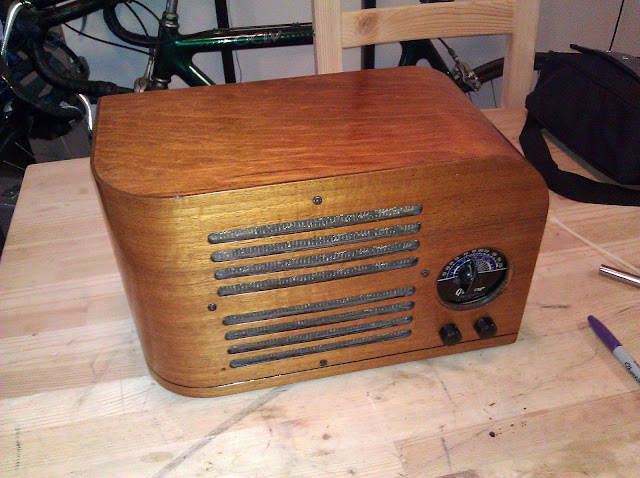
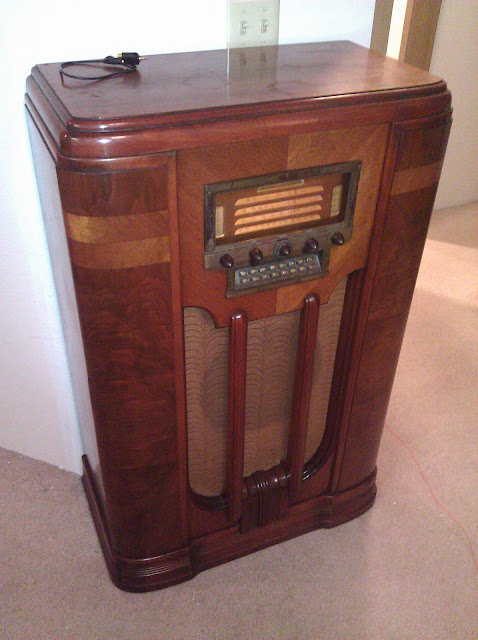
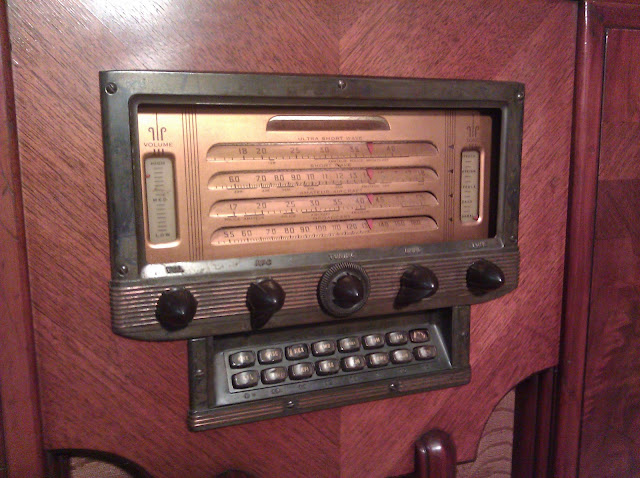
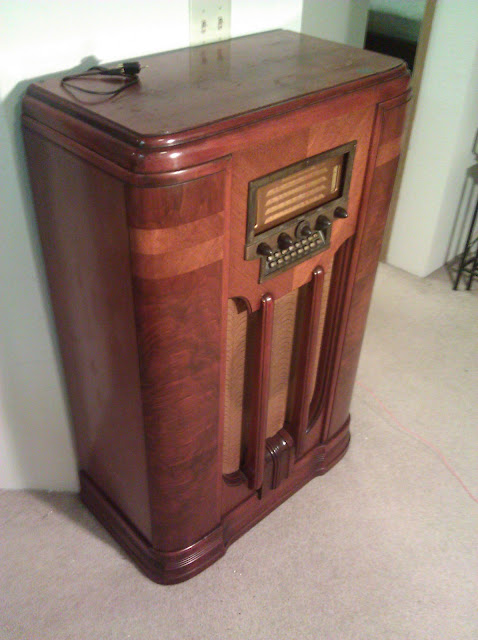
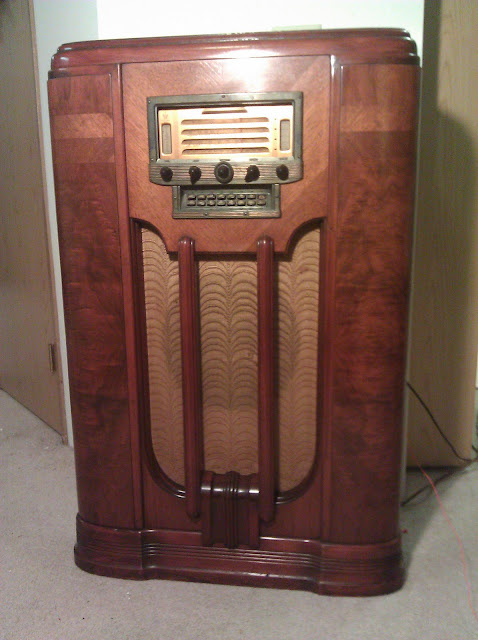
I’ve finally had the time to finish one of my long-running projects repairing GE’s most powerful radio offering from 1937, the GE F-135. I picked it up from Craigslist back in November but other responsibilities kept me from getting much done on it until the 1st of this year. Finally, after a few months waiting, it’s finished and playing!
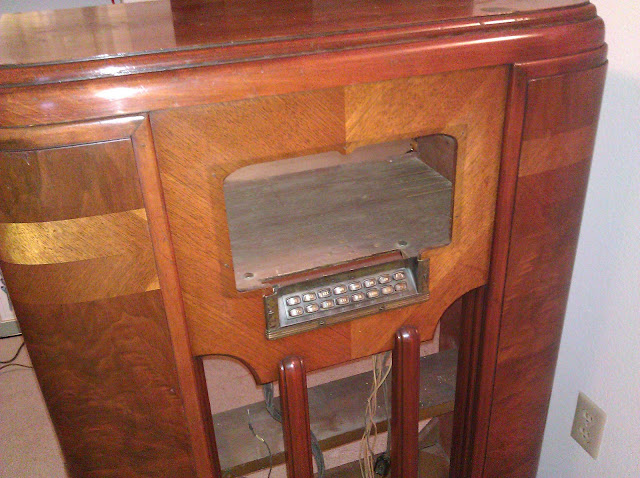
The radio came to me complete and in decent shape for the age. It’s missing the glass for the dial, but is otherwise completely intact and the finish isn’t in bad shape despite a few scratches here and there.
This radio is the current king of my collection. The best radio GE sold in 1937, it has a lot of innovative features – early APEX hi-fi reception, dual 6L6 output tubes putting out 20W of audio to a large and rich-sounding 12″ speaker; a total of 13 tubes including a tuned RF stage, dual IF stages, separate oscillator and “station seeking” automatic frequency correction.
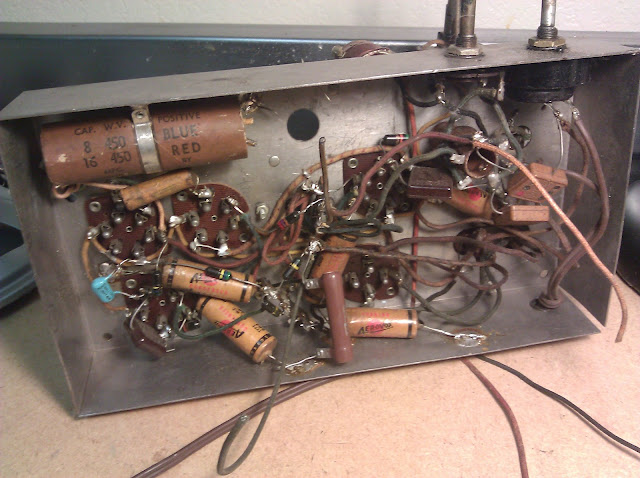
Under the chassis it’s in decent shape too. It looks like it has been worked on before a few times – there are some ’40s, a ’50s and a couple of ’90s capacitors installed. There’s a sticker from a Seattle-area Jukebox Repair store on the back which probably explains the more-recent repairs; I looked up the address and they don’t seem to be around anymore.
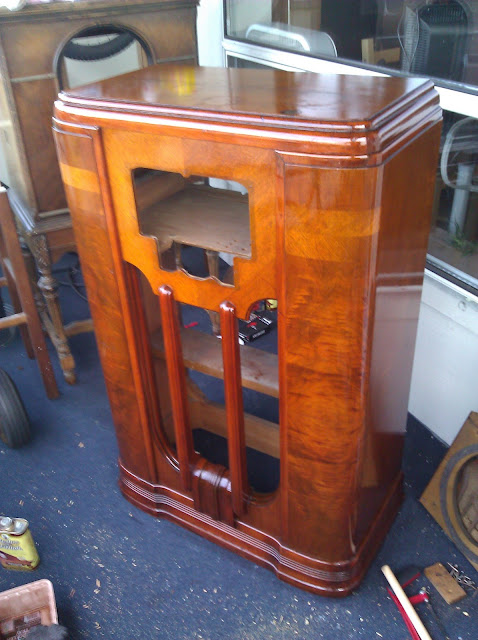
First thing first after doing the complete set of intake checks on the radio, I gave the cabinet a thorough scrubbing and hit it with Howard Restore-a-Finish and it came out beautifully. The intake checks were uneventful so I didn’t take any photos, but the power transformer, all the IF transformers, oscillator and antenna and RF coils and the speaker transformer and coils were just fine. After applying the Howard’s, it really cleaned up the fading and covered over a couple of small scratches and really brought out the natural shine on the wood.
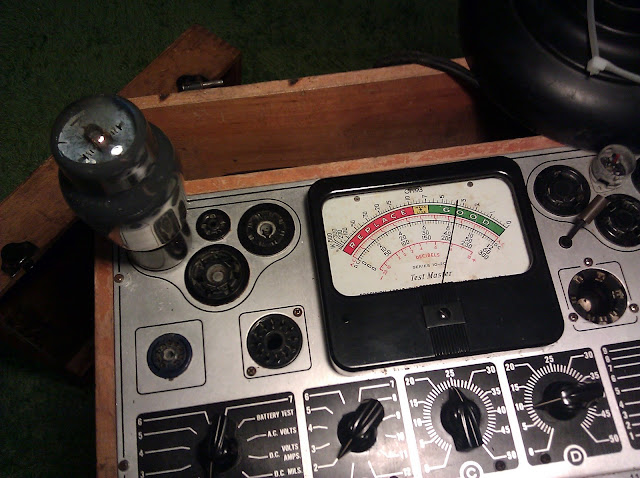
Then I tested all the tubes and found that most were in good shape (especially the 6L6G tubes installed) there were a few 6J5 and 6K7 tubes that needed replaced. I had these in stock and so it was easy to solve that problem.
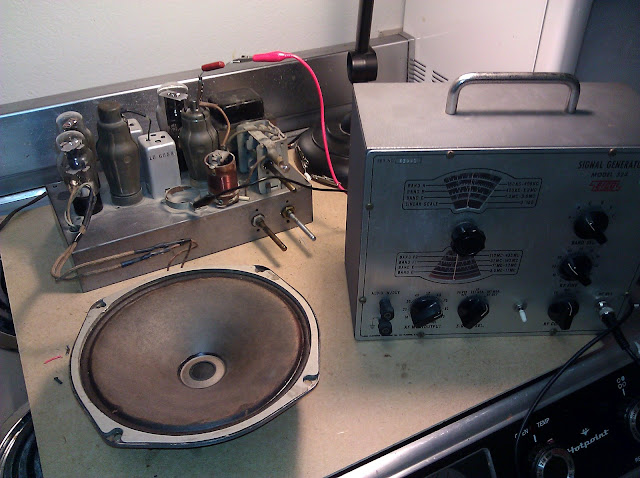
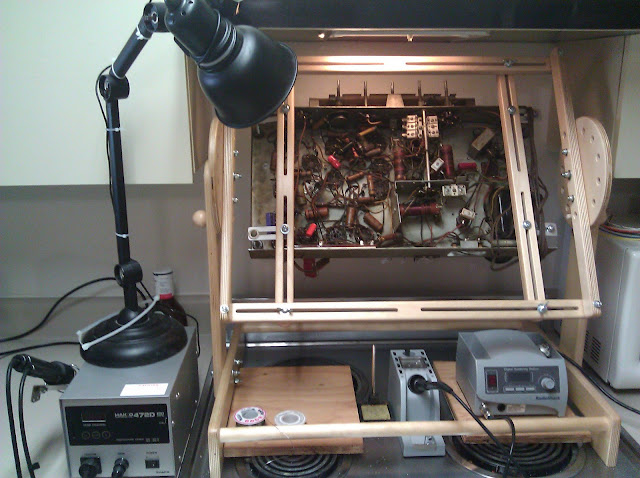
I worked on this one under my kitchen’s vent hood as it’s currently too cold to vent soldering fumes outside. The chassis stand is the right width though so that’s perfect.
Every paper and filter capacitor needed replaced, as well as nearly every single one of the resistors which had drifted as much as +100% in value in some cases. Fortunately the coils are all intact or this could’ve been a much messier repair.
I also found a couple of places where the previous repairman who worked on the set may have been dyslexic, as there were a couple places were numbered resistors were reversed – i.e. R23 being in R32’s place and so forth. I imagine that couldn’t have made it work any better, anyway. I tested and replaced going along from the bottom up as needed. These are in-progress shots, so you might see a couple places where leads aren’t trimmed or components aren’t yet soldered. All of those issues were taken care of but might not have made it into the photo series.
Small caps dealt with, it was time to replace the multi-section caps. There is a 4-section can, insulated from the chassis, mounted up top with a set of 2 filter caps and 2 cathode-bypass caps. These all ran to a hole in the chassis where they went above. I snipped the long cross-chassis leads and moved the components close to their intended locations. In this photo, I’ve replaced the 10uF cathode bypass capacitor with its replacement. I like using bipolar caps for the large-value cathode bypasses but that’s just my preference and what I keep in stock (I keep those values around for repairing crossovers in old speakers) but you could use a standard polarized capacitor there.
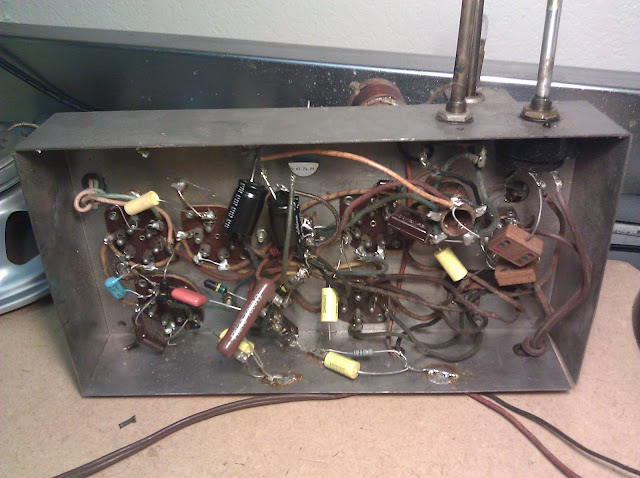
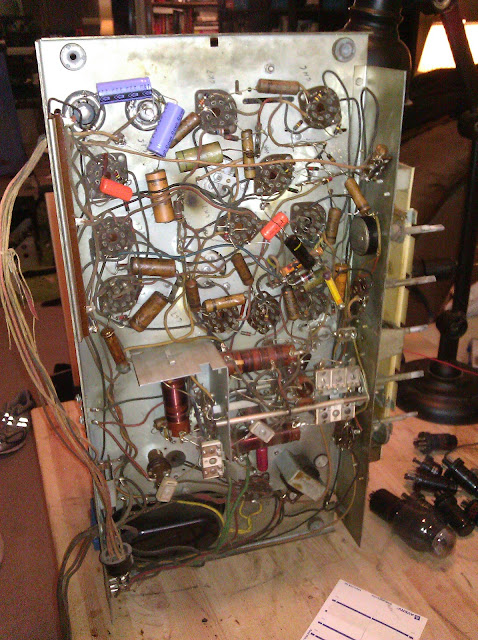
Here’s the totally-complete underside shot.
There’s still a matter to deal with above the chassis, though. This is an AFC radio which uses a special and complicated transformer heading into the diode which recovers the audio. And it has a small resistor which is reading double it’s value and needs replaced as well, or it won’t align right.
Then I sealed the can back up:
I hooked the speaker and pushbutton assembly up on the bench and gave it a test run – it fired up immediately and started pulling in a few stations even on the Shortwave bands. The dial was off alignment a bit though, so it was time for that.
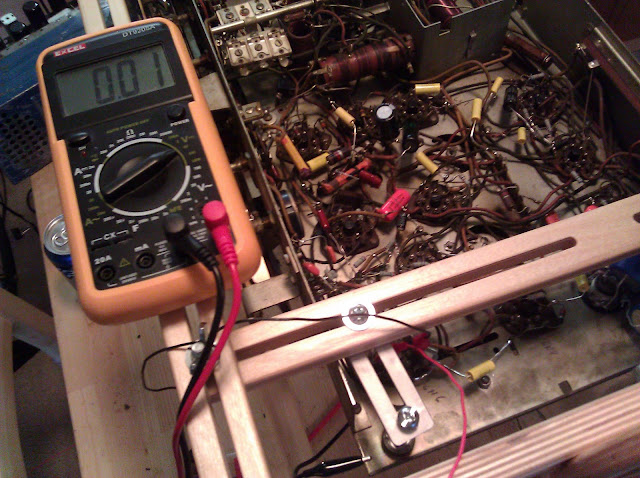
For the alignment, I pulled up the signal generator and started with an IF alignment before going back to the RF stages. This radio has a special IF arrangement with a procedure, so I aligned the 3rd IF primary, second IF secondary and primary, first IF secondary and primary, then went back and aligned the 3rd IF secondary that feeds into the diode. Aligning that discriminator was a maddening 10 minutes spent trying to nudge the adjustment ever so slightly. My goal was to get 0V between two segments, but it approached that point at an incredibly steep slope. I managed to get it there, though.
The original 0V spec was made with a primitive meter; I’ll take 0.01 on a more sensitive modern instrument. That’s perfect IF alignment. It was definitely worth it though. Now onto the RF, which involved tweaking something like 16 trimmers in a precise order with an RF signal generator at various frequencies.
Finally, it was all set! Time to reassemble.
At this point, the radio plays beautifully and pulls in stations from all over, and I’ve added a line input to let me hook up an audio source. The hassle of the AFC calibration was definitely worth it, it’s nearly like magic to watch it work. With the switch off, the radio tunes sharply and a station comes in over just a few degrees of rotation. With the switch activated, it’s like an entirely different radio – the same station will come in across about a quarter-turn of the knob, 2 divisions in either direction from the center frequency and it will block quieter stations from interfering.
The radio sounds great with a pretty good frequency response and more volume than I know what to do with, too. The relay for the motor is burnt out, though. I missed that on the initial checks so when I went to test the pushbutton function…I got a whole lot of nothing. I’ll make another post here when I do get the motor resolved but for now I’m going to hang this one up and start playing it. This was a very fun and enjoyable project and I have a beautiful radio with a commanding presence to enjoy for many years to come.
I had an interesting call the other day with a gentleman about a radio he’s working on, among other topics:
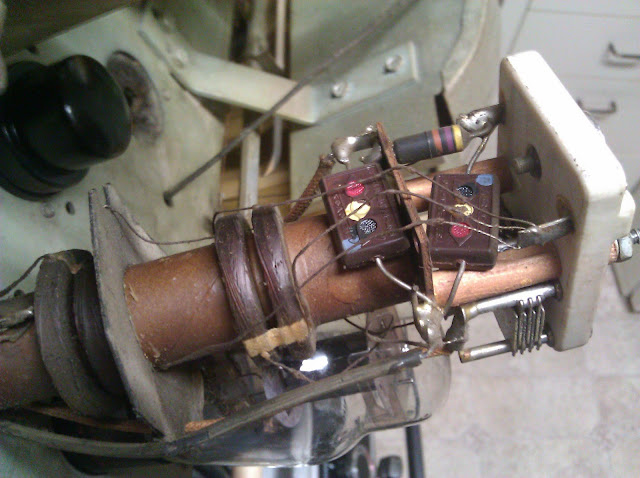
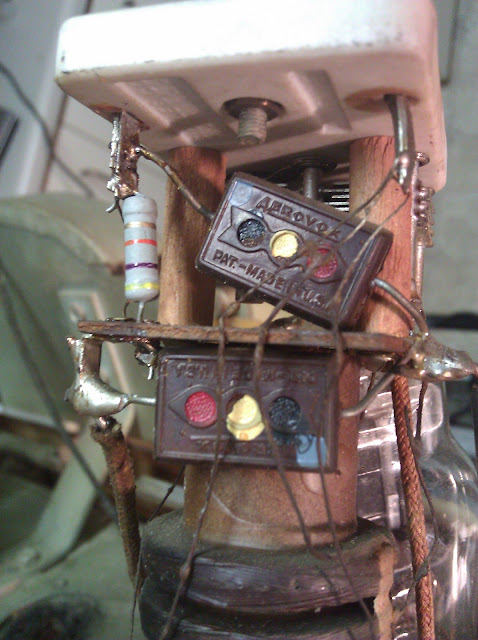
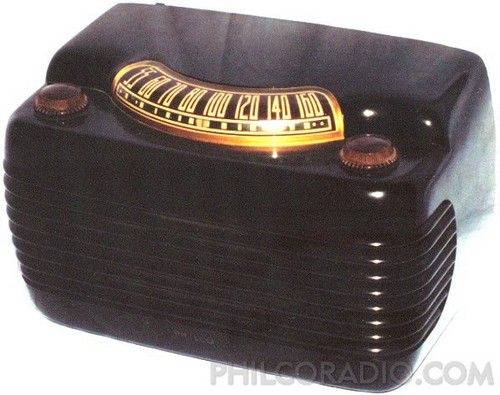
That’s a Philco 46-420. They’re nice little bakelite radios with 6 tubes designed to receive the AM broadcast band. He’d come across some unlabeled wiring while repairing and had dealt with it but we were talking about what it’s purpose was.
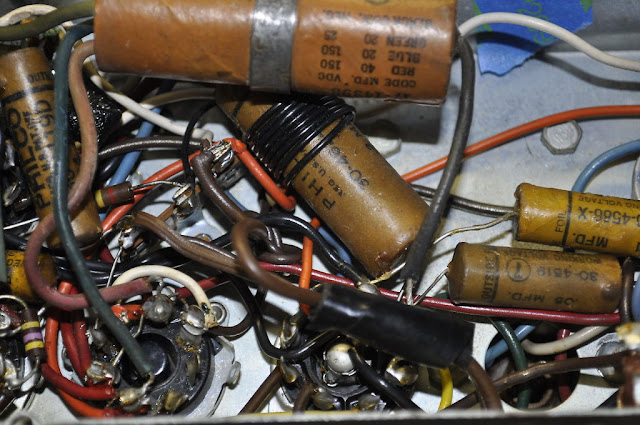
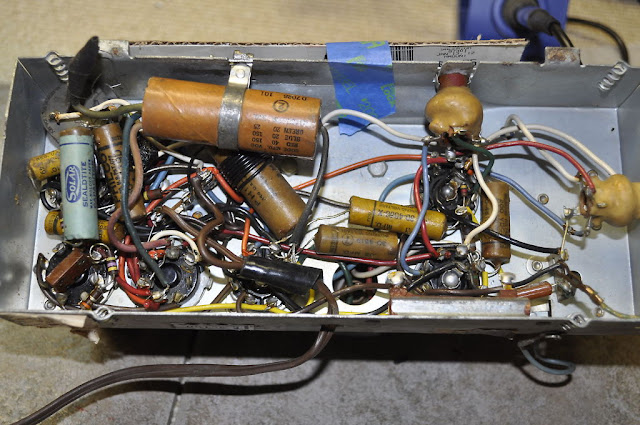
I generally work on pre-WW2 radios so haven’t run into this particular arrangement personally, but I’ve read a few different articles by other collectors on this topic and recognized it immediately. The coil, wound 8 turns around the capacitor and connected at one end to the chassis, is a type of wave trap designed to cancel out the inductance of the old capacitor. This helps to prevent interference – both received, picked up through the cap as if it were an antenna, and radiated interference from the signal passing through the cap. Philco used these capacitor wave traps in most of their radios from 1946 and on. There’s an article at the Philco Repair Bench describing one style; this is a slightly variation with the same effect.
Modern caps are constructed out of metalized polymer films that have very little inductance, but these older capacitors were just concentrically coiled metal foil sheets with a lot of natural inductance.
Modern caps don’t have that physical property, so it’s safe to replace the wrapped capacitor with any modern replacement and either shove the new cap through the coil, or remove the coil entirely.
Thanks to Bob from Old Tyme Radio for these photos of his project, and for distracting me from being snowed in for a bit!
















How Television Benefits Your Children [Vintage Ad]
Motorola, leader in television, shows how TV can mean better behavior at home and better marks in school!
Own a Motorola and you know you own the best.
Does that clown look terrifying to anyone else?
Share this: