The Speaker Spotter – February 14th, 2016

Another installment of the occasional series “The Speaker Spotter”, showcasing interesting speakers for sale right now on the local Seattle Craigslist. As always, I am not affiliated with any of these postings. If the linked ad doesn’t load, it’s likely the item already sold. If you like what you see, you should contact the seller by clicking through to the original posting.

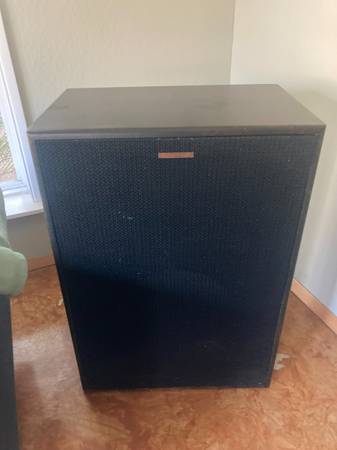
Soniphase Fully Horn-Loaded Speakers
$1795 in Kent

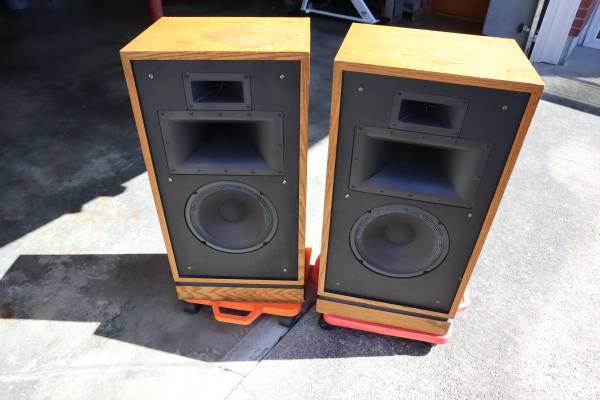
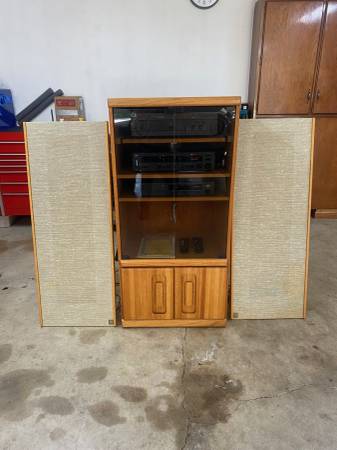
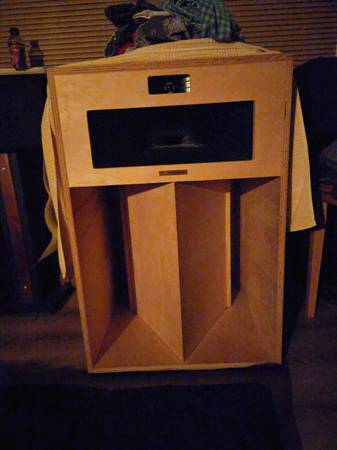
The seller describes these as similar to Klipschorns or La Scalas, and indeed they look very similar to a K-Horn except a bit narrower, and with a port at the bottom front. 15″ woofer down to 35 Hz without a corner (and lower in one), and treble to past 20 KHz sounds like a good combination to me.

00q0q_lKesDajtloA_600x450[1]

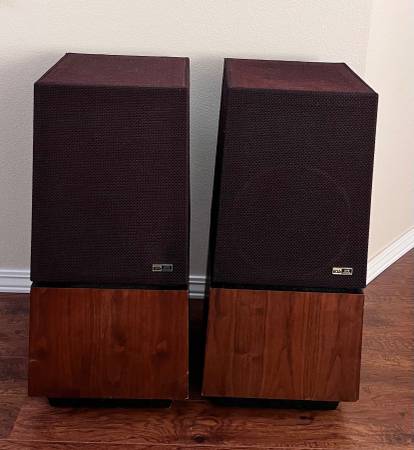
RTR DR-1 Electrostatic Hybrid Speakers
$1999 in Kent

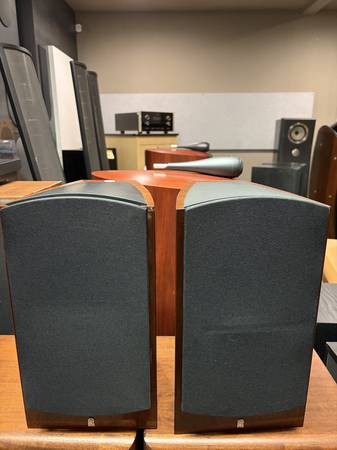
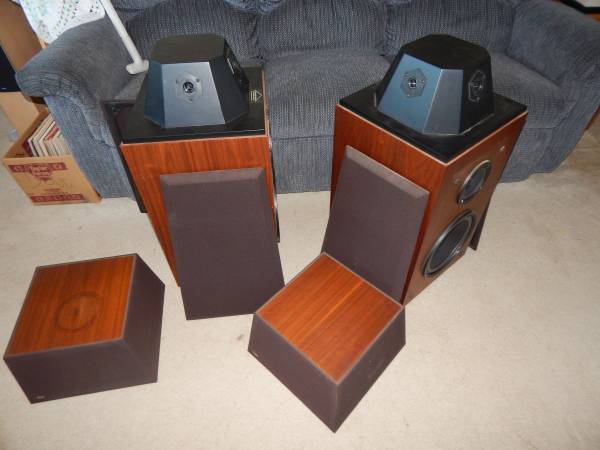
“These completely unique speakers were manufactured by RTR in around 1980 or 81. They utilize a cylindrical electrostatic element from 350hz/up and an innovative three-woofer bass section from 350/below.” These speakers look unlike anything I’ve ever seen, but I’d love to listen to a pair. Shared without further comment because I’m unfamiliar with the entire RTR line-up – but I’m fascinated.

00o0o_gza722qPSZM_600x450[1]

00L0L_cLRMozKHPeH_600x450[1]

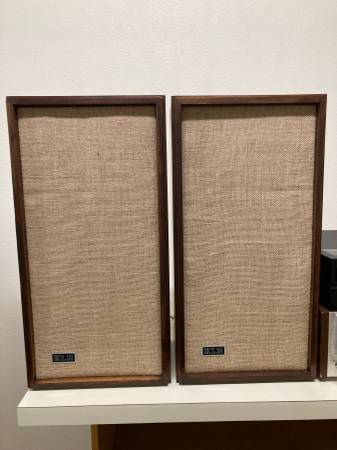
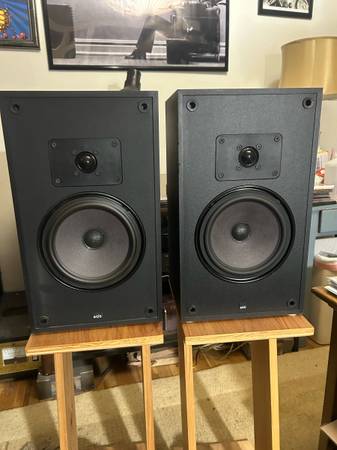
Marantz Imperial 6G Speakers
$160 in Olympia, WA

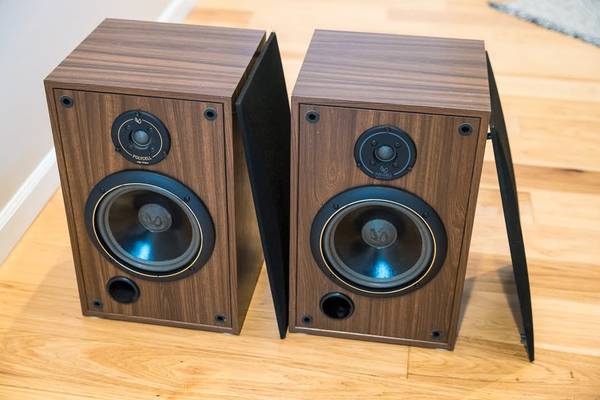
Solidly designed, no-frills speakers, these are pretty efficient and have a 10″ woofer and a phenolic ring tweeter. I’m a big fan of the way the phenolic ring driver manages to sound both clear and accurate, but without any rough edges; any speaker with the ring tweeter is worth a look anyway. The dust covers on the woofers are pushed in but it looks like the grille cloths are intact. Not a bad set of speakers for a starter vintage system.

00h0h_a0pBJ92M66F_600x450[1]

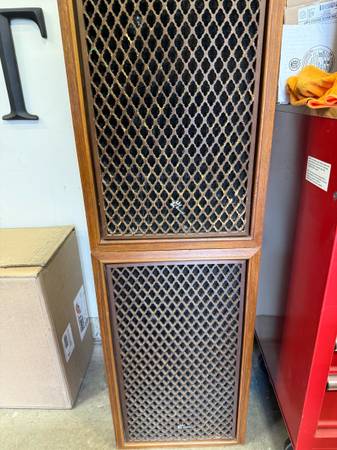
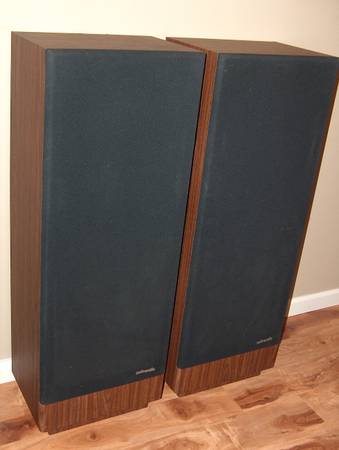
Coral BX 2000 Speakers
$175 in Olympia, WA

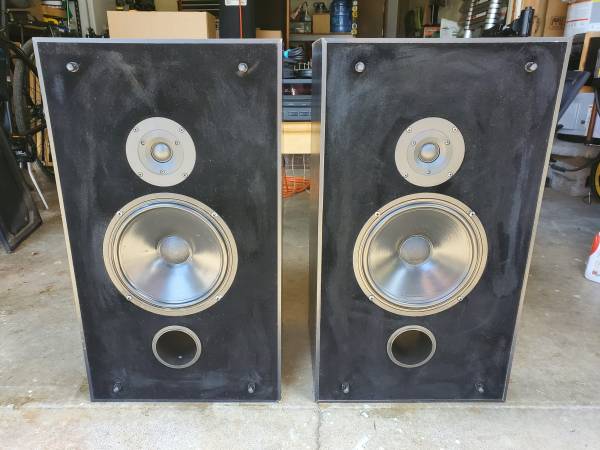
I’ve always understood Coral speakers to be a great example of “kabuki” speakers which had their driver selection and placement dictated more by aesthetics than acoustics, although some of them can sound pretty good. I’m not sure where these fit into the line-up, but they have interesting fan-shaped diffusers over the twin mids and twin tweeters, and what looks like a 12″ woofer. I’d guess it probably sounds somewhat similar to a Sansui.

00c0c_2ZMGHXdMnvG_600x450[1]

“Speaker Factory” Speakerlab Speakers
$300 in N. Seattle

Speakerlab built great products down to their entry-level models, both kits and manufactured speakers. They were fond of using components fairly similar to what Klipsch used at the time, and used some really innovative designs. By visiting the Speakerlab web site, I found these are Speakerlab 4s. (Page 23) I’m a fan of the Electrovoice T-35 tweeters used in these and many other Speakerlab speakers, I bet they sound great in a mid-sized system.

00303_6OGoKQ2eIpE_600x450[1]

Speakerlab Tower Speakers
$200 in Bonney Lake

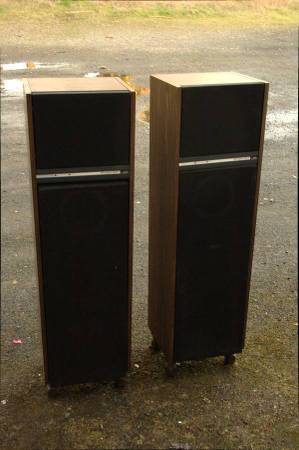
These are an alternative driver arrangement of the Speakerlab 7s from the looks of it: tall horn mid, EV T-35 tweeter, and pair of 12″ woofers with one being a passive radiator. With the mid oriented vertically, though, I think these would have a very narrow sweet spot. Great to focus on your hifi chair, maybe not so great if these are going to be paired with a stereo system by a couch. Very interesting!

00S0S_9Yc8O2d6rbV_600x450[1]

Speakerlab 7s
$350 in Everett, WA

Another set of Speakerlab 7s, again in a nontraditional cabinet. These are in rough shape compared with the previous set. The T-35 is mounted vertically in this set, with the midrange horn mounted horizontally along the top. Fortunately, the builder set up the T-35s to be directional so there’s a “Left” and “Right” speaker which will allow for adjusting the sound field a bit more accurately.

00S0S_e9XO4hq1vB3_600x450[1]

Speakerlab K-Horns
$450 in Marysville, WA

This is a set of the later-generation Speakerlab Ks. The earlier generation was a very close clone of the Klipsch Klipschorn, being fully horn loaded. These have a folded horn with either a 12″ or a 15″ woofer, a front-firing 8″ cone midrange, and vertically mounted EV T-35 tweeter. I bet they sound quite good, and could be used in a room a little smaller than the full-sized K-Horns. The prices vary wildly on them, but this seems to be fair.

01313_jnMP3TzZBbj_600x450[1]

“Large Vintage Speakers, Horns & Woofers” 
$300 in Lakeridge

These look really interesting, like they might be a clone of an Altec Lansing of some kind. The woofers need to be refoamed. The owner doesn’t know what brand the drivers are, either. These do look like they’d be a really good project, and you might get lucky with the drivers.

00c0c_aN1so4AsOvB_600x450[1]

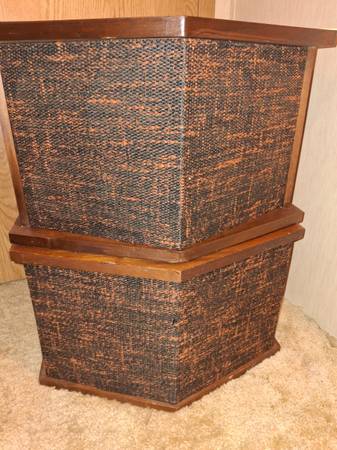
Microtower MT-1 Stereo Speakers
$35 in Lakewood, WA

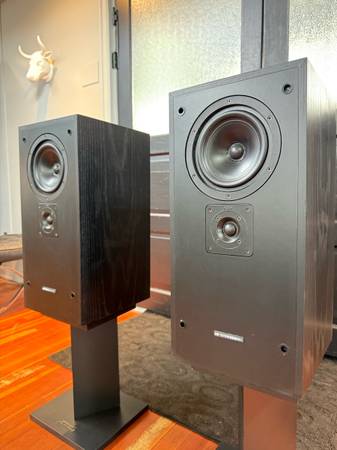
Definitely coming in at the bottom end of the price range, I’ve actually featured these before at a slightly higher price. They’re just kind of novel. These are a pair of enclosures with two 4.5″ drivers mounted in the top and a lengthy cavity and port opening on the bottom. Maybe an early type of waveguide cabinet? I don’t think these would win any awards for sound quality, but they might be interesting to listen to.

00f0f_iGdYYfgvdnU_600x450[1]


Posted in Audio, Collections, Speakers | Tagged , , , | 3 Comments

ARCANE RADIO TRIVIA: Electric Banana

Arcane Radio Trivia found a really cool banana-inspired portable record player, allegedly from the Andy Warhol era.

Banana

Plays in any position…even upside down! I’d love to see one of these in person. I wonder how many were ever manufactured in the first place.

I recently found this… Supposedly it was inspired by the work of an Andy Warhol. It’s based on his painting of a banana that served as album art for the Velvet Underground. The Warhol Foundation has reported that it was not officially licensed.  They are rare as you might imagine, but they do have one at the International Banana Museum in Mecca, CA.  The image above comes from an old issue of  the Speigel catalog. Regardless.. one of the strangest record players I’ve ever seen.

via ARCANE RADIO TRIVIA: Electric Banana.

Posted in Uncategorized | 2 Comments

Like Classic Receivers? Check Out This Blog

If you’re reading this, you’re probably at least somewhat interested in vintage stereo gear, since that’s a huge amount of what I work on. There’s a lot of it out there! I just discovered a great new blog that showcases a different vintage receiver every few days, with a quick photo summary and some links to more information or to find some on eBay.

ClassicReceivers.com

They’re showcasing a Harman Kardon 330B right now.
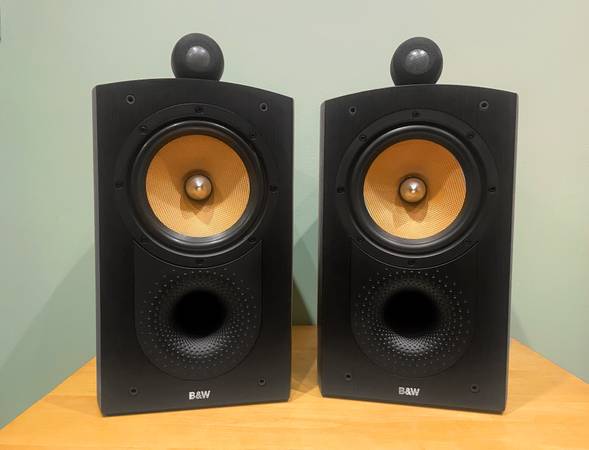
Worth checking out!


Posted in Commentary, Internet | Tagged , | 2 Comments

How to Read Capacitor Codes

I ended up with a massive stash of mil-spec CDE Mica caps recently, and was searching for a refresher on decoding their military part numbers like “CM05FD221GP3”, since the caps came marked for their values but not their voltage ratings.

I stumbled on the Xtronics Wiki page about reading capacitor codes, which has all the info I needed, and more. It has instructions on reading EIA and Miiltary codes, and tables of the tolerance, delectric materials, temperature coefficients and ranges, and working voltage codes.

Turns out, those are 500V CDE Mica caps, 2%, and with a +/- 0.05%+0.1pF capacitance drift over temperature. Not bad!

If you need a quick reference for all these different codes, definitely check out the Xtronics wiki.

Posted in Commentary, DIY, Electronics | Tagged , | 1 Comment

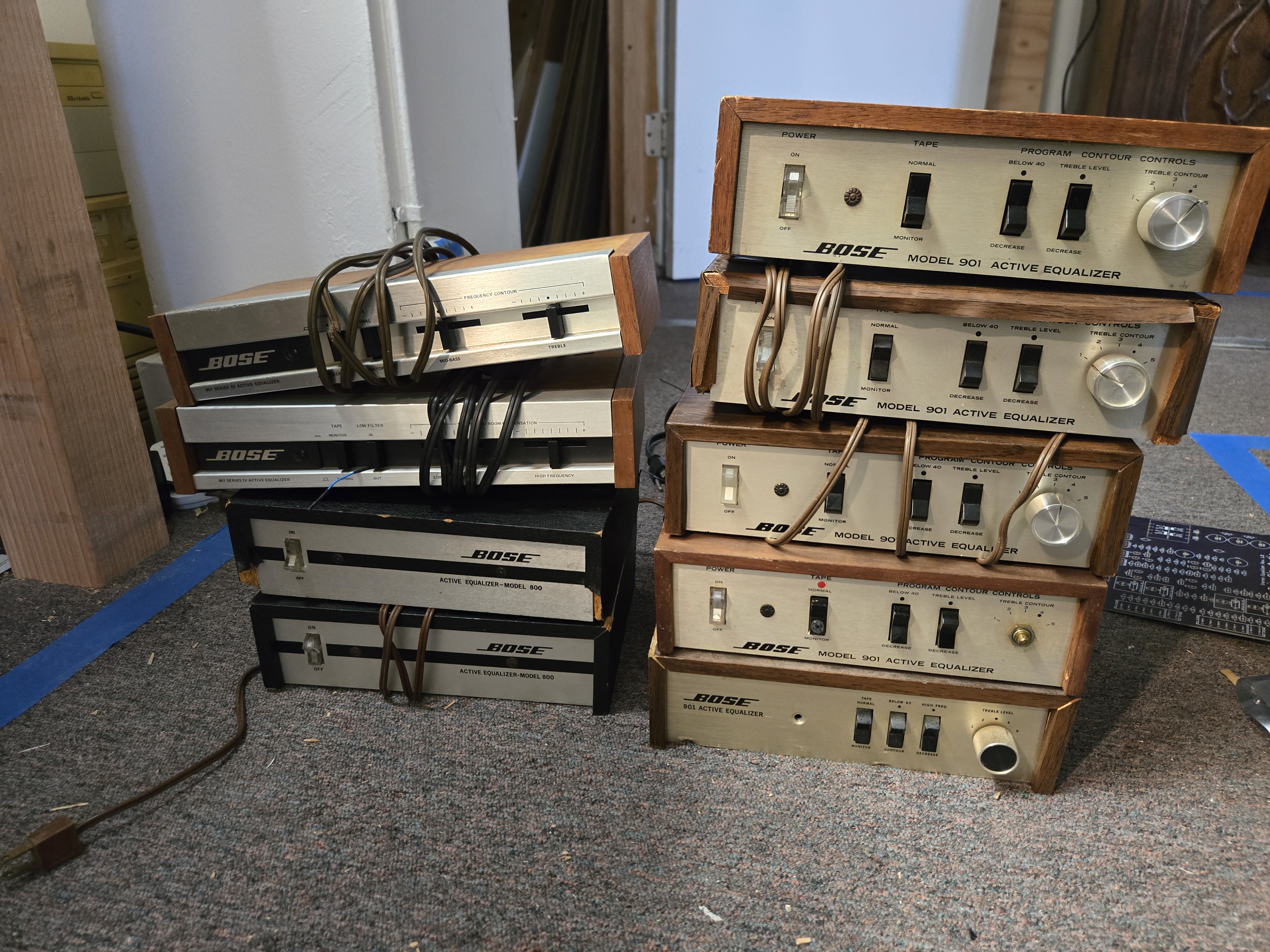
Bose® 901 Series IV Active Equalizer #501554 Overhaul and Upgrade

From the Rain City Audio Repair Blog:

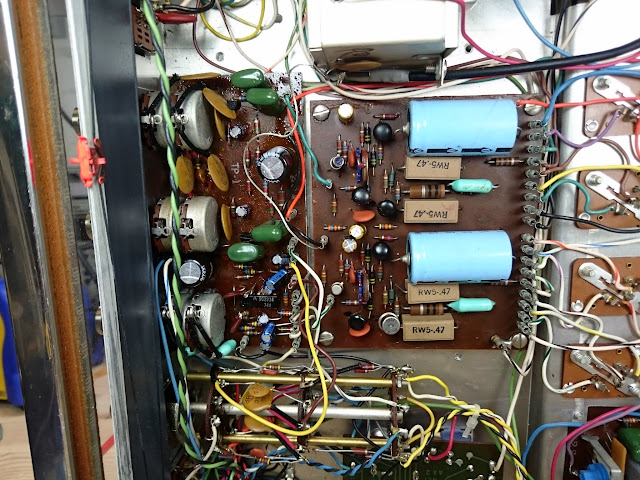
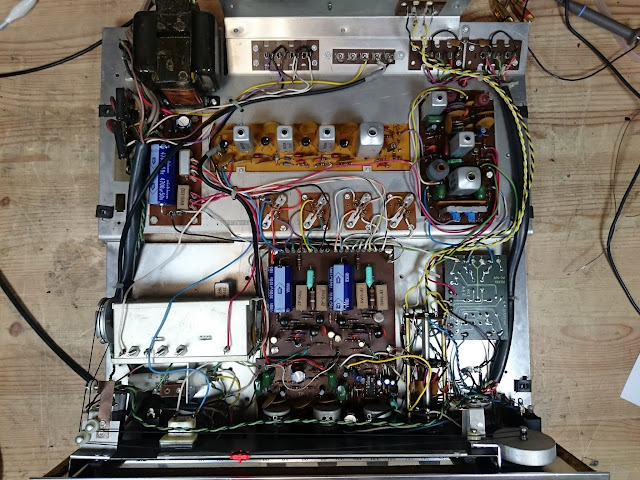
This Bose® 901 Series IV Active Equalizer, serial #501554, came into the shop with the owner reporting that it loses output on one channel and the sound degrades the longer it is powered on. Definitely time for an overhaul!

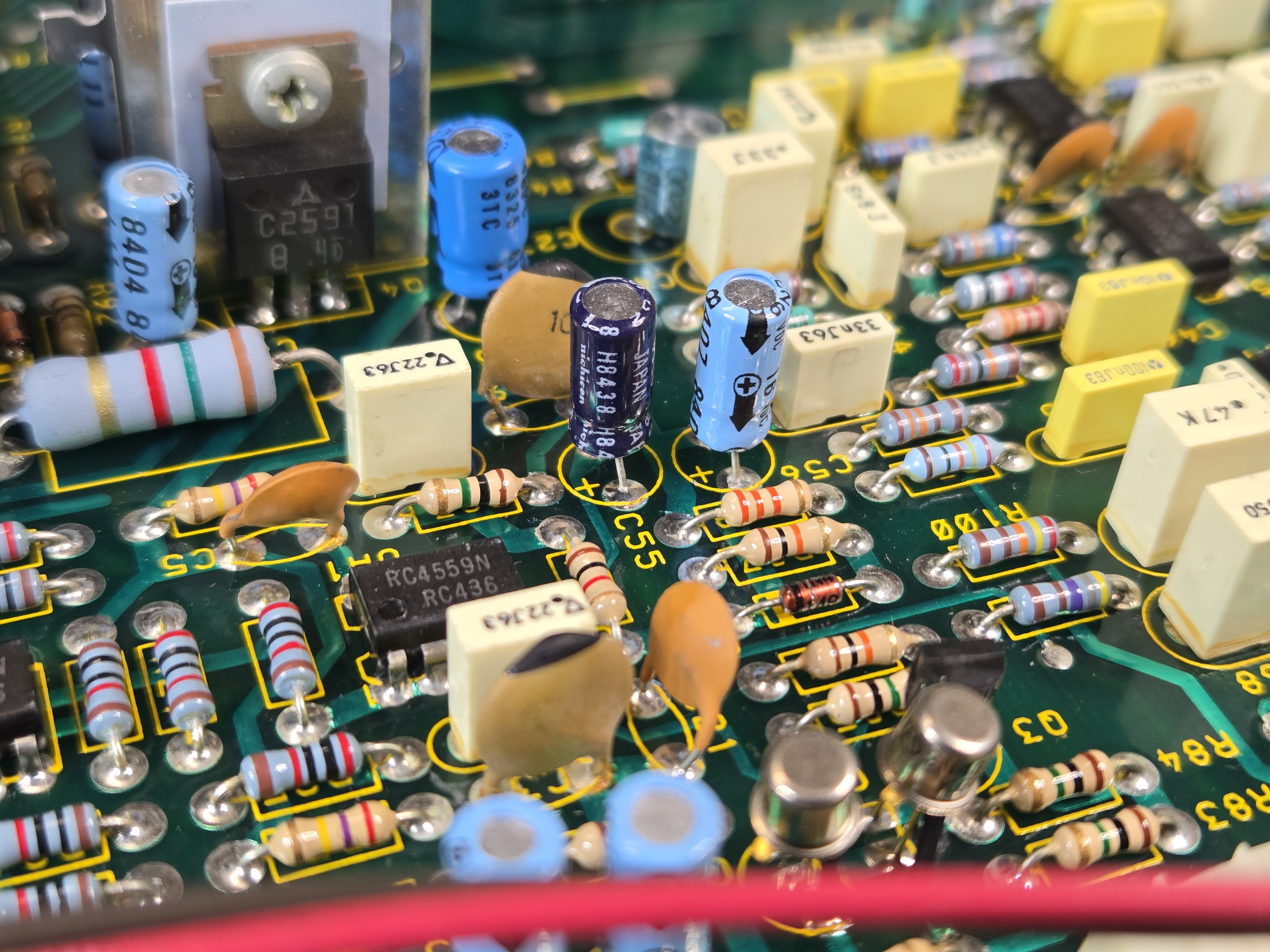
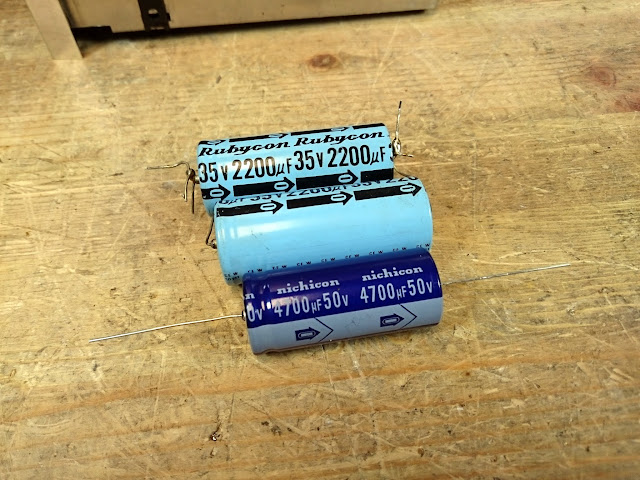
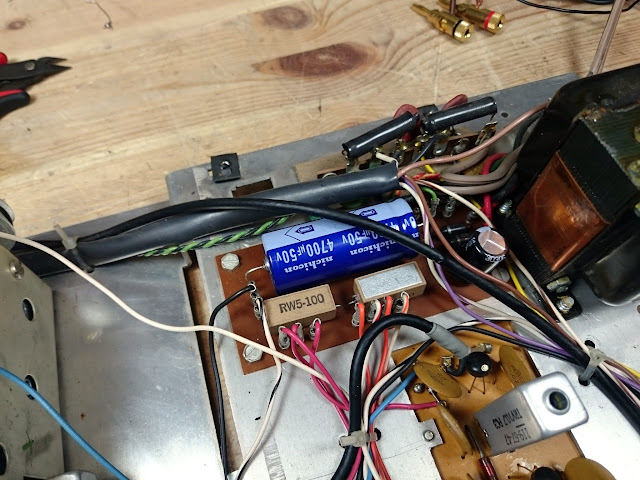
There were a couple of things which were interesting about this particular Active Equalizer. For one, the voltage marking was covered in residue. Inside were a different style of capacitors with European markings:

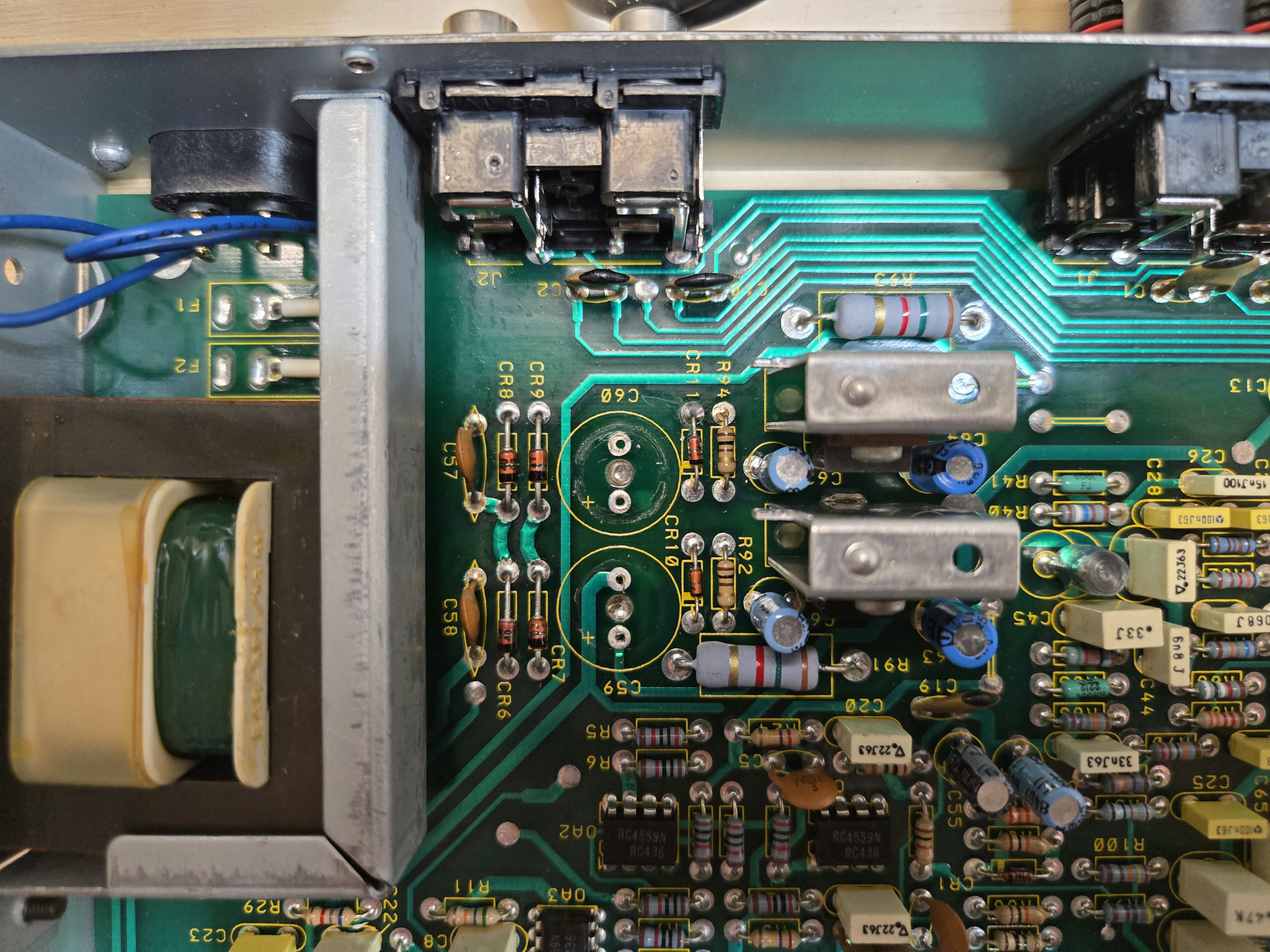
And finally, the power supply links had been added:

This unit was originally used on 220V in Europe, but was converted to U.S. operation at some point in the past.

Interestingly, this one also came from the factory with sockets for the op-amp chips, and the same National LF353 op-amps which were the subject of a January 1983 service bulletin recommending their replacement.

In this case, the owner requested an upgrade to TI precision low-noise op-amps which offer much improved performance over the originals, along with the standard capacitor overhaul and performance verification.

All set! This Active Equalizer sounds fantastic and works perfectly, just like it should.

Posted in Audio, Bose, Electronics, Projects | Tagged , , , | 1 Comment

Bose® 901 Series II Active Equalizer #107915 Repaired

From the Rain City Audio Repair Blog:

This Bose® 901 Series II Active Equalizer, serial #107915, came through the shop for a repair. The owner reported it was developing the typical age-related problems, so it was time for an overhaul!

This unit was originally designed for European voltages, but had already been converted at some point in the past for the U.S. electric service.

Inside, the main filter caps were looking pretty crusty, and one of the secondary filters had blown an end out. Definitely time for service. And judging from the soldering on the back, these capacitors had been replaced in the late ’70s or early ’80s.

Bose® used very short leads, which have a distinctive crimp which prevents them being pulled back through the front of the PCB which was a giveaway they were populated with an old automatic placement machine. The replacements have longer, bent over leads. They’re all getting replaced anyway, though!

With all new parts and a thorough control and switch cleaning, this equalizer was ready to go home and sound great for a long time to come!

Posted in Uncategorized | Leave a comment

Philips High Fidelity Laboratories 673 Tuner Repair and Alignment

From the Rain City Audio Repair Blog:

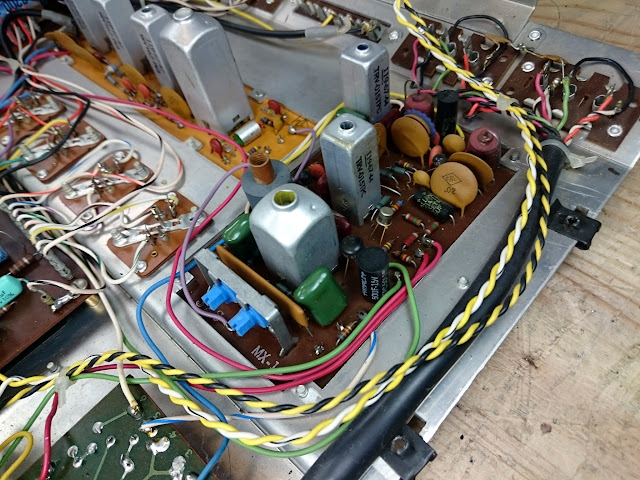
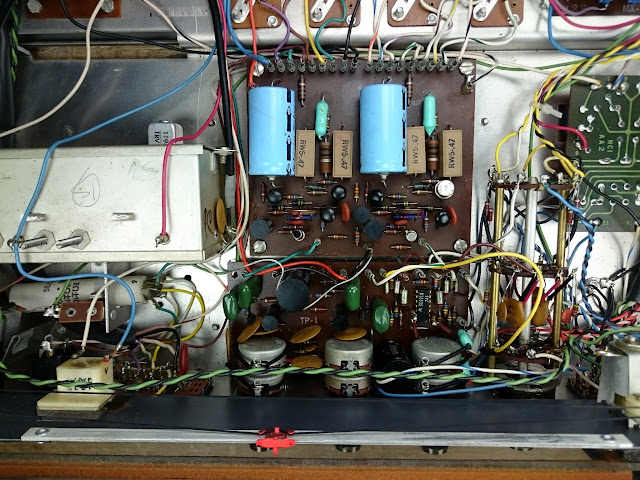
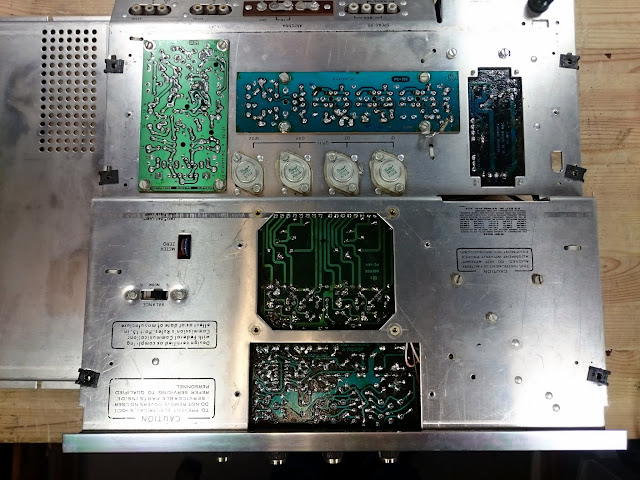
This Philips 673 tuner just came through the shop for an overhaul and adjustment. It was working for the most part but the alignment had shifted and there was room for improvement on the sound quality. Philips designed this tuner sparing no expense. It’s an extremely well designed setup, with all of the components on removable PCBs for even easier service.

The power supply received all new capacitors.

All of the buttons in this tuner are capacitative touch sensors, with a relay controller to actuate the various settings.

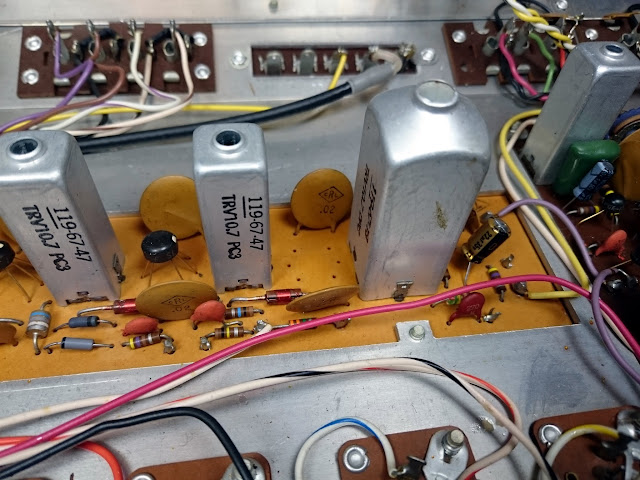
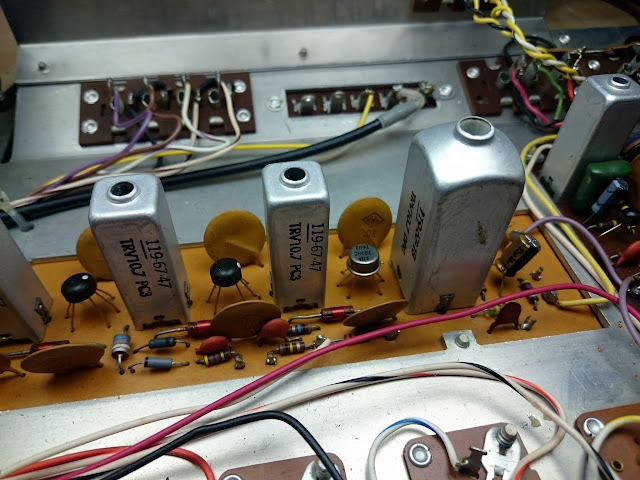
There are several more capacitors hidden under the shield.

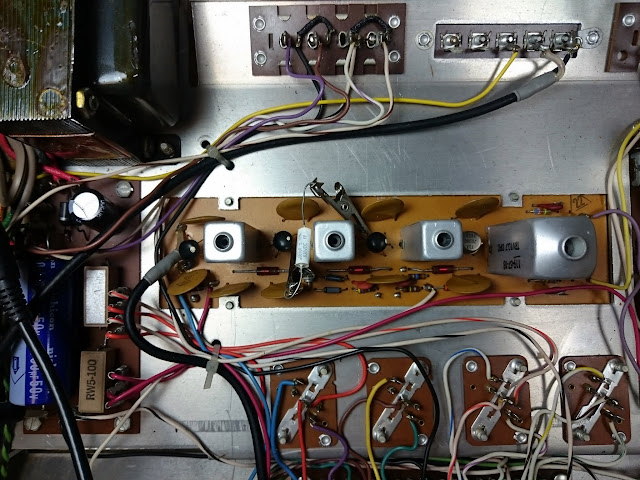
The large blocks with the Philips logo are a set of 8-pole tuned filters. These were pre-tuned from the factory, and Philips provided no alignment instructions. Without specifications they’re impossible to align, but fortunately none required adjustment as the tuner met its specifications after an alignment.

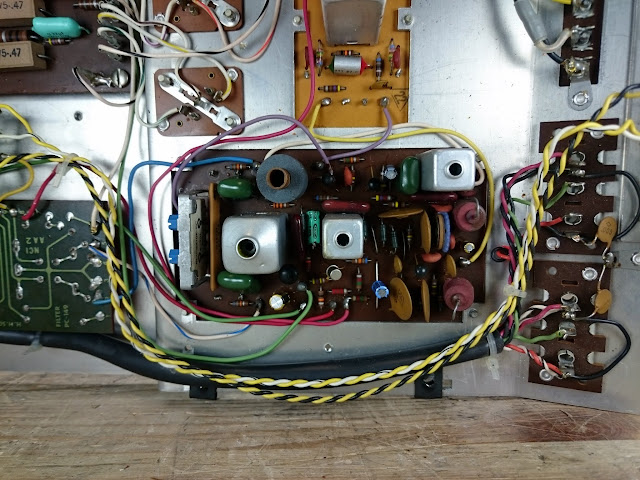
The AM board has a large shielded area, and two 4-pole and an 8-pole filter.

Next up was the AM alignment, which required just a test signal, level meter, and some alignment tools. The center and signal indicators built into the tuner provided the rest of the indication.

AM alignment raised the received signal 2 full units on the signal indicator.

Next up was an FM RF alignment. This involved watching the FM Multipath Vertical output with an oscilloscope.

There were quite a few adjustments.

Calibrating the multipath indicator.

Some alignment tests required shorting out this junction to ground.

Time to align the discriminator and measure distortion. Starting in, the tuner was receiving 0.178% THD – better than even some other contemporary high end tuners, but it could do better.

Not bad. Next was adjusting the outputs to 1V each.

Time for the MPX alignment.

The instructions involve adjusting the VCO on the chip for a 19 kHz pilot signal.

Initially, the oscillator was running at 18.54 kHz; the spec is 19 kHz +/- 50 Hz, which would be from 18.95 to 19.05 kHz. This misalignment would have caused the stereo separation to be off; it settled on 19.02 kHz after adjustment.

Ultimately, 78 capacitors were replaced in this unit along with the alignment.

Posted in Audio, Electronics, Radio, Vintage | Tagged , , , | 3 Comments

Bose® 901 Series IV Active Equalizer #219533 Overhaul

From the Rain City Audio Repair Blog:

This Bose® 901 Series IV Active Equalizer, serial #219533, came through the shop for an overhaul. The owner was reporting the left channel went out, so it’s clearly time for an overhaul!

A little uneven, the first step was to give this Active Equalizer a new set of feet. Inside, it looked all original.

One interesting thing to note is this Active Equalizer came with IC sockets fitted from the factory, which were still populated with the original National LF 353 op-amp chips. These chips are a big, known problem in Series IV Active Equalizers. So much so that in January 1983, Bose® issued a product service bulletin describing their unusually high tendency to exhibit high noise or fail completely due to lead contamination in the manufacturing process. The factory recommended using the TL072, or RC4558 or RC4559 op-amp instead, and that all op-amp chips be changed if a unit came in for service.

New parts, and new chips, were an easy install:

As was repairing cracked joints on the rear panel connectors:

Good as new!

Posted in Audio, Bose, Electronics, Projects, Vintage | Tagged , , , | Leave a comment

HH Scott 233 Stereo Integrated Amplifier Overhaul

From the Rain City Audio repair blog:

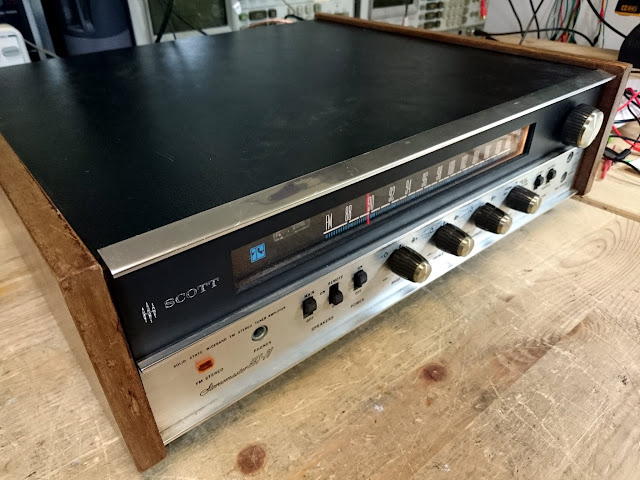
I was lucky enough to get to work on a very nice Scott 233 stereo integrated amplifier. This example was wonderfully well preserved, coming out of a storage unit looking like it had just left the showroom floor. Unfortunately, though, the electronics weren’t in such great shape after sitting for so many years and this amp’s owner reported it would start to smoke when powered on. A bit concerning of a start!

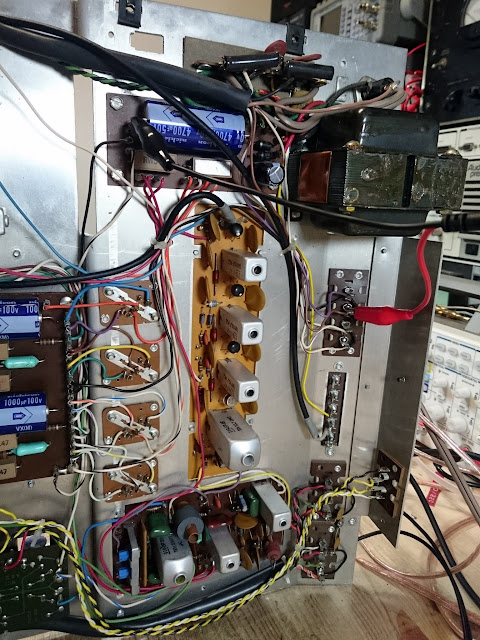
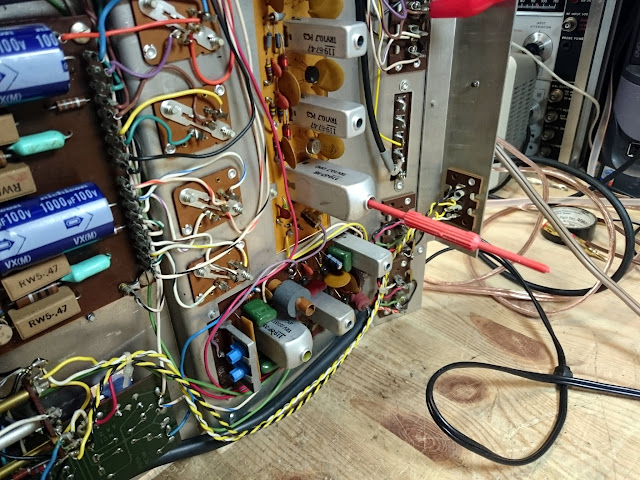
Underneath it was all original, with Ceracap sealed paper capacitors, and a handful of electrolytic and ceramic caps.

Checking all the iron, everything seemed in order, so it was on to a component replacement.

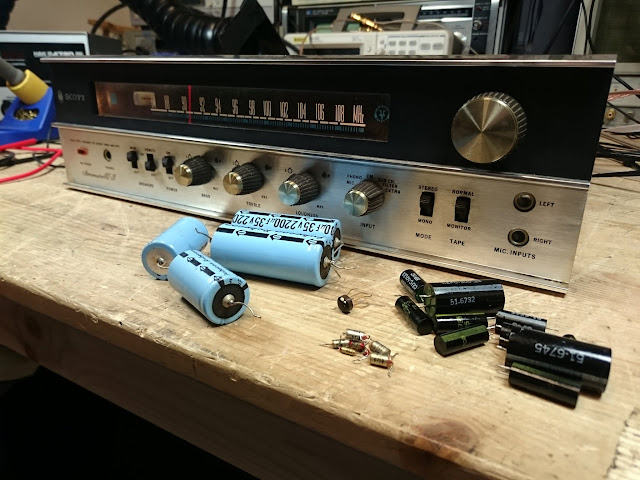
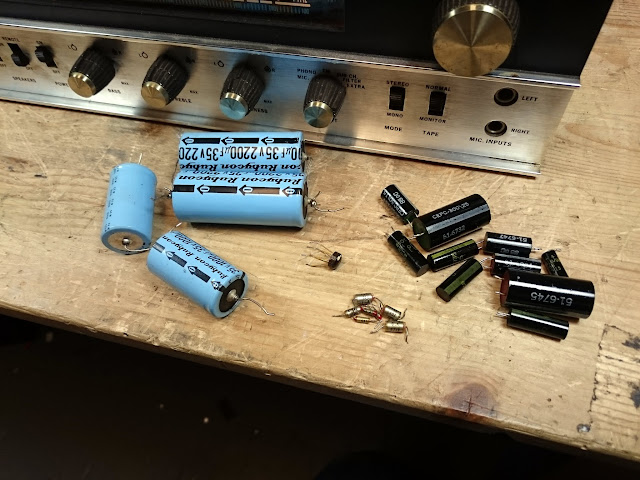
There’s not enough room under the chassis for a full set of terminal strips for the electrolytic capacitors, so I fitted this amplifier with CE Manufacturing new manufacture twist-lock capacitors.

The second can cap had a bit more wiring.

There was enough room for the 100 uF 75V caps used for filtering the bias voltage; the original early bias rectifier diodes were also replace with 1N4007s.

All the tubes tested good:

Time for the first power-up. Success! Sound and everything. There were a couple of problems, though. Immediately at low volumes, there was a bit of a channel imbalance. Shown here at the input to the driver/phase inverter tube for each channel with the good channel in yellow and the weaker channel in blue, with a 1 KHz test signal.

Working backwards, though, the signal was fine – with the only item in between being the compensation network on the volume control.

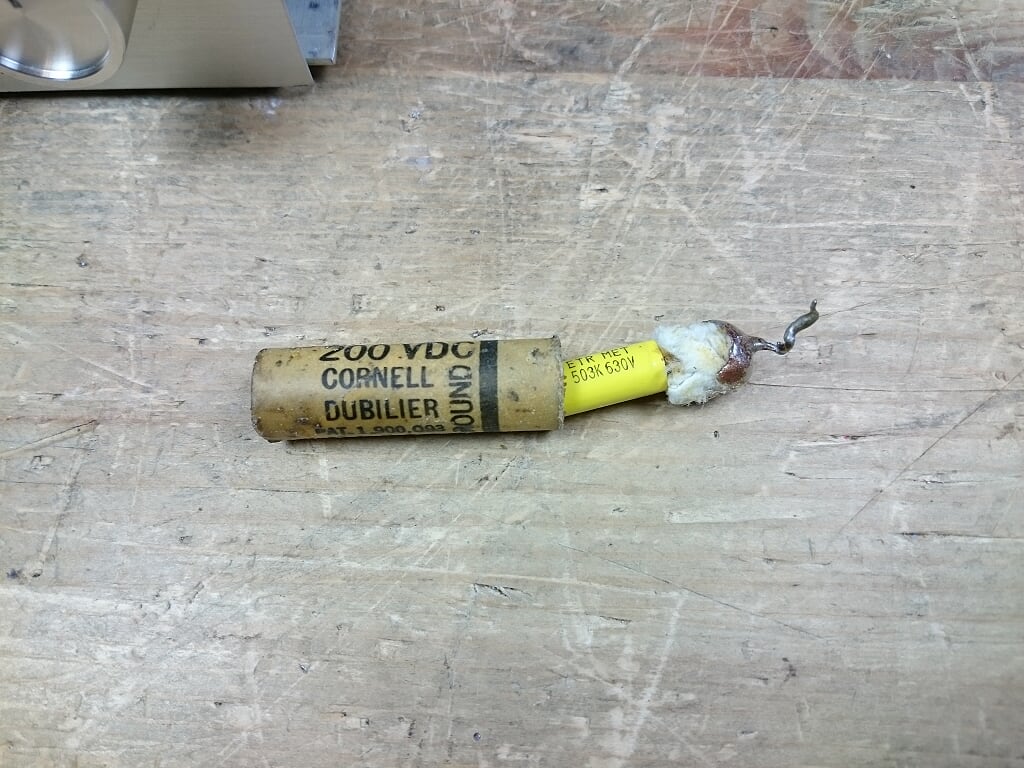
The failure traced to one of the 0.02 uF ceramic coupling capacitors was fading, going low in value. For good measure, I replaced both channel’s 0.02 uF capacitors, both ceramic 47 pF capacitors in the compensation network, and tested the resistors which were in-spec. One couldn’t be saved, though, during the operation and was also replaced. The larger were replaced with CDE film caps, and the smaller with CDE mica capacitors which are nearly perfectly stable over a range of temperatures and bias voltages.

Much better, now both channels get an equal signal at the inputs to their driver stage:

Total power output is very, very uneven though. While one channel plays well, the other caps out at about 1W of power and won’t go any higher. With the oscilloscope, it showed that the driver stage of V3/V103 wasn’t properly amplifying; the yellow trace demonstrated the good channel while the blue the channel lacking output power.

I spot-checked and replaced a couple of components which seemed questionable, but overall the DC voltages were correct for both channels, and those turned out not to be the root cause.

It’s tough to track down the specific issue with the feedback loop involved, so I disconnected the feedback. With no feedback connected, both channels rose in power output equally, so the trouble had to be in the feedback circuit.

Ultimately, I opted to replace all of the components in the feedback loop, including a 68 Ohm resistor, 8.2K resistor, 270 pF capacitor, 270K resistor, and the 4/250 capacitors for a second time. Once again, I used mica capacitors in the feedback loop for their precision and stability, and replaced the electrolytic screen filters with film capacitors for good measure.

Succcess! One of the small ceramic caps had failed, making the feedback circuit fail to operate correctly. With all those components replaced, it worked great on both channels.

Time for biasing. This unit has both DC balance, and DC bias controls. The idle current adjustment is set with the DC bias control. Scott specified 220 mV with no signal originally, but for an additional safety factor with today’s higher line voltages, I set this to 200 mV. One channel was low, at 125 mV and the other high at 320 mV to start.

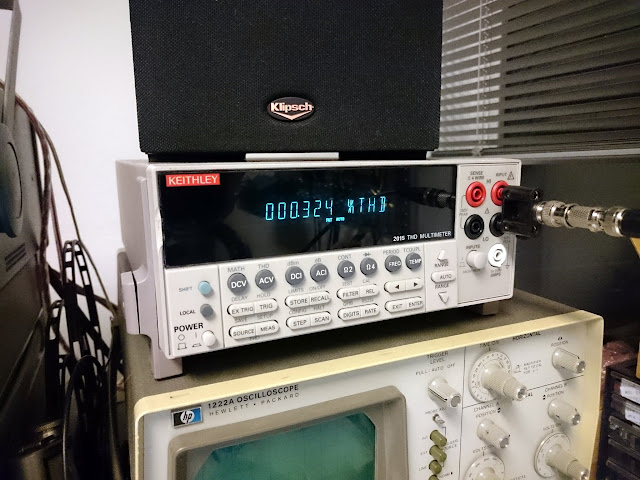
The DC Balance adjustment relates to the relative bias of the driver tubes, and should be adjusted for lowest distortion, but it also interacts with the bias control so I needed to measure both distortion and voltage output at the same time to a high degree of precision. For the first time, the Audio Precision DCX-127’s voltmeter came in handy here. It’s calibrated and accurate, just like the Keithley, which I used to measure the bias voltage while adjusting for lowest distortion, then re-adjusting bias.

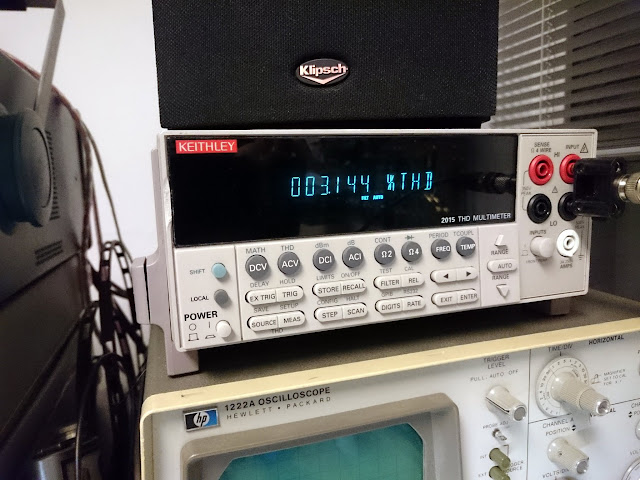
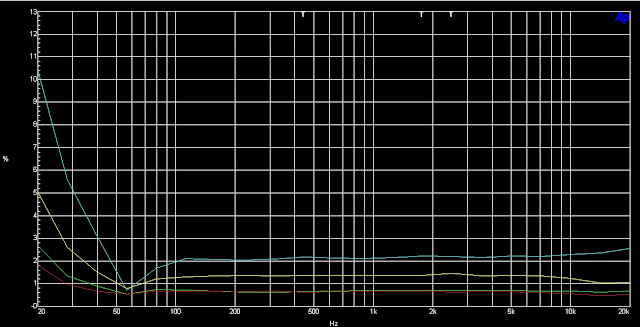
Shown here measuring 0.69% THD to start, which adjusted down to < 0.5% THD.

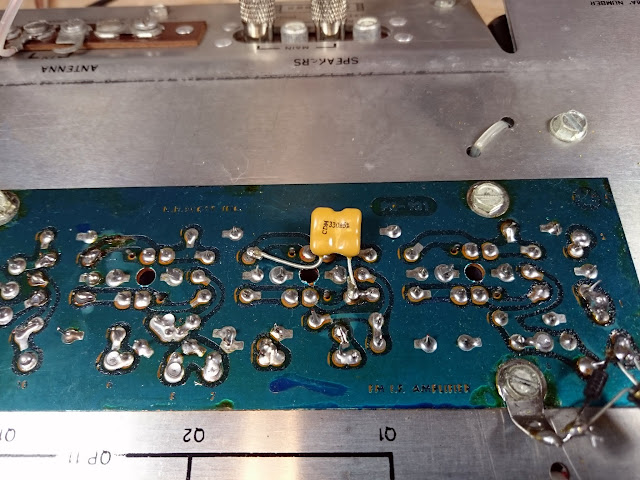
Looking good so far – but there was still some trouble with the phono input. While the Mag Input worked well when set to Tape Head, the RIAA curve below the 1 KHz turnover point for the pre-amp equalizer dropped off sharply. Both signals passed through the small, red PEC 222ER couplets near the input selector. While in the Phono position, the input signal was coupled partially through that 150 pF capacitor as the only difference between both modes; that pointed to the internal cap as the cause of failure. Fortunately, it’s connected just across pins 2 and 4 internally, so could be easily replaced with an external mica capacitor by simply clipping Pin 4 at the base, and wiring the external cap directly between the switch terminal and the couplet’s Pin 2.

Both channels had failed in the same manner, so were both replaced with the yellow 150 pF mica capacitors shown.

With that last problem sorted it was time to pack everything up and run performance tests to determine the sensitivity of the various inputs. Quite a bit came out of this amp:

Testing shows very closely matched channels (seen here before re-scaling):

The output tubes have a great glow.
And back in the case, this amp looks fantastic.
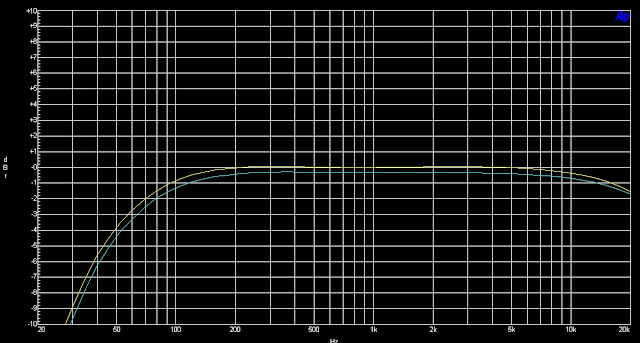
Ultimately this example of the Scott Stereomaster 233 produced a full scale output of 28W RMS, all channels driven into an 8 Ohm load, with frequency response from 26 Hz – 20 KHz +0 / -3 dB, THD < 0.5%, relative to 1 KHz. The Mag Low input had 4 mV sensitivity for full output; Mag High 8 mV sensitivity, and Ceramic 500 mV RMS sensitivity. Both the Tuner and Extra inputs also demonstrated 500 mV sensitivity for maximum output at full volume.

Posted in Audio, Electronics, Radios and Tubes, Stereo, Vintage | Tagged , , , , , , | 7 Comments

Service Shortcuts December 1932

Due to a technical problem, this post was initially published with no content on Tuesday, December 29th. Retrovoltage regrets this error.

Hints for the service shop, from December 1932’s Radio Retailing:

A.V.C. Accessory for Screen-Grid Sets
by Joseph E. Soos

A simple automatic volume control arrangement which works well with most sets using screen-grid type 24’s in r.f. stages is shown in the diagram. All models in which I have installed this system perform excellently.

A 27 tube is connected in such a manner that the voltage applied to the r.f. grids is automatically varied in relation to the signal input. Wired on a small panel, the 27 unit is connected to the receiver by simply breaking the screen-grid lead to the r.f. tubes and connecting the plate lead of the 27 to this point instead, and by tapping the grid lead of the 27 into the detector grid circuit (second detector in case of a super) without breaking the original grid lead.

dec32-1

In order to control the volume properly the screen-grid potential must be made variable over a considerable range. This is achieved by adjusting the bias of the volume control tube with a 50,000 ohm potentiometer. The plate current passing through the 35,000 ohm resistor provides the necessary drop to vary the voltage over the required automatic range for control of r.f. amplification. A signal applied to the grid of the 27 control tube reduces its bias and consequently increases plate current, providing an automatic decrease in gain.

The constants of the circuit must be proportioned as to function rapidly, while electrical inertia must still be great enough to avoid any possibility of swamping out low-frequency modulation as this is actually slow changing of signal input.

Since the volume control tube must have its plate at the same potential as the screens of the r.f. amplifier it is necessary in order to obtain the correct voltages on the 27 to take off voltage taps at minus 60 and minus 80 (with respect to ground) on the voltage divider of the receiver’s power supply unit. This puts a potential of approximately 135 volts on the plate with respect to the cathode. Ground all r.f. tube cathodes.

Curing Hum With the 56
by Boris S. Naimark

Many of the older sets using 27 detector and 26 first a.f. stages have an annoyingly high hum-level. The trouble arises in the audio stage and the remedy is to substitute a heater type tube for the 26. A 27 could be used for this purpose were it not for the fact that the 2.5 volt transformer winding could probably not supply filament current for two 27’s without serious overload.

The answer is the 56. Substitute 56s for both detector and first a.f. tubes, running their heaters from the 27 transformer winding. This places only 1/4 amp. overload on the winding, which it will probably stand without danger.

The 56 is installed as a detector in the same manner as the original 27 with the single exception that the cathode is connected to the center tap of a 50 ohm resistor placed across the heater winding as shown in the accompanying diagram. Use wafer sockets for the substitution and it will be found that the smaller height of the 56 will permit tubes and wafer socket to fit in the average set with room to spare.

dec32-2

Substituting 47’s for 45’s
by J. P. Kennedy

Adapters which permit substitution of 47’s for 45’s do not ordinarily change the value of the C bias and consequently do not permit maximum results from the pentodes. This can be corrected in two ways: The first is to substitute a 420 ohm resistor, in the case of a single power tube, for the 1,500 ohm C bias resistor used with the 45, or a 210 ohm resistor for the 750 ohm unit in a push-pull or double power-tube arrangement. This means opening the chassis, an awkward thing to do, especially when trying to sell a customer the changeover idea.

The second method consists of bridging a 20 ohm center-tapped resistor across the filament circuit of one power tube by means of an external adapter and shunting a 600 ohm (584 is the exact value) one-watt resistor from the center tap to the chassis or ground post. Inasmuch as the two bias resistors – the original and the new – are now connected in parallel this gives a net value of 428 ohms, which is close enough to the recommended 420 to work satisfactorily. When two power tubes are used, half the resistance (300 ohms) with a two-watt power raging will bias the 47’s properly.

As a further improvement, for the sake of tone quality, a 10 mfd., 25-volt electrolytic condenser across the external C bias resistor will effectively by-pass the lower audio frequencies. As the above changes can be made quickly without opening the hcassis it should be easy to sell an adapter, consisting of resistors and by-pass condenser, plus new tubes by actual demonstration.

I.F. Alignment Kink
by Lloyd H. Harder

The i.f. stages of a superheterodyne may be readjusted to the proper frequency without a special oscillator if another super using the same intermediate frequency and an ordinary broadcast-band oscillator are available.

Connect the ground posts of the two sets together. Then fasten a wire between the grid of the standard receiver’s second detector and the grid of the repair’s first detector. Connect the r.f. oscillator to the standard set in the normal manner and tune both oscillator and standard to 1,400 kc.

Connected in this manner the output of the standard receiver’s i.f. amplifier, a signal of the desired intermediate frequency, feeds into the i.f. amplifier of the set under test in precisely the same manner as would a special i.f. oscillator. Thus the repair job may be balanced in the usual fashion, its i.f. stage trimmers being adjusted for maximum output.

It may be necessary to cut out the oscillator of the repair by grounding the cathode tap of its oscillator coil, particularly if a combination first detector and oscillator are employed. It may also be necessary to disconnect the permanent grid lead to the set’s first detector.

Twin Speaker Installation
by W. T. Golson

Two dynamic speakers may be connected in a twin arrangement, one reproducing treble notes best and the other bass, by utilizing two output transformers and two .002 mdf. condensers. Select a large cone for the bass and mount it on a large baffle. (In consoles the built-in unit is usually suitable.) Obtain a small cone for the treble and mount this on a small baffle, or in the bottom of the console cabinet facing the floor. Connect the output transformers and condensers as shown in the diagram.

The condenser, in series with the primary of the transformer feeding the treble speaker will pass high frequencies better than low to thus unit while the condenser shunting the primary of the transformer feeding the bass speaker short circuits high frequencies out of this cone. In one satisfactory installation I used a 13 in. cone for bass and a 6 in. unit for treble, both being dynamics.

dec32-3

Curing Critical Volume Controls

Many supers that use 51’s and 35’s in their i.f. stages employ a 10,000 ohm volume control to simultaneously vary cathode bias and also to shunt the antenna circuit. A characteristic of such sets is a rather critical point between minimum and maximum volumes. This is often so critical that the user cannot control the volume of dx signals.

Observe the position of the volume control arm at the critical point and with an ohmmeter measure the resistance from cathode to ground. Wire a fixed resistance having approximately twice the observed value from the cathode of tube to ground. The control will then work smoothly over its entire range.

dec32-4

Miscellaneous Hints

STROMBERG 29. On-off switch and tone control unit is electrically and mechanically identical to the phonograph and pickup switch and volume control unit. When on-off switch contacts are discovered to be burned out, and the set is not equipped with a pickup, interchange the two units, making sure that the “jumper” across the pickup input is in place. This saves $1.95 until the customer wants to use a pickup.

PHILCO 70, 90. If airport beacons operating on 260 kc. cause interference, readjust the i.f. compensating condensers and the oscillator compensating condenser to either 250 or 270 kc.

RCA M30. Lack of complete manual volume control is usually an indication of trouble in the a.v.c. circuit.

RCA R34, R35, R39, RE57. 90 per cent of the trouble experienced with these receivers may be traced to the 70,000 ohm red and green resistor in the plate circuito f the first audio stage, the 1 1/2 meg. red and white resistor in the detector control grid circuit and the 1 1/2 meg. blue and green resistor located under the resistance board.

CROSLEY. Certain Mershon condenser models hum and may be repaired by drilling a 1/4 inch hole in the bakelite top of the electrolytic unit, being care3ful not to damage the “innards”, filling with distilled water to a point about 1/4 inch from the top and closing the hole up again with sealing wax. Discharge the condenser before drilling.

AK. Volume controls which become noisy need not always be replaced. Remove them from the chassis, swab the winding with a cloth saturated with alcohol, bend the slider arm so that it makes firmer contact with the winding and also tighten it against the tension spring.

FADA. Some of the older models use special knobs equipped with tension springs which fit into a notch cut into the shaft. To hold these in place while replacing knobs first put a little soft pitch or candle tallow in the notch.

COLONIAL 32. Loss of volume accompanied by poor tone is usually due to an open first audio bias resistor. These are of the flexible type and breaks generally occur near either end. Unwind a few turns of resistance wire to cut out the break and resolder.

SPARTON 410. Type 45 power tubes may be substituted for the 183’s by rewiring the output stage filaments in series, including a half-ohm resistor in the circuit.

Posted in Uncategorized | Leave a comment