What do you get from a $25 multimeter?

Fred Clift wrote over on his blog about why it’s worthwhile to pick a more expensive multimeter. He’s comparing a $200 Fluke to a $6 Harbor Freight multimeter, which really is a no-brainer. I’m not sure the Harbor Freight model would be safe to use on any of the higher range measurements with those whispy, poorly insulated test leads.

I use a few mid-grade meters for basic bench measurements and was interested to see how they compare with the Fluke 87V and the Cen-Tech from Harbor Freight.

I use the Mastech MS8268 meter which I recommended in my “Getting Started with Basic Tools” post.  It’s durable, rugged, and costs only $25. Really, it’s about what I expected to find. As you go down in quality you lose accuracy, but the Mastech meter has all the same functions as the Fluke – just not quite as tight.

The Fluke does have some cool features that Fred picks out. It will tell you min/max/average over an interval, faster continuity beeps to quickly check a strip of connections, and a higher voltage continuity test that can actually light up an LED. Otherwise, though, the Mastech has the same basic capabilities including 200 kHz frequency measurements. I’ve been able to use that in a pinch as a signal tracer – set the meter’s range to measure frequency, and probe the stages of an audio amplifier. Meter shows the tone? Move on to the next stage.

A lot of applications don’t need 0.05% accuracy on a DC voltage reading, so I stand by my recommendation of the Mastech as a “good enough” meter for most hobby work and vintage equipment repairs. There’s definitely situations where it’s worth it to spend a bit more, though.

Posted in Commentary, DIY, Electronics, Gadgets, Test Equipment | Tagged , , , , , , | Leave a comment

Wherever you go – you’re headed for FUN with Motorola Portables

motorolaportable

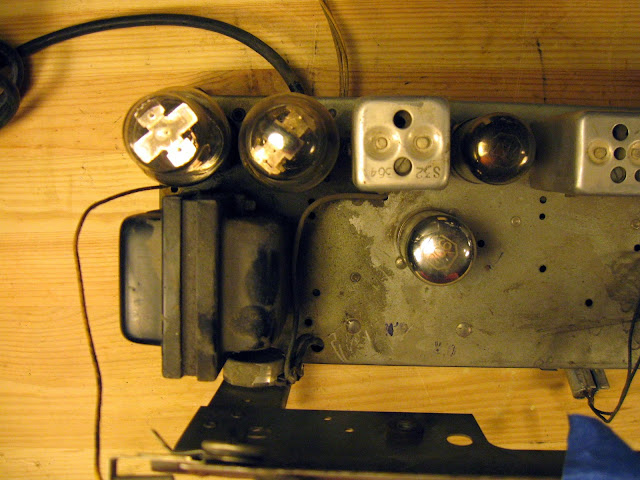
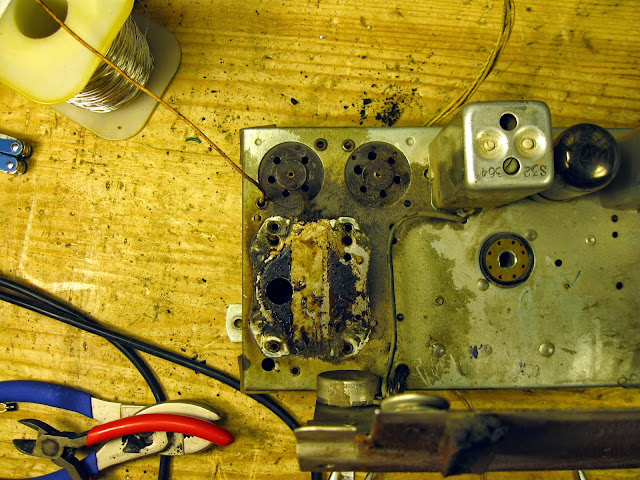
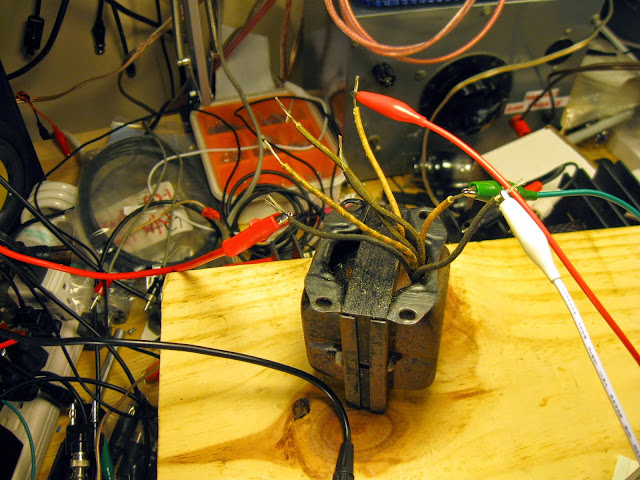
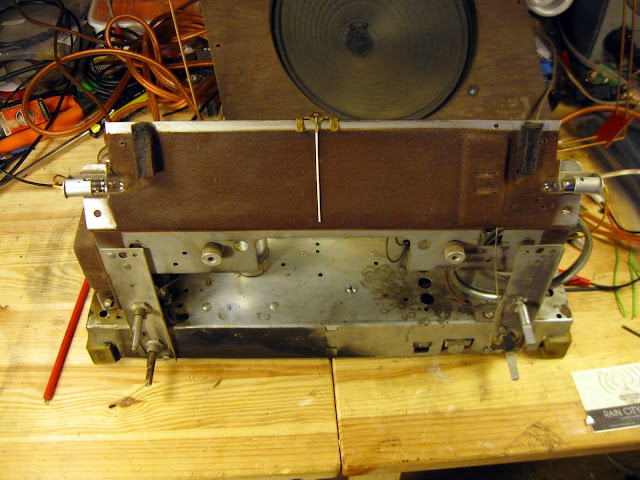
No matter where you’re going, you’re headed for more Fun with a Motorola Portable! They play anywhere – on their own batteries or on house current. You’ll like the dependable performance that comes from the ruggedly built chassis and shock-resistant tubes. And you’ll be proud of the beautiful styling of the sturdy, weather-resistant cases. Make your choice the choice of millions…Motorola!


Posted in Collections, Photos, Radios and Tubes, Vintage | Tagged , , , , , , , , | Leave a comment

New Toy: HP 130C Oscilloscope

I’ve been looking for a nice balanced input oscilloscope to use as a bench audio scope for a bit, and I do enjoy some vintage test equipment…so I recently ended up with an HP 130C oscilloscope.

This early ’60s tube scope from HP is the third revision of their first oscilloscope line, the 130 series, which began with the 130A. The 130C has a much more serviceable construction and a variety of improvements, including a no parallax CRT for more accurate readings. It’s often regarded as one of the finest oscilloscopes HP has ever produced for the care that went into its design. It’s not the most full-featured by any means, but it was top of the line in its day and still offers extremely sensitive inputs for the smallest signal measurements.

This one was being used at HP Microwave Semiconductor in California until 1982 when it was put into storage.

Being in use into the ’80s, most of the paper capacitors which would have failed have been replaced. There’s only one 0.1 uF capacitor in place which needs to be swapped out, and the electrolytic capacitors, and it will be ready for a first power-up.

This one will be a great audio scope. It has a built-in X-Y mode and very, very sensitive – 200 uV/div, which is 20x more sensitive than any of my other oscilloscopes for detecting the smallest amounts of distortion and high frequency noise on an audio signal. There’s a working condition HP 130C on eBay right now which displays a trace for an example of what they look like. It’s a very classy instrument!

Should be a fun project. I’ll post here when it’s ready to go!

Posted in Electronics, Test Equipment, Toys, Vintage | Tagged , , , , , , , , , , | 1 Comment

Steampunk USB Vacuum Tube Flash Drives

I ran across these very cool steampunk-inspired USB flash drives drives built around a vacuum tube while looking for some tube shields. They look like they’re really well built and are a clever use of an old vacuum tube. I have a jar of dead 7- and 9-pin miniature tubes that I give away for art projects, and this is a perfect example of how electronic waste can be recycled into something cool.

$_570

$_57

They come in 8-64GB sizes and 4 color choices. Looks like they’d make a good gift, too. They’re for sale from eBay vendor slavatech, and ship for free worldwide.

Posted in Computers, Electronics, Gadgets, Photos, Toys | Tagged , , , , , , , , , , , , | Leave a comment

NordeMende Globetraveler 7/601 Rebuild

This rare and valuable example of late 1960s German engineering came through my shop recently, the NordeMende Globetraveler 7/601. Marketed as the Globetrotter in Europe, RCA already marketed a radio called the Globetrotter in the United States and so the NordeMende was re-branded Globetraveler when sold over here. While it came in working on its original components, there were a few issues. First, the alignment was a bit off. As a battery radio, the dial lamps are only on when the lamp button is pressed; that switch was stuck with the lamps always on. The bass and treble controls were a bit gummed up, too, and it sounded muddy.

Since this is a rare, intricate and valuable piece it deserved a full overhaul, complete with a precision alignment of every band – and there’s a lot of them: FM, AM, Longwave, and 11 distinct spread shortwave bands. Talk about a lot of tweaking!

Those problems would’ve been extremely tough to fix, but fortunately the owner had a donor parts set in even worse shape he was able to send along as well. Between the two poorly working radios, there’s enough to make one good one!

These early PCBs are extremely fragile and even with lab-grade rework tools can still be damaged. Fortunately, this set used all axial electrolytic capacitors, so I was able to clip the leads and use the old leads as mounting parts. A few locations I was able to de-solder and re-solder directly to the PCB, but most were axially mounted.

You can see in the lower left corner of the MAWIM capacitor that it’s started to leak a bit.

Capacitors replaced, the audio quality cleaned up very nicely. Then, on to tackling the other issues. After unsuccessfully trying to clean the switch with several different methods, the only way to swap them out was to disassemble the entire front dial.

The controls in question are the lower two on the right:

I carefully removed first the lower, then the upper, keeping track of the lead arrangements.

I installed a new resistor to replace the one whose leads I’d cut.

Then it was time to reinstall the new controls in reverse:

Now all the functions work perfectly! I used some rubbing alcohol to clean a few switch contacts which were acting up but otherwise it was in good shape and ready to be aligned.

First up is a bias adjustment:

Followed by 8 AM adjustments:

Longwave adjustments:

Shortwave bias adjustment:

Followed by no fewer than 34 separate adjustments for each shortwave band. I used a new precision signal generator for the alignment:

Using the scope and generator together, it was easy to check the alignment out. I’m not going to post every band here, but due to the sharp tuning, it was very important to get these just right.

Repeat 3 dozen times, and the alignment is complete! Very, very fortunately none of the trimmers or coils were damaged so it was long but uneventful. Then, with it working perfectly, back in the case:

With all new parts and a precision alignment on all bands, this should play well for a long time. It’s pretty sensitive, too, although shortwave stations are pretty tough to pick up these days so I’m unsure how the real-world performance will be. It sounds great, and pulls in a ton of AM and FM stations though!

Posted in Electronics, Projects, Radios and Tubes, Vintage | Tagged , , , , , , , , | Leave a comment

Test Equipment Round-Up – September 20th, 2014

I always keep an eye on eBay for plug-ins for my HP 143 oscilloscope and even if they don’t turn up, it’s always interesting to see what else is in the category. Some of these are pretty interesting – there’s definitely a lot of project oscilloscopes, but you can get a bargain if you know what to look for. Some of these are definitely pretty rare and unusual, too. Here’s a few that I thought were worth sharing:

There’s an HP differential scope from just a couple years after my 143, the HP 175A oscilloscope. It has a built-in differential vertical input, optional x-y mode and delayed sweep capabilities. It’s priced a little high but some of that’s the vintage condition.

$_12

There’s an odd looking HP 1980B Oscilloscope Measurement System, loaded with two dual-channel plug-ins and a dual time base. It screams 1980s  with the membrane keys instead of knobs – although I think it would be very annoying to actually use like that. Plug-in scopes are always a great choice but given I just have to assume plug-ins for this one would be very difficult to come by.

$_57

There’s an example of HP’s very first oscilloscope out there, too: the HP 120A. This one is in pretty good cosmetic condition although it’s missing a knob. Great for a collector of test gear, although priced a bit high in unknown condition in my opinion.

$_57

The HP 183B is a pretty intimidating looking piece of gear with a 4-channel, 200 MHz vertical amplifier. Looks like it has some functional issues, but it’s got a very cool looking front panel. (Test equipment user interfaces are surprisingly interesting!)

$_57

There are plenty of the older HP 141T storage mainframes that come fitted with plug-ins. For some reason they mostly seem to come configured as spectrum analyzers, but that’s also a useful thing to have for a shop. The most common ones are from 0.1-110 MHz and there are a few others. Often in good working condition. One that’s there currently comes with a tracking generator, too.

$_57

$_57

There were a lot of interesting plug-ins for that series. I’m looking for vertical amplifier plug-ins, but they made a variety of spectrum plug-ins, sampling plug-ins, and even a TDR. I can’t think of any use for that, but it might have some use if you’re designing antennas or transmission lines.

$_57

I am still looking for 1400-series vertical amplifier plug-ins, but hopefully someone finds something useful or interesting! I’ll continue posting more round-ups of cool, hard to find and unique test gear that pops up from time to time, too.


Posted in Collections, Test Equipment | Tagged , , , , , | 1 Comment

Marantz 2245 Stereophonic Receiver Rebuild

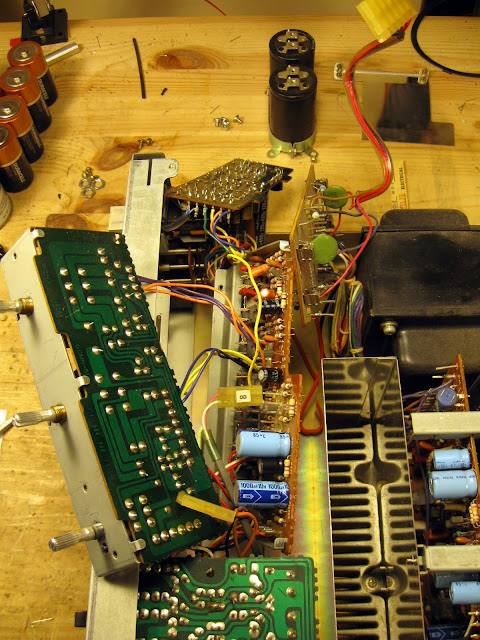
An iconic piece of kit from the golden age of hi fi just came through my shop: the Marantz 2245 Stereophonic ReceiverThis fantastic receiver is in pretty good cosmetic shape, but its owner reported that it started acting up – it’d take a little while for the signal to come through, the controls were scratchy, and it was heavily balanced to one side. Time for some service! This receiver was made between 1971 and 1976, so it’s about 40 years old on its original set of components.

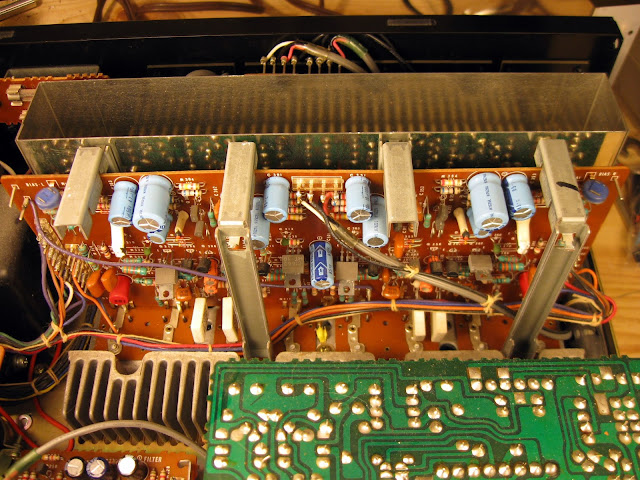
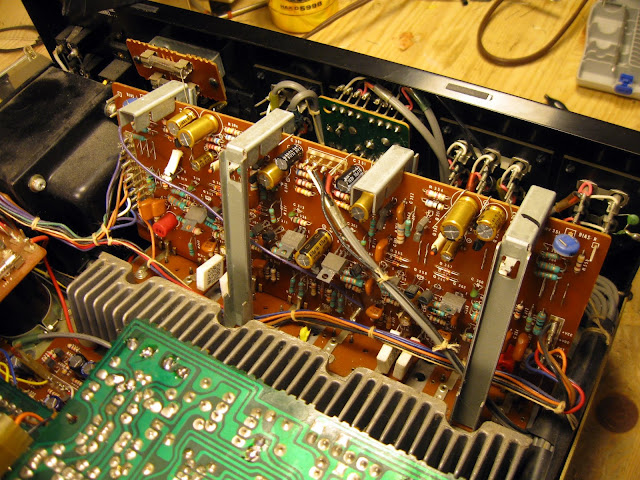
There’s a shop sticker on the back, but I couldn’t see anything obviously that was re-worked, so that might be the shop it was bought from when new. Underneath the cover, it’s pretty spacious. Most of the boards can be unscrewed and swiveled out of the way to work on them without even removing them from the chassis.

There are two massive main electrolytic capacitors, 9000 uF each at 55V.

Power supply:

AM board:

Phono preamp board:

Tone amplifier board:

FM detector board:

First thing’s first, the capacitor replacement. I went slowly, working one board at a time and powering up after each. There were no surprises along the way, and the receiver’s design made it quite easy to work on.

There’s some errata on the AM board. One capacitor’s polarity silkscreen is backwards, and one lacks a silkscreen entirely.

The replacement main filters are much smaller than the originals. They’re being run slightly de-rated; I believe these have a minimum 20,000 hour working life and should last much longer than that as de-rated.

The smaller caps will help the air flow in the receiver a bit, too. The only challenging part was getting the final amplifier boards out of the case to rebuild.

With those checks completed, it was ready for finish work! First was the master power supply adjustment. With the multimeter connected between J802 and J803, I adjusted the power supply trimmer for 35V.

Then it was time to adjust the DC offset on the speakers for 0.0 mV. One channel was pretty significantly off, measuring 43.1 mV; the other measured -6.3 mV. Both reset to 0 without any issue.

Then it was time to adjust the bias. There’s an error in the service manual here as well – if you followed the instructions, you’d never get it as it tells you to measure between two points which don’t vary and adjust to the wrong value. The correct adjustment is 10 mV.

With the receiver’s power supply and amplifier fixed up, I cleaned the controls. They were pretty easy to get to, open style controls. Very easy to clean with control cleaner and lubricant, but easy to get gunked up over the years. To ensure each control was properly cleaned, I turned the amplifier up with no signal and worked each control and switch back and forth making sure the crackles and rumbles which were previously present were gone.

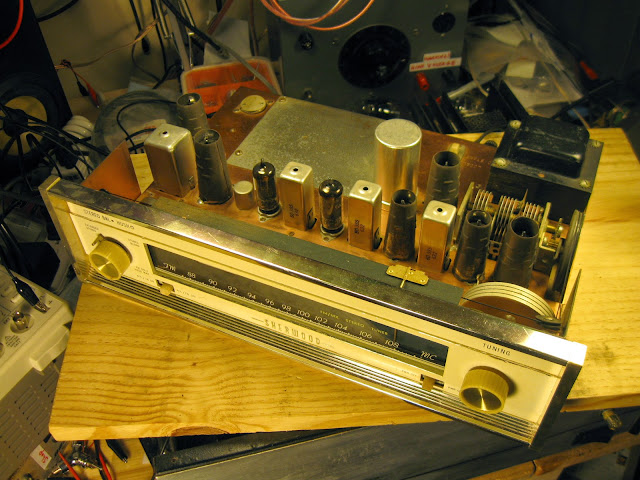
Then it was onto a full AM and FM alignment on the receiver as well. The dial was significantly off on FM, and AM reception was very poor.

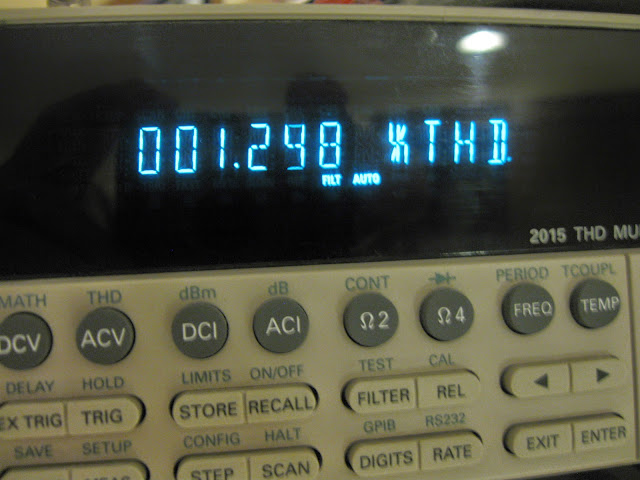
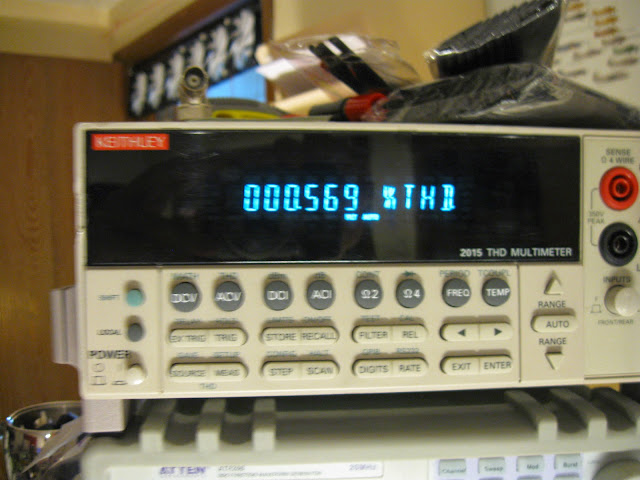
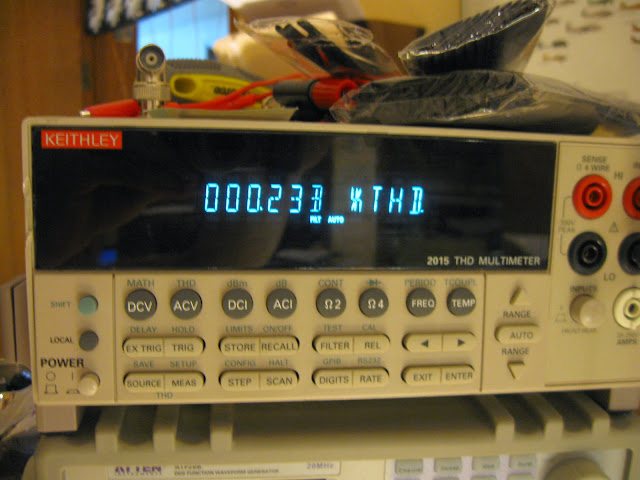
With this receiver there’s a series of adjustments to make. The AM alignment is pretty straightforward, substantially similar to an AM alignment on any other kind of radio receiver. The FM alignment, however, was an assortment of about 12 different adjustments targeting “minimum distortion”. Fortunately, that’s where my THD analyzer comes in handy:

The analyzer has a built in low-noise signal source, which I fed into the external modulation input of my AM/FM Stereo Analyzer, which fed the signal to the Marantz’s 300 Ohm FM antenna input over a length of twinlead.

With the FM adjusted for minimum distortion (best alignment), it was time to characterize the amplifier’s power output. Marantz specified 45 W/channel from 20 Hz – 20 KHz at 0.3% THD. Upon measurement, the actual receiver produced 0.101% THD 0-45W, and kept on going up to about 65W although at 20% THD. I’d never recommend overdriving the amplifier like that, but it does have some headroom. I’m going to go ahead and say it’s running better now than it did when it was brand new!

If you have a stereo receiver that’s on its original components and it’s just starting to act up, don’t wait to have it serviced until it goes out entirely – proactive tune-ups are much cheaper than repairing a catastrophic failure, and you’ll be able to enjoy your stereo for many years to come, just like the owner will enjoy this Marantz.


Posted in Audio, Electronics, Hi-Fi, Projects, Stereo, Vintage | Tagged , , , , , , , , , , , | 7 Comments

Getting Started With Vintage Radio and Electronics: Basic Tools for the Hobbyist

A few people have asked me variations of  “What tools do I need to fix my first radio?”, “What do I need to put together this soldering kit?”, and such. It’s not as simple as you might think. There’s a lot of equipment out there, and if you’re starting out it’s not always easy to tell what’s good from what’s garbage. Picking the wrong tool for the job will give you a frustrating repair experience at best, or could even damage your project.
You do only need a few things to get started: a soldering iron, a multimeter, a wire clipper, wire stripper, and some basic safety gear. If you’re a casual hobbyist who will do a few projects a year, you can get started for under $100. If you’ll be working on electronics a little more often than that, you’ll want to spend a little more for more durable tools, but they’re still pretty affordable.

Below are some tools I’ve selected which will help you get through your first project and then some:

Soldering Iron:

Probably the most important item on this list, you’ll use the soldering iron to make connections between wires and components. You need to make sure you get an iron that will be durable enough, and produce enough heat, to quickly melt the solder and heat up joints without taking too long and causing “heat soak” which can damage other near-by components you’re not actively working on. While it might seem counter-intuitive, too small of a soldering iron is actually a bigger problem than too big! I recommend a soldering iron around 50W for most hobbyist applications. Stay away from any of the “cold heat” soldering tools which aren’t very effective for this kind of work, and stay away from any gas-powered soldering iron as those are more suited for plumbing or off-the-grid work.

For electronics repair, you can get started with a no-frills soldering iron for under $10 (left). I’d recommend spending a little more, though, to gain temperature control and easier replacement parts if you need a new tip or heating element. For about $20, you can upgrade to a Velleman 50W adjustable soldering station (center) which has a handy cleaning pad and soldering iron holder built in. If you’ve got deeper pockets, Hakko makes excellent professional-grade soldering products like the FX888D digital soldering station (right) which has a digital temperature control, and you can get dozens of different size and shape tips and replacement parts very easily.  I use the Hakko FX888D in my shop, and it’s fantastic.

31UGHM+E6IL4117H3FKSVL51zBadEeFqL._SL1500_


You’re also going to want the right kind of solder. Rosin Core Solder is the right kind for electronics and includes flux inside for a good connection. There’s new RoHS-compliant (“lead free”) solder out there, but personally I find it’s more difficult to work with. Wash your hands after soldering and you’ll be fine using traditional lead solder, like this basic 60/4o Electrical Repair Solder (left). Standard tin/lead solder comes in a several varieties; 60/40 and 63/37 are pretty common and there’s not a major difference. If you’re going to be doing work on sensitive audio or RF circuits, some kinds of solder can offer a little better performance. Silver-bearing solder forms joints with a lower resistance; tube radios won’t really benefit but some high-end vintage hi-fi gear can benefit. Tenma makes a very nice 96.5% tin, 3% silver, 0.5% copper solder (right). Be sure never to use acid-core solder as you’ll damage your device, acid-core solder is only suitable for plumbing.

81q4xTieexL._SL1500_51+IQ2ZtQZL

Multimeter:

You’ll use the multimeter to make a few circuit tests, including checking for the correct voltage at a few points in the circuit, and for measuring the value of resistors. A homeowner’s multimeter isn’t a good choice for these repairs, but even an inexpensive digital multimeter will be more accurate than most of the tools in a repair shop back in the day. At about $25, the pictured (left) MASTECH AC/DC Auto/Manual Range Digital Multimeter will measure AC and DC volts up to a higher range than you’ll ever likely need. It also can measure current, resistance, test diodes and continuity with a buzzer (useful for checking coils!), roughly measure the value of capacitors, and do some basic frequency measurements. Sure, it’s no Fluke (right) but it’ll get the job done just fine. A meter very similar to the MASTECH is my everyday go-to meter that I use during all but the most precise measurements, and it’s never let me down.

61u6S7W135L._SL1500_61GYU-kHFxL._SL1500_

Wire Clippers:

You’ll need to cut old component leads and cut wires down to size when doing repairs. A set of flush-cut wire clippers makes short work of this, and they’ll last longer and won’t get the cutting edges nicked up as if you tried to use a general cutting tool like a pair of household scissors. They’re very inexpensive – under $5 – and come in handy around the house as well as in the workshop.

71QGl0rv6rL._SL1500_

Wire Stripper:

Right along with the wire clippers, you’ll need to prepare old and new wiring for soldering by removing the insulation. An adjustable pair of wire strippers is critical so you remove the insulation without damaging the wires underneath. At the low end, around $5 will get you a set of TEKTON continuously variable wire strippers (left) with an adjustment nut, and they have a cutting edge as well. This is okay if you have only one wire size, but it’s a bit annoying to adjust every time. I prefer wire strippers with their own sized guide holes. Moving up to around $20, you can pick up a nice Klein Tools wire stripper (center), or a Greenlee Communications wire stripper (right). I own the Greenlee and it’s got a comfortable grip and is very sharp and easy to use.

71Sw7Gu9jUL._SL1500_31DB7M88W6L71q3HSUxMKL._SL1500_

Recommended Extras:

Soldering does produce some toxic fumes, and you’ll want to make sure you’re in a well ventilated area. Soldering indoors isn’t a big deal occasionally, but you don’t want to breathe in the smoke too often. If you can’t open a window, you can use a variety of smoke absorbing filters for your workbench. They start at about $35 for a smaller desktop model, suitable for light work, up through many hundreds of dollars for a professional fume extraction system like the Hakko FA-430 which Rain City Audio uses.

414sjplV98L31K2eivD7VL


Sometimes molten solder can splash, or a piece of wire can go flying, and you’ll want to protect yourself. Safety glasses are highly recommended, and can be had for as low as $3 if you’re buying some of the other items. That’s a low price to pay for peace of mind! Some people like to use a surgical filtration mask while soldering as well, to help with residual fumes. They’re available for about $1 each in boxes of 20. I don’t use a mask, personally, but if you don’t want to spring for a fancy ventilation system and don’t have good airflow in your location, you might consider it.

61CH2hLGAIL._SL1500_41444dlUYYL

tip cleaner and debris catcher is also very handy for keeping your iron clean but isn’t strictly necessary. At a minimum, keep a damp kitchen sponge on hand with a scrubby side and use that to clean your tip after every few joints.

71e+Mv+rBKL._SL1500_


And then:

That’s all you’ll need to get started. If you get further into the hobby, or run into functional issues once you’ve finished replacing the needed components, you’ll also want a few pieces of test equipment. Look for my recommendations on hobby test gear for radio and electronics repair in a future article!

Posted in Collections, Commentary, DIY, Electronics, Gadgets, Resources, Tools | Tagged , , , , , , , , , , , , , , , , , | Leave a comment

New Toy: LogiMetrics 921A RF Signal Generator – Refurbished by KISS Electronics

I just had an unexpected run-in with Murphy’s Law and found myself needing a modulated signal generator in short order. Bad news when my modulated signal generators decided to die right when I went to perform an alignment! My Leader Standard Signal Generator has developed a fault in the power supply somewhere which trips the crowbar, and my EICO seems to not want to produce any output.

Lacking the time to troubleshoot either, I purchased a “new” signal generator: the LogiMetrics 921A RF Signal Generator, refurbished by KISS-Electronics in Cornelius, OR via their eBay Store.  I generally take care of my own test equipment, but for something like this where I needed it done quickly and done right, it was worth it to spend a little extra for a professionally refurbished one.  The owner is a fellow amateur radio enthusiast as well which was encouraging. KISS-Electronics specializes in vacuum tube and transistor test equipment from the ’60s and ’70s, which definitely describes the 921A:

You might also notice the upgraded digital frequency read-out. More on that in a bit. This is a very cool generator with big analog panel meters, showing the calibrated output voltage (1 uV ~ 3V in 1-3-10 steps) and the modulation percentage.

This generator will produce an unmodulated sine, or a 400 Hz or 1 kHz tone from an internal oscillator; there’s also a panel jack for an external modulation input. There’s also the frequency analog output, which produces a voltage proportional to the frequency of the output, and the Freq Shift input which can be used as a remote frequency vernier or to produce an FSK/NBFM signal. It’s “ham radio FM”, not broadcast FM, but it might come in handy if I need to align a communications receiver at some point.

The output ranges from 50 kHz to 80 MHz in 7 bands. The replacement counter is bright and easy to read, and there’s dual-speed tuning plus a fine tuning adjustment near the frequency read-out. It’s pretty stable once warmed up, but it does take about an hour to stabilize.

Inside, it’s a well built machine. There are shop notes written on the cover to the left: it looks like this one was reconditioned on 1/5/2014 and sat around for a few months before coming to live with me. The tuning mechanism is under the shield, with the tuning knob and band switch passing through the plate.

One cool upgrade is the N3ZI Compact Counter, which replaced the Nixie Tube frequency counter this was originally fitted with. The original counter was good enough for what it was, but nixie tubes require a high voltage power supply along with a variety of high voltage logic chips that haven’t been made for decades and really never appeared in any other kind of equipment; they also tend to go bad over time and go bad due to other failures in the high voltage circuitry. All of that means that it’s generally not worth the trouble to fix up a nixie tube display. Swapping the nixie tube counter out for a modern counter saves time, money, power and weight. The shop calibrated the counter against their GPSDO for accuracy and I checked it against my bench counter and it’s spot on.

Underneath the cover, there’s a board, and the power supply for the N3ZI compact counter. Underneath on the bottom of the unit, there’s a few more pieces of gear. The HV power supply components have been removed, since there’s no need for an HV supply with the digital counter.

Quality work. A bunch of discrete transistors, and a few early op-amp ICs in Ceramic DIP packages, along with plenty of adjustments. It looks like it was aligned perfectly as the internal counter and my external counter perfectly tracked each other through the whole tuning range. Hopefully these close-up board photos of the LogiMetrics 921A circuit boards will be helpful to someone – according to various forum posts, the service manual is a bit hard to locate.

You can never have too many oscilloscopes; this GoldStar OS-904RD 40MHz dual-trace analog oscilloscope is a recent gift. There’ll be a post about it separately at some point, but I used it to check out the output waveforms on the LogiMetrics. It produces beautiful, clean, accurate RF envelopes. Here’s 430.2 KHz modulated by 1 KHz at 50% modulation:

It is a bit large, so I’ve had to rearrange my bench to make room, but it’s going to be great. It certainly will beat the EICO in any task, hands down, and has a greater frequency range than my Sencore AM/FM Stereo Analyzer which only works on the U.S. AM and FM broadcast bands. I’m going to get a lot of use out of this while aligning shortwave and amateur receivers.

I hear these are likely to drift a bit, and mine does seem to go about 200 Hz low as it warms up. The counter in the photos is showing 430.2 KHz, when the generator was set to 430 KHz and re-tuned over about an hour, so it’s definitely shifted some, but like any piece of precision equipment some time to warm up and stabilize is key. The seller already has another one for sale, and it’s the slightly enhanced model which I believe has an external 10 MHz timebase input on the back – great if you have a precision external timebase lying around.

KISS-Electronics eBay Store

Posted in Collections, Test Equipment, Toys, Vintage | Tagged , , , , , | Leave a comment

New Toy: Keithley 2015 THD Multimeter

I picked up a new piece of gear for the shop recently, the Keithley 2015 THD Multimeter.

It was a fantastic deal – a refurbished and calibrated unit for about 10% of the MSRP. These have been manufactured for about 20 years now and are still being sold for around $4000 and have about all the features you could ask for in a basic lab bench meter: 6.5 digit precision, 2- and 4-wire resistance measurements, direct readout in dB/dBm, temperature display from an external thermocouple, and most interestingly to me: a low-noise audio source 20Hz-20KHz, frequency counter, and distortion analyzer.

This meter will come in very handy in power amplifier repair, but also for performing FM alignments – it’s not always easy to check the alignment with a scope, but with this meter, you can watch the distortion decrease as the circuit comes into alignment. Dave at the EEVBlog has a teardown review of this exact multimeter posted last year. His teardown was instrumental in deciding to get this particular model over several others I was considering.

It’s not going to be used every day, but it’s going to be indispensable when it does come out.

Posted in Commentary, Test Equipment, Toys | Tagged , , , , , | Leave a comment